
How a Digital Product Engineering Company Accelerates Enterprise Innovation
From legacy systems to scalable digital ecosystems - how product engineering turns enterprise ideas into market-ready innovation, faster.


Enterprise innovation sounds exciting in boardroom presentations. But behind every bold digital vision lies a difficult reality: legacy systems, fragmented data, slow release cycles, security concerns, and constant pressure to deliver ROI.
That’s where a Digital Product Engineering company becomes a strategic growth engine rather than just a technology vendor.
In this article, we’ll explore how product engineering accelerates enterprise innovation, why traditional IT approaches often fail, and how enterprises can move from idea to scalable, market-ready digital products—faster and smarter.
The Enterprise Innovation Dilemma
Large organizations don’t lack ideas. They struggle with execution.
Most enterprises face challenges such as:
- Outdated legacy infrastructure
- Siloed departments and disconnected data
- Slow development cycles
- Risk-averse technology decisions
- Difficulty scaling digital initiatives
Innovation often stalls because IT teams are busy maintaining systems instead of building new ones. Meanwhile, startups move quickly, test faster, and iterate aggressively.
The gap widens.
To compete, enterprises must adopt a product mindset—focused on speed, scalability, user experience, and continuous improvement.
What Does a Digital Product Engineering Company Actually Do?
A Digital Product Engineering company goes beyond software development. It combines strategy, design, engineering, DevOps, cloud, data, and emerging technologies to build digital products that drive measurable business outcomes.
Instead of just “building features,” product engineering focuses on:
- Product discovery and validation
- Experience-driven design
- Agile development
- Cloud-native architecture
- Continuous integration and delivery
- Scalability and performance optimization
It’s about creating products that evolve with business goals—not static systems that become obsolete in two years.
From Idea to Impact: The Innovation Lifecycle
1. Product Discovery & Validation
Innovation starts with clarity.
Product engineers work with stakeholders to:
- Define the problem
- Validate the market need
- Identify user personas
- Build prototypes or MVPs
- Test assumptions early
This stage reduces risk dramatically. Instead of investing millions upfront, enterprises validate concepts quickly and refine them before full-scale development.
For example, a financial enterprise exploring a digital lending platform can launch a limited-feature MVP, test adoption in a specific region, and refine workflows before scaling nationwide.
2. Modern Architecture for Speed and Scale
Innovation collapses when systems can’t scale.
A product engineering partner designs cloud-native, API-first, microservices-based architectures that support:
- Faster feature releases
- Independent service scaling
- Improved system resilience
- Seamless third-party integrations
Modern architecture reduces technical debt and prepares the enterprise for long-term growth.
Instead of rebuilding systems every few years, businesses can continuously evolve their digital ecosystem.
3. Agile & DevOps-Driven Execution
Traditional waterfall development slows innovation.
Product engineering teams adopt:
- Agile sprint cycles
- Continuous integration (CI)
- Continuous delivery (CD)
- Automated testing
- Infrastructure as code
This enables faster releases, fewer bugs, and real-time feedback loops.
When enterprises move from quarterly releases to bi-weekly or even weekly deployments, innovation accelerates significantly.
Accelerating Innovation Through Emerging Technologies
Innovation isn’t just about speed—it’s about competitive advantage.
A Digital Product Engineering company integrates technologies like:
- Artificial Intelligence for personalization and automation
- IoT for connected ecosystems
- Blockchain for transparency and trust
- Advanced analytics for predictive insights
- AR/VR for immersive experiences
For instance, in healthcare, AI-powered patient monitoring systems can detect anomalies in real time. In logistics, IoT-enabled fleet management improves efficiency and reduces operational costs.
The key is not adopting technology for trend value—but aligning it with measurable business impact.
Breaking Legacy Barriers
One of the biggest innovation blockers in enterprises is legacy infrastructure.
Product engineering teams help modernize systems through:
- API enablement
- Cloud migration
- Application re-architecture
- Containerization
- Data platform modernization
Instead of replacing everything at once (which is costly and risky), they implement phased modernization strategies.
This allows enterprises to innovate without disrupting core operations.
Customer-Centric Product Design
Innovation fails when products ignore user experience.
Modern enterprises compete on experience as much as functionality.
Product engineering emphasizes:
- UX research
- Journey mapping
- Usability testing
- Human-centered design
Whether it's a banking app or an enterprise SaaS dashboard, intuitive design directly impacts adoption and revenue.
Enterprises that prioritize user experience often see:
- Higher engagement
- Reduced churn
- Improved operational efficiency
- Stronger brand perception
Faster Time-to-Market = Competitive Advantage
Speed is innovation currency.
Enterprises that launch faster:
- Capture market share earlier
- Respond quickly to changing trends
- Test business models faster
- Outpace competitors
A Digital Product Engineering company shortens development cycles by combining cross-functional teams, agile processes, and automation.
Instead of taking 18 months to launch a new digital product, enterprises can go live in 4–6 months with iterative improvements.
That speed changes everything.
Data-Driven Decision Making
Innovation isn’t guesswork anymore.
Product engineering integrates data analytics frameworks that help enterprises:
- Track user behavior
- Measure product performance
- Identify drop-off points
- Optimize conversion funnels
- Predict future demand
When product decisions are backed by data, innovation becomes systematic rather than experimental.
For example, an enterprise SaaS company can analyze feature usage patterns and prioritize high-impact enhancements instead of relying on assumptions.
Scalability Without Chaos
Many enterprises successfully launch digital products—but struggle to scale them.
Product engineering ensures scalability by focusing on:
- Load testing
- Auto-scaling cloud infrastructure
- Secure architecture
- Monitoring and observability tools
- Performance optimization
This prevents system crashes during growth spikes and ensures seamless expansion into new markets.
Innovation should grow revenue—not create technical bottlenecks.
Security & Compliance Built-In
Enterprises operate in regulated environments.
Innovation must comply with:
- Data privacy regulations
- Industry-specific compliance frameworks
- Security standards
Product engineering integrates security practices from day one—DevSecOps, encryption, secure APIs, identity management—so enterprises don’t retrofit security later.
This reduces risk while maintaining agility.
Real-World Example: Enterprise Transformation in Action
Consider a traditional retail enterprise transitioning to omnichannel commerce.
With product engineering support, they can:
Build a unified commerce platform
Integrate inventory systems
Launch a mobile shopping app
Enable AI-based product recommendations
Implement real-time analytics
Instead of fragmented systems, they create a cohesive digital ecosystem that drives revenue across channels.
Innovation becomes measurable—not theoretical.
Why Enterprises Prefer Product Engineering Over Traditional IT Vendors
Traditional IT vendors focus on project completion.
Product engineering companies focus on product success.
The difference is significant:
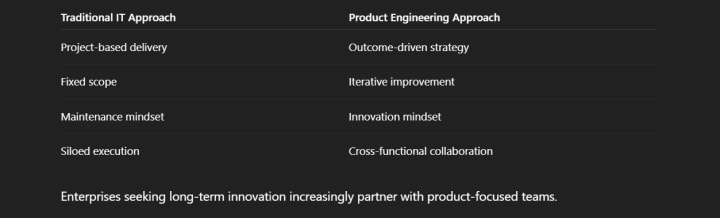
Enterprises seeking long-term innovation increasingly partner with product-focused teams.
The Bottom Line: Innovation Is a Continuous Journey
Enterprise innovation isn’t about launching one digital product. It’s about building a sustainable innovation engine.
A Digital Product Engineering company enables organizations to:
- Validate ideas faster
- Reduce development risk
- Modernize legacy systems
- Integrate emerging technologies
- Accelerate time-to-market
- Scale securely and efficiently
In today’s competitive landscape, innovation cannot be slow, fragmented, or reactive.
If your enterprise is serious about digital growth, the question is no longer whether to invest in product engineering—but how quickly you can start.
Because in the digital economy, speed, scalability, and user-centric design determine who leads—and who follows.
About the Creator
alan michael
Technology expert with 5+ years of experience in IoT, AI, app development, and cloud solutions. I provide concise, expert insights on emerging tech trends and their practical applications. Updates on the future of technology.
Keep reading
More stories from alan michael and writers in 01 and other communities.
How Long Does It Take To Build an App in 2026?
You have a great app idea. Maybe it’s the next fintech disruptor, a healthcare platform, or an AI-powered productivity tool. But before budgets, features, or tech stacks—there’s one question that almost every founder and enterprise leader asks:
By alan michaela day ago in 01
The Future of Digital Identity: How Meta Earth is Pioneering Web3 Universal Basic Income 🌍
In an era where digital scams and data breaches have become the "new normal," the search for legitimate, privacy-preserving blockchain projects is more critical than ever 🛡️. The crypto landscape is often cluttered with noise, making it difficult to distinguish between fleeting trends and projects with a robust technological foundation. One such project gaining significant traction in 2026 is Meta Earth, specifically through its innovative ME Pass ecosystem.
By Piotr Nowak3 days ago in 01




Comments
There are no comments for this story
Be the first to respond and start the conversation.