
How AI Agent Architecture Works in 2025: Core Principles, Best Tools, and Top Use Cases Explained
AI Agent Architecture 2025: Principles, Tools, & Use Cases


1. What Is AI Agent Architecture and Why Does It Matter in 2025?
AI Agent Architecture refers to the structured design framework that defines how intelligent agents perceive their environment, process information, make decisions, and execute actions autonomously. In 2025, AI agent systems have become more than reactive tools; they now operate as adaptive, self-evolving entities capable of handling uncertainty, continuous feedback, and real-world decision complexity.
This matters deeply for businesses, especially those seeking scalable automation solutions. Traditional automation systems follow static rules, while agentic systems apply reasoning and planning in real-time. In sectors like finance, healthcare, logistics, and SaaS platforms, agent architecture is now the foundation for building intelligent assistants, self-optimizing workflows, and decentralized decision-making.
2. How Does AI Agent Architecture Work?
AI agent architecture works through a combination of modular, interacting components that simulate human cognitive processes. Each agent typically operates within a perception-decision-action loop:
Perception Layer: The agent gathers input through APIs, sensors, or data streams. This layer abstracts raw input into structured information (e.g., NLP text processing, time-series signals).
Reasoning & Decision Layer: Using pre-defined goals, policies, or ML models, the agent reasons through available options. This includes symbolic reasoning, utility calculation, and planning logic.
Memory Management: Agents leverage short-term memory (session context) and long-term memory (learned experiences, user profiles) to make consistent, personalized decisions.
Execution Engine: The agent performs an action—whether it’s calling an API, sending a message, triggering a workflow, or updating a database.
Feedback Loop: The system logs outcomes, evaluates success/failure against goals, and adjusts strategies—sometimes retraining components or altering decision paths.
This cyclical structure allows AI agents to continuously operate, adapt, and optimize their behavior in dynamic environments.
3. Why Are Autonomous Agents Critical for Modern Software Systems?
Autonomous agents play a vital role in modern software because today’s systems face unpredictable data, diverse workflows, and escalating demands for responsiveness and personalization. Manual rule-writing and linear automation don’t scale across these variables.
Autonomous agents:
- Reduce dependency on human operators by automating high-frequency, high-complexity tasks.
- Enable real-time decisioning based on current context and historical patterns.
- Handle ambiguity using reinforcement learning, feedback loops, and probabilistic models.
Examples:
- In FinTech, agents detect fraud patterns, optimize investments, and make portfolio adjustments.
- In healthcare, agents personalize patient engagement, schedule appointments, and recommend care paths.
- In logistics, agents dynamically reroute shipments based on supply chain delays or weather changes.
4. What Are the Core Principles Behind AI Agent Design?
Designing AI agents requires adherence to foundational principles that ensure adaptability, accountability, and performance:
Autonomy: Agents function independently, handling goals and responding to change without external commands.
Goal-Orientation: Every decision aligns with a predefined objective or optimization target (e.g., increase conversions, minimize errors).
Context Awareness: Agents interpret data using context—current task, user history, environment state—enhancing decision accuracy.
Feedback & Learning: Agents evolve behavior using mechanisms like reinforcement learning, gradient updates, or human feedback.
Modularity: Each component (e.g., perception, planning, memory) is independently upgradable, enabling flexibility and resilience.
This architecture mirrors cognitive psychology and biological systems, creating scalable, reusable agentic patterns across verticals.
5. What Are the Different Types of AI Agent Architectures?
AI agents can be classified by their internal design and decision strategy:
Reactive Agents: Stateless systems that respond to inputs immediately (e.g., temperature control bots).
Utility-Based Agents: Prioritize actions based on utility scores (e.g., best ROI, lowest risk).
Model-Based Reflex Agents: Use an internal model of the world to infer the best response.
Learning Agents: Incorporate training mechanisms to update strategies over time, ideal for evolving environments.
Hybrid Agents: Combine rule-based reasoning, probabilistic learning, and goal-based planning for sophisticated control.
Multi-Agent Systems (MAS): Distribute intelligence across multiple agents that communicate and cooperate (or compete).
These architecture types are chosen based on task complexity, environment dynamics, and deployment goals.
6. When Should You Use Each Type of AI Agent?
Selecting the right agent type depends on business requirements:
Use reactive agents for simple, deterministic tasks with tight latency (e.g., alerts, UI bots).
Choose utility-based agents when decisions must optimize competing priorities (e.g., logistics routing).
Deploy model-based reflex agents in partially observable environments (e.g., trading bots using predictive modeling).
Implement learning agents where the environment evolves or has hidden variables (e.g., dynamic pricing).
Hybrid/MAS architectures are best for complex domains needing distributed decision-making, such as robotics swarms or smart cities.
7. What Are the Key Components of an AI Agent System?
Every effective AI agent system contains the following layers:
Perception Module: Handles data ingestion and normalization. In language agents, this might be text parsing and semantic understanding.
Decision Engine: Encodes goals, decision policies, planning algorithms, and fallback strategies.
Memory System: Maintains short-term context (e.g., session history) and long-term learning (e.g., user preferences, success metrics).
Planning Unit: Decomposes goals into executable subtasks using decision trees, search graphs, or dynamic planners.
Action Executor: Interfaces with external systems to perform tasks (e.g., APIs, databases, interfaces).
Learning Layer: Uses supervised, unsupervised, or reinforcement learning to update internal models based on experience.
Each component must be designed for observability, scalability, and adaptability.
8. Which Tools Are Best for Developing AI Agent Architectures in 2025?
The ecosystem for agentic tools has matured considerably in 2025. Top platforms include:
LangChain: A framework for chaining LLM calls, planning steps, and executing complex workflows in language agents.
Orq.ai: A robust orchestration layer that enables visualization, observability, and control of agent pipelines.
Autogen (by Microsoft): Enables dynamic, multi-agent communication with memory, feedback, and tool orchestration.
CrewAI: Specialized in team-based agent design—agents can take roles, delegate tasks, and share memory.
MetaGPT: For simulating entire organizations of agents (e.g., marketing team, dev team) with scalable planning.
These tools support plug-and-play workflows, observability dashboards, and role-based architecture—ideal for production-grade AI systems.
9. How to Build Scalable, Production-Ready Agentic Systems?
To scale agent systems from prototype to production:
Modular Architecture: Separate perception, reasoning, planning, and memory layers. Allows independent scaling and versioning.
Feedback Loops: Monitor results, log context, and feed into retraining or policy refinement.
Scalable Infrastructure: Deploy agents in containers (e.g., Kubernetes), enable autoscaling, and use distributed task queues.
Security & Guardrails: Implement access control, prompt injection protection, decision audits, and fail-safes.
Observability: Use dashboards like Orq.ai to monitor agent steps, decisions, and API usage.
This structured approach ensures agility, compliance, and continuous improvement.
10. What Are the Top Enterprise Use Cases for AI Agent Architectures?
Customer Support Automation: AI agents handle support tickets, FAQs, and even escalate when needed—reducing human workload by up to 80%.
Marketing & Sales Co-pilots: Agents that write emails, qualify leads, and schedule demos based on CRM data.
Finance Optimization Engines: AI agents that monitor market data, rebalance portfolios, or underwrite loans.
Supply Chain Coordination: Multi-agent systems that adjust routes, supplier orders, and warehouse management in real time.
Healthcare Assistants: Patient triage bots, health monitoring agents, and appointment managers that align with medical protocols.
Each use case improves efficiency, personalization, and business intelligence.
11. What Are the Challenges in Implementing AI Agent Architectures?
Misalignment: Agents may pursue goals that conflict with user expectations or system values.
Unexplainable Decisions: Some decisions may be hard to audit without proper tracing.
Tool Complexity: Tooling ecosystems like LangChain or Autogen require setup, tuning, and ongoing maintenance.
Security Risks: Agents can inadvertently access or expose sensitive data without strict access policies.
Multi-Agent Chaos: In MAS, uncoordinated agents may act inefficiently or at cross-purposes.
Mitigating these challenges requires robust design patterns, ethical alignment, and cross-functional oversight.
12. How Will AI Agent Architectures Evolve in the Next 3 Years?
Looking forward, the next evolution in agentic AI will include:
Greater LLM Synergy: Agents will seamlessly integrate multi-modal LLMs (text, image, voice) for deeper reasoning.
Swarm-Based Intelligence: Large teams of agents collaborating in real time for complex distributed problem-solving.
Auto-Self-Improvement: Agents that monitor their own performance and auto-adjust prompts, workflows, and heuristics.
Domain-Agnostic Architectures: Generic agentic templates deployable across healthcare, logistics, finance, etc.
Edge-Deployable Agents: Agents that run on-device or near-data to reduce latency and preserve privacy.
These trends point to a future where agent systems aren’t just assistants—they become co-creators and decision-makers within enterprises.
About the Creator
Vitarag Shah
Vitarag Shah is an SEO expert with 7 years of experience, specializing in digital growth and online visibility.
Keep reading
More stories from Vitarag Shah and writers in 01 and other communities.
How AI Software Development Services Are Powering Next-Gen Digital Products
There’s something kinda wild about how much AI is shaping the tools we use daily—and most of us don’t even realize it’s happening. You scroll, click, get personalized recommendations, and talk to a chatbot that gets you... And everything just works. That seamless experience? It’s not luck. It’s what AI software development services are quietly powering behind the scenes.
By Vitarag Shah8 months ago in 01
Savannah Guthrie’s Mom
Savannah Guthrie is widely known as a trusted face of American journalism. As a longtime co-anchor of Today, she has built a reputation for calm authority, empathy, and professionalism. Yet behind the public figure is a deeply personal story shaped by family, resilience, and the influence of her mother. In recent months, online searches such as “Savannah Guthrie mom missing” have raised questions and confusion, prompting a closer look at who Savannah Guthrie’s mom really is—and why misinformation can spread so easily.
By Saboor Brohi 6 days ago in 01
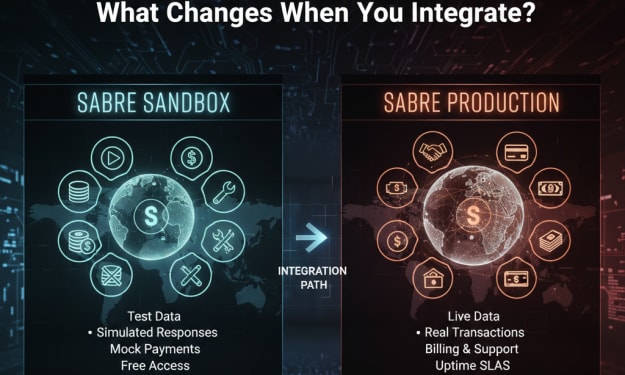
Sabre API Sandbox vs Production: What Changes When You Integrate?
Building a travel booking platform is exciting, but the real challenge begins when you move from testing to handling real users and real bookings. Many teams feel confident while working in a test environment, only to face unexpected issues when they go live. This is especially common when working with travel technology platforms, where data accuracy, pricing, and booking behavior can change dramatically outside a testing setup.
By Nico Gonzalez6 days ago in 01
Cabin Fever Because of Snow, Sleet, and Freezing Rain That Turned to Icy Roads
What Is Cabin Fever? The short answer is that cabin fever is restlessness from being in a confined area. Cabin fever is the distressing irritability or restlessness experienced when a person or group is stuck at an isolated location or in confined quarters for an extended time. Research shows that prolonged cold, gray skies, and being stuck indoors can trigger mood shifts similar to “winter blues.”
By Margaret Minnicks7 days ago in Humans



Comments
There are no comments for this story
Be the first to respond and start the conversation.