
How Enterprises Are Using AI to Fix Content Management in 2026
A deep dive into enterprise AI adoption examples in content management, showing how global companies automate tagging, search, compliance, localization, and personalization.

I reckon if you are still manually tagging your digital assets in 2026, you are basically trying to empty the ocean with a spoon. It is proper chaotic. Most firms have finally realized that humans are hella slow at sorting through terabytes of data.
Current data shows that enterprise ai adoption examples content management have moved from "maybe one day" to "we need this or we are toast." By early 2026, over 80% of large businesses have integrated some form of generative AI into their content workflows, according to IDC spending reports. It is not just hype anymore. It is survival.
Why Your Old Folder System is a Dumpster Fire
Real talk, y'all. The traditional folder structure is dead. Nobody can find anything. I once spent three hours looking for a logo version that apparently lived in a folder named "Miscellaneous_Final_v2_USE_THIS." That is a dodgy way to run a business.
Modern AI systems now use vector databases to understand what is actually inside your documents. They do not care about file names. They look at meaning. It is like having a librarian who has read every single page you ever wrote and remembers it all perfectly.
Content Categorization on Autopilot
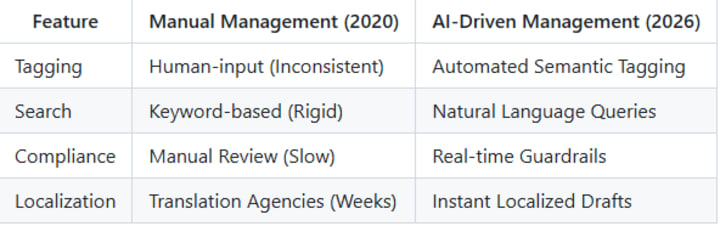
One of the best enterprise ai adoption examples content management involves automated metadata generation. Companies like Salesforce have rolled out tools that scan every upload and tag it with perfect accuracy. You do not have to lift a finger.
This has slashed the time spent on "content discovery" by nearly 60% in most marketing departments. If you are still paying an intern to type keywords into a CMS, you are wasting money. The machines are just better at it, mate.
Real-World Adoption: Who is Actually Winning?
I am stoked to see how big retail is handling this. They have thousands of products and millions of images. Doing that manually is a nightmare. They are using AI to write product descriptions that actually sound like a human wrote them.
Speaking of which, app development company california shows how this works in practice by building these smart features directly into custom enterprise tools. It is about making the software work for you, not the other way around.
Global Retailers Smashing the Localization Barrier
Netflix and Spotify have been using AI for years, but now the average enterprise is catching up. They are using LLMs to localise content for fifty different regions in minutes. It used to take months of back-and-forth with translation agencies.
Now, a brand in Austin can push a campaign and have it ready for Sydney and London by lunch. The AI handles the regional slang and cultural nuances. It is not always perfect, but it is fair dinkum close enough for a first draft.
Banking Giants Automating Compliance Nightmares
Finance is usually slow to move, but they are terrified of regulators. They are using AI to scan every piece of outward-facing content for compliance risks. If a tweet or a blog post breaks a rule, the AI flags it instantly.
This is a massive win for the legal teams who used to spend their whole lives reading fine print. Now, they only look at the stuff the AI is unsure about. It is a proper time-saver for everyone involved.
Intelligent Search That Actually Works
We have all used those crappy internal search bars that return zero results for a basic query. Thing is, AI search now understands intent. If you search for "that thing about the 2025 budget," it finds the right spreadsheet.
Microsoft Viva and similar platforms have integrated this so deeply that employees do not even feel like they are "searching." The info just surfaces when they need it. It is almost creepy, but it is brilliant for productivity.
"Generative AI is the most powerful tool for creativity and productivity we have ever seen, and it is fundamentally changing how content is created and managed." — Shantanu Narayen, CEO of Adobe, Adobe Newsroom
The Tech Behind the Curtain
It is not just about ChatGPT. Enterprises are building "Content Graphs" that link data points across different departments. Your sales deck now knows what your product manual says. They are finally talking to each other, which is a miracle.
Many firms are using RAG (Retrieval-Augmented Generation) to make sure their AI stays within the bounds of their own data. This prevents the AI from "hallucinating" or making up random facts about your company's history or products.
Multi-modal LLMs for Visual Assets
We are seeing a huge shift in how video and images are managed. AI can now "watch" a video and create a transcript, a summary, and ten social media clips automatically. It is hella efficient for content creators who are burnt out.
This multi-modal approach means you can search for "video where the CEO wears a blue tie" and find the exact frame. No more scrubbing through hours of footage. My cynical side says we are getting lazy, but my practical side is chuffed.
💡 Jensen Huang (@nvidia): "The enterprise is the next frontier for AI. We are moving from general purpose tools to specialized agents that understand your specific business content and logic." — NVIDIA GTC Context
Zero-Trust Content Security
With all this AI, security is a massive worry. Enterprises are adopting AI-driven "Content Firewalls." These systems detect if sensitive data like social security numbers are accidentally included in a public-facing document. It is sorted before it leaks.
This is vital because, let's face it, humans are dodgy with passwords and privacy. Having an AI watchdog that never sleeps is the only way to stay safe in 2026. It is a bit like a digital bouncer for your data.
💡 Sam Altman (@sama): "AI will eventually be the primary interface for how we interact with all information. The file system as we know it will become invisible." — OpenAI Vision Updates
"We are moving toward a world where the computer doesn't just store your data, but understands the context of your work and provides the right content at the right time." — Bill Gates, Co-founder of Microsoft, GatesNotes
Hyper-Personalization at Scale
One of the most impressive enterprise ai adoption examples content management is the rise of dynamic content. Instead of one landing page for everyone, the CMS generates a unique version for every visitor based on their history.
This is not just "Hello [Name]" anymore. It is a total rewrite of the value proposition to match what that specific person needs. It is effective, though it does make me wonder if we will ever see the same internet twice.
Future Trends: 2027 and the Road Ahead
Looking toward 2027, the trend is moving toward "Agentic Content Systems." These are not just tools you use; they are agents that work on your behalf. They will notice your whitepaper is outdated and suggest a rewrite based on new market data. Market analysts at Gartner suggest that by 2027, 40% of enterprise content will be self-maintaining. We are talking about a total shift where the CMS becomes a living entity that grows and prunes itself. The "human in the loop" will move from being a writer to being an editor and strategist, which is a massive change for the workforce.
Is AI Taking Your Job or Just Your To-Do List?
There is a lot of fear about AI replacing creators. But honestly, most of the work being replaced is the boring stuff nobody wanted to do anyway. Sorting, tagging, and formatting are not exactly "creative" tasks. They are chores.
I reckon we will see a surge in "High-Human" content. This is stuff that is clearly not made by AI—opinionated, messy, and authentic. The AI will handle the enterprise ai adoption examples content management side, leaving us to do the thinking.
The Sustainability Question
Running all these AI models takes a heap of power. Some companies are starting to push back, looking for "Small Language Models" that are cheaper and greener. It is a bit of a contradiction, wanting all the power but none of the carbon.
We might see "Green Content Certifications" soon. It is a bit of a mess right now, but that is the price of progress. Hopefully, the hardware catches up to our software ambitions before we melt the ice caps.
At the end of the day, enterprise ai adoption examples content management show that we are in a transition. It is messy, it is sometimes scary, but it is better than being buried under a mountain of unorganized PDFs. Get sorted or get left behind, y'all.
About the Creator
Keep reading
More stories from Sherry Walker and writers in 01 and other communities.
How Does the Cleo App Work? Meet the AI That Roasts Your Spending Habits
I reckon y’all are tired of those dusty banking apps that look like they were designed in 1998. Real talk, most financial tools are about as exciting as watching paint dry in a humidity wave. Enter Cleo. It is 2026, and if you are still asking how does the cleo app work, you are missing out on the only AI that has the stones to call you out for your 2 a.m. taco runs.
By Sherry Walkerabout 7 hours ago in 01
How Indi IT Solutions is Building the Next Digital Ecosystems in the USA
The American digital world has evolved fast. Standalone apps are being replaced by deeply connected ecosystems. In 2026, a digital ecosystem is not a trend. It is a survival requirement for modern enterprises.
By Devin Rosario7 days ago in 01



Comments
There are no comments for this story
Be the first to respond and start the conversation.