
Medical Cyclotron Market Growth: Nuclear Medicine Expansion, Oncology Applications & Forecast to 2034
Rising applications of radioisotopes in diagnostic imaging and treatment planning are enhancing adoption across hospitals in the Medical Cyclotron Market.

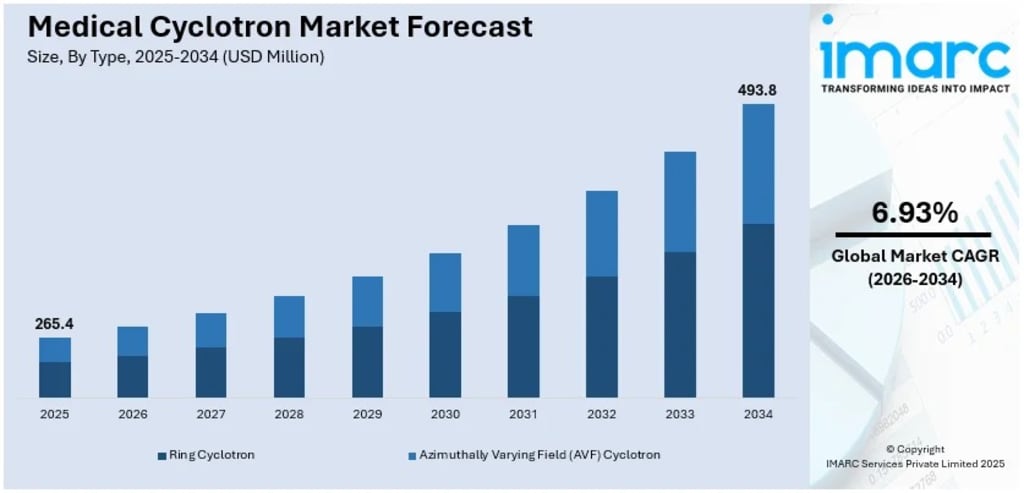
To prepare your press release and blog, I have extracted the specific data from your website and researched the requested qualitative insights.
IMARC Group Data Extraction
Keyword: Medical Cyclotron Market
Market Size (2025): USD 265.4 Million
Projected Market Size (2034): USD 493.8 Million
CAGR (2026-2034): 6.93%
Historical Period: 2020-2025
Forecast Period: 2026-2034
Key Segments:
By Type: Ring Cyclotron (Largest segment), Azimuthally Varying Field (AVF) Cyclotron.
Get a Sample Report for Actionable Market Insights
By Product Type: 10-12 MeV, 16-18 MeV (Market Leader), 19-24 MeV, 24 MeV and Above.
By End User: Hospitals (Largest segment), Diagnostic Centers, Pharmaceutical Companies, Specialized Clinics.
By Region: Asia Pacific (Leading region), North America, Europe, Middle East and Africa, Latin America.
Press Release/Blog Content
Headline: Scaling Precision Medicine: How Medical Cyclotrons are Revolutionizing Global Cancer Diagnostics and Radiopharmaceutical Supply
In the modern healthcare landscape, the ability to catch a disease at its cellular inception is no longer a luxury—it is a necessity. At the heart of this diagnostic revolution lies the medical cyclotron, a sophisticated particle accelerator that serves as the "engine room" for nuclear medicine. By producing the radioisotopes required for Positron Emission Tomography (PET) scans, these machines allow clinicians to see how a tumor behaves in real-time. Recent data from IMARC Group highlights that the global medical cyclotron market reached a value of USD 265.4 Million in 2025. As healthcare systems pivot toward personalized medicine, this infrastructure is expanding rapidly, with the market projected to reach USD 493.8 Million by 2034.
Market Growth Drivers: The surge in medical cyclotron adoption is primarily fueled by the global burden of chronic diseases, particularly cancer, which accounted for nearly 9.7 million deaths in recent years. This creates an urgent demand for early-stage diagnostic tools like PET-CT scans that rely on Fluorine-18, a short-lived isotope produced primarily by 16-18 MeV cyclotrons. Furthermore, the shift toward "theranostics"—a practice where the same isotope or chemically similar ones are used for both diagnosis and targeted therapy—is necessitating larger, more localized production facilities. In the United States alone, the use of cyclotron-produced F-18 FDG in early-stage imaging has been shown to reduce unnecessary hospital admissions by over 23%, saving billions in annual healthcare expenditures while significantly improving patient survival rates through timely intervention.
Market Trends: A defining trend in the current market is the decentralization of isotope production through the deployment of compact, self-shielded cyclotrons. Traditionally, hospitals relied on large, centralized nuclear reactors, but supply chain vulnerabilities and the short half-life of isotopes like Technetium-99m have pushed facilities toward on-site manufacturing. We are seeing a major rise in "plug-and-play" systems that require less specialized shielding, making them accessible to regional diagnostic centers rather than just Tier-1 university hospitals. Additionally, the integration of Artificial Intelligence (AI) in cyclotron control systems is optimizing beam stability and predictive maintenance. This automation reduces the need for constant on-site radiochemists and lowers the operational overhead, which typically costs facilities upwards of USD 1.9 million annually, thereby making the technology more commercially viable for private healthcare providers.
Recent News and Developments in the Medical Cyclotron Market: The industry is witnessing high-stakes partnerships aimed at closing the gap in isotope access. In 2023, GE HealthCare partnered with ALISA in South Africa to deliver two new cyclotrons, specifically designed to expand molecular imaging in regions previously underserved by nuclear medicine. On the technology front, Advanced Cyclotron Systems recently launched the TR-ALPHA, a Canadian-made system optimized for producing Astatine-211, an isotope gaining massive traction for its potential in treating deep-seated tumors with minimal damage to healthy tissue. Meanwhile, government initiatives are playing a pivotal role; for instance, India’s Department of Atomic Energy (DAE) has launched a Public-Private Partnership (PPP) model to build a dedicated research reactor and cyclotron hub, aiming for self-reliance in medical isotopes. These strategic moves, alongside acquisitions like Telix Pharmaceuticals’ USD 82.5 million buyout of ARTMS, signal a clear trend toward securing a robust, localized radiopharmaceutical supply chain.
Quantitative Insights and Segment Performance: The efficiency of the 16-18 MeV segment cannot be overstated, as it led the market in 2025 due to its perfect balance of energy output and cost-effectiveness for producing PET isotopes. Hospitals remain the primary end-users, commanding over 50% of the market share, as they integrate cyclotron vaults directly into their oncology wings to ensure a fresh supply of tracers for daily patient schedules. Geographically, while North America holds a significant revenue share, the Asia Pacific region is emerging as the fastest-growing frontier. Massive infrastructure investments in China and India, coupled with favorable regulatory updates like the phasing out of medical device tariffs between India and the US, are facilitating the installation of high-energy ring cyclotrons across the region.
Conclusion: For healthcare executives and investors, the medical cyclotron is no longer just a piece of lab equipment; it is a strategic asset. As we move away from "one-size-fits-all" treatments and toward molecular-level precision, the demand for high-purity, locally-sourced radioisotopes will only intensify. With the market set to nearly double in value by 2034, the focus is now on making these systems smaller, smarter, and more integrated into the clinical workflow. By investing in this technology today, the medical community is not just buying a machine—they are securing the future of early diagnosis and effective cancer therapy for millions of patients worldwide.
About the Creator
Rahul Pal
Market research professional with expertise in analyzing trends, consumer behavior, and market dynamics. Skilled in delivering actionable insights to support strategic decision-making and drive business growth across diverse industries.
Maximizing App ROI via Predictive Analytics in 2026
The landscape of mobile engagement has shifted. In 2026, acquiring a user is not the only success metric. The true value lies in the Lifetime Value (LTV). LTV measures the total revenue a user generates over time. For many firms, acquisition costs have risen by 20%. This has happened over the last two years. Platform saturation and new privacy laws are the main causes. To stay profitable, businesses must pivot their strategy. Move from reactive support to proactive retention.
By Devin Rosario5 days ago in 01
Top Benefits of Agentic AI Pentesting for Modern DevOps and Cloud Security
Introduction Cloud security has shifted from perimeter defense to identity governance. Modern environments now span distributed workloads, dynamic permissions, and layered trust relationships that evolve continuously. Yet industry research shows that nearly 70% of cloud security incidents are tied to misconfigurations and excessive access permissions.
By Sam Bishop3 days ago in 01
Winterthorne
Winterthorne stood alone at the edge of the park. The beautiful snow that had surrounded him was all trampled now, from the feet of all of the children who had built him. He missed the sparkly clean snow blanket, but he was happy that so many children had come out to make him.
By Laura DePace6 days ago in Fiction




Comments
There are no comments for this story
Be the first to respond and start the conversation.