
Paper Straw Market: Sustainability and the Shift in Food Service
Eco-Friendly Alternatives Reshaping Beverage Packaging Across the Global Food Service Industry

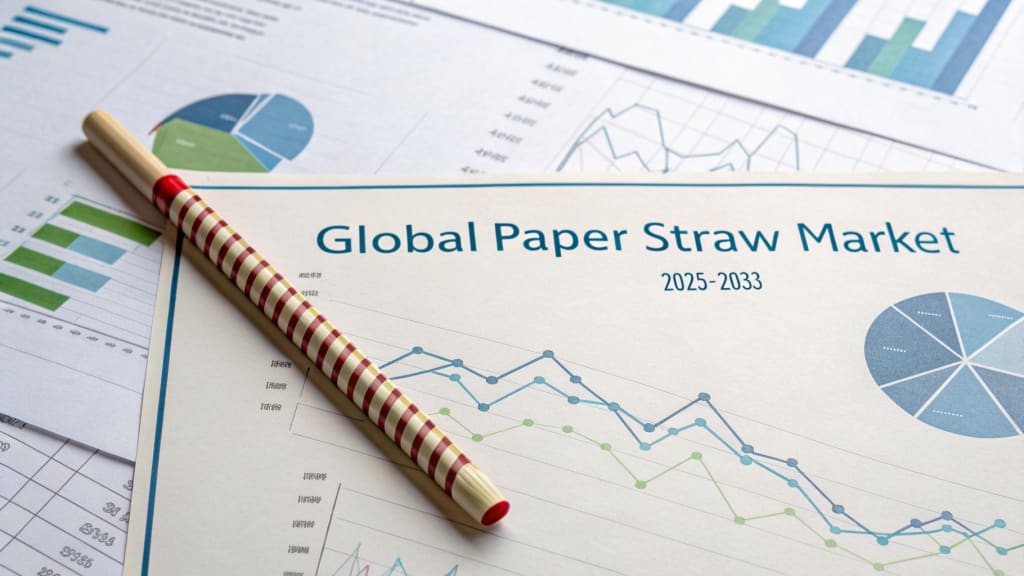
The paper straw market has transitioned from a niche environmental alternative to a mainstream commodity. Driven primarily by legislative bans on single-use plastics and a massive shift in corporate social responsibility (CSR) goals, the industry is now focusing on balancing environmental performance with user experience.
1. Market Drivers: The Regulatory Wave
Plastic Bans: Significant legislation (such as the EU Single-Use Plastics Directive and various bans in California and China) has forced a near-instantaneous pivot toward paper alternatives in the food and beverage industry.
Brand Perception: Major global chains (Starbucks, McDonald’s, Disney) have utilized the transition to paper straws as a highly visible "green" marketing signal to eco-conscious consumers.
2. Product Engineering & Quality Challenges
The primary hurdle for the market remains the "user experience gap" compared to plastic:
Soggy Factor: High-quality paper straws utilize specialized food-grade coatings and 3-to-4-ply spiral winding to maintain structural integrity for at least 60–120 minutes in liquid.
Adhesives: The use of water-resistant, food-safe glues is critical. There is increasing scrutiny on the use of PFAS (per- and polyfluoroalkyl substances) in some coatings, leading to a demand for "PFAS-free" certified products.
Bending Technology: While traditionally rigid, newer manufacturing techniques have introduced "U-shape" and flexible paper straws to accommodate juice boxes and ergonomic needs.
3. Manufacturing & Material Science
FSC Certification: Consumers and brands increasingly demand Forest Stewardship Council (FSC) certified paper to ensure that the "sustainable" alternative isn't contributing to deforestation.
Biodegradability vs. Compostability: Unlike plastic, paper straws are designed to break down within 2–6 months in marine or soil environments, though industrial composting is the preferred end-of-life route.
High-Speed Production: The industry has moved toward high-speed automation capable of producing 300–600 straws per minute to meet global volume demands and lower the unit cost.
4. Competitive Landscape & Alternatives
Paper straws are not the only solution, and they face competition from:
PLA (Polylactic Acid): Corn-based bioplastics that feel like plastic but require industrial composting to break down.
Bamboo & Wheat: Natural stalks that require minimal processing but are harder to scale and standardize.
Reusable (Metal/Silicone/Glass): Driven by "zero-waste" lifestyle movements, though less practical for high-volume quick-service restaurants.
Strawless Lids: A major trend where the cup itself is redesigned to eliminate the need for a straw entirely.
5. Regional Insights
Europe: The most mature market due to early and strict regulation.
North America: High growth driven by municipal bans and corporate mandates despite the lack of a federal ban.
Asia-Pacific: A massive manufacturing hub (particularly China and Vietnam) and a rapidly growing consumer market as urban centers implement plastic restrictions.
6. Future Outlook
Cost Convergence: As manufacturing scales, the price gap between plastic (approx. $0.005) and paper ($0.02 - $0.05) is narrowing, though paper remains significantly more expensive.
Material Innovation: Research into seaweed-based coatings and fungal mycelium is underway to create a straw that is even more durable than paper but dissolves completely in water.
Conclusion
The paper straw market is a prime example of "policy-led" market growth. While it faces criticism regarding durability and the carbon footprint of paper production, it remains the dominant immediate solution for a world moving away from petroleum-based disposables.
About the Creator
Rahul Pal
Market research professional with expertise in analyzing trends, consumer behavior, and market dynamics. Skilled in delivering actionable insights to support strategic decision-making and drive business growth across diverse industries.
Apple’s 12-Inch MacBook Is Back: 10 Huge Leaks, Price, Specs, and Release Date
Get ready, because the iconic 12-inch MacBook is officially on the road to revival. According to one of the most trusted voices in the Apple leak world, this long-lost laptop isn’t years away—it’s just months from launch. And yes, it’s staying true to its roots with a 12-inch display, but this time, Apple is fixing everything that went wrong the first time.
By Info Post Gate4 days ago in 01
How Are Crypto Marketing Agencies Driving Pre-Sale Token Success in 2026?
In the world of blockchain and cryptocurrency, launching a successful token pre-sale is no longer just about innovative technology or promising ideas. In 2026, crypto marketing agencies are emerging as the linchpins of pre-sale success, helping projects not only reach their funding goals but also establish long-term credibility and trust within the community. With competition intensifying and investors becoming more discerning, agencies are deploying multi-faceted strategies that combine traditional marketing, digital growth tactics, influencer partnerships, and cutting-edge analytics.
By Jack santo5 days ago in 01
Goodbye, Mr. Duvall
It is turning out to be an interesting year. I was in the middle of teaching a class when a pop-up appeared on the screen announcing the death of Mr. Robert Seldon Duvall (yes, that was his full name). I was in the middle of a discussion on the obsession we have with winning when it comes to sports (the Winter Olympics was a theme), and I felt as though things were coming full circle. We had already lost Gene Hackman last year, and along with that titan, it feels though one particular golden age has closed off to be replaced by...?
By Kendall Defoe 6 days ago in Geeks



Comments
There are no comments for this story
Be the first to respond and start the conversation.