
Step-by-Step Guide to Launching an RWA Token in 2026
Legal, technical, and compliance roadmap to launch your RWA token

In 2026, the financial and digital asset landscape continues to evolve as enterprises and startups look beyond purely speculative crypto assets. One of the most discussed areas is Real World Asset Tokenization. From real estate and private equity to commodities and receivables, physical and financial assets are being represented on blockchain networks through RWA Tokenization models.
An RWA token represents ownership, revenue rights, or a claim linked to a tangible or off-chain asset. Unlike utility tokens, these tokens are usually backed by something measurable and legally documented. As regulations mature and institutional participation increases, launching an RWA token in 2026 requires careful planning, compliance awareness, technical depth, and a clear business objective.
This guide explains every stage involved in launching an RWA token, including structuring, compliance, technology, marketing, and long-term governance.
Understanding the Concept of RWA Tokenization
Before starting, it is important to understand what RWA Tokenization means in practice. Real World Asset Tokenization refers to converting ownership rights of physical or traditional financial assets into blockchain-based tokens. These tokens can represent fractional ownership, income distribution rights, debt exposure, or equity participation.
Assets commonly tokenized include real estate properties, bonds, private funds, carbon credits, commodities, and even intellectual property. A professional RWA Tokenization Company generally assists issuers in structuring the asset, selecting a blockchain network, handling legal frameworks, and managing issuance and post-launch processes.
The concept is simple in theory, but requires coordinated efforts across legal, financial, and technical domains. In 2026, investors expect clarity in documentation, audited smart contracts, and defined governance models.
Step 1: Define the Asset and Business Objective
The first stage in launching an RWA token is selecting the asset. This decision influences regulatory obligations, token economics, risk profile, and investor appeal.
Ask the following:
* Is the asset income-generating?
* Is it divisible or suitable for fractionalization?
* Does it require custody by a third party?
* What jurisdiction governs ownership rights?
For example, a real estate income property may generate a rental yield. A private credit fund may distribute interest payments. Each structure requires a different approach.
Define the business objective clearly. Is the token meant to raise capital, provide liquidity to existing stakeholders, or attract a global investor base? The objective determines token structure and investor targeting.
Many issuers work with a real-world asset tokenization platform company to conduct feasibility studies and risk analysis at this stage.
Step 2: Legal Structuring and Regulatory Planning
Compliance is one of the most critical aspects of Real World Asset Tokenization. In most jurisdictions, RWA tokens are treated as securities because they represent ownership or profit rights.
You must determine:
* Whether the token qualifies as a security
* Which investor categories can participate
* KYC and AML requirements
* Reporting obligations
* Custody arrangements
A legal entity must be formed to hold or manage the underlying asset. Often, a Special Purpose Vehicle is created. The SPV issues tokens that represent economic rights.
An experienced RWA tokenization development company usually collaborates with legal advisors to align token issuance with securities regulations. Ignoring this step may result in penalties or restrictions later.
Documentation required at this stage may include:
* Offering memorandum
* Token purchase agreement
* Risk disclosure statement
* Asset valuation reports
Proper structuring builds investor confidence and reduces future disputes.
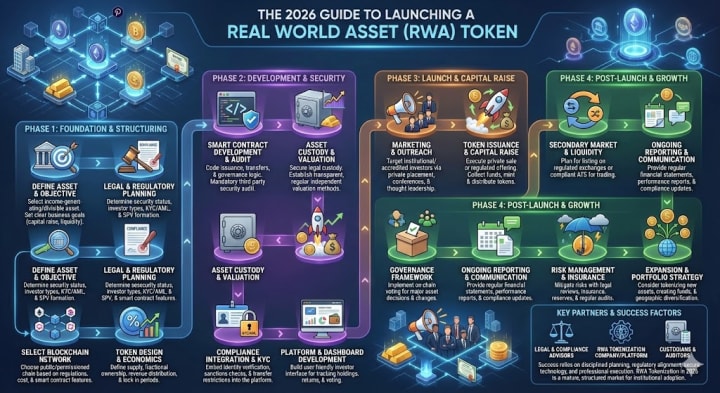
Step 3: Select the Blockchain Network
The next step is choosing the blockchain infrastructure. In 2026, several public and permissioned blockchains support security token standards.
Key factors to consider:
* Regulatory acceptance
* Smart contract functionality
* Transaction costs
* Network stability
* Ecosystem support
Some issuers choose public networks for liquidity and accessibility. Others prefer permissioned environments for compliance control.
A rwa tokenization platform development company helps evaluate network compatibility with compliance modules such as identity verification, transfer restrictions, and whitelisting.
The chosen blockchain should support token standards that allow transfer restrictions and programmable compliance rules.
Step 4: Token Design and Economics
Tokenomics refers to the economic model behind the token. In the case of RWA token development, token design must reflect real asset economics.
Define:
* Total supply
* Fractional ownership percentage
* Revenue distribution mechanism
* Lock-in periods
* Voting rights
* Redemption structure
For example, if a property worth 10 million dollars is tokenized into 1 million tokens, each token represents 0.001 percent ownership. Revenue distribution may occur quarterly based on rental income.
Token economics must align with asset cash flows. Overcomplicated models can confuse investors.
Professional RWA Tokenization Services typically conduct financial modeling to determine pricing and expected returns.
Step 5: Smart Contract Development and Audit
Smart contracts represent the digital logic governing token issuance and transactions. For real-world asset tokenization platform development, smart contracts manage:
* Token minting
* Transfer restrictions
* Dividend distribution
* Investor whitelisting
* Governance voting
Security is critical. Any vulnerability may expose funds or disrupt token operations.
After development, contracts must undergo a third-party audit. A RWA tokenization platform development team generally collaborates with blockchain security firms for code review and testing.
Testing includes:
* Unit testing
* Integration testing
* Simulation of edge cases
* Security penetration tests
Audited smart contracts enhance credibility during investor outreach.
Step 6: Asset Custody and Valuation Mechanism
Since the token represents a real-world asset, custody arrangements must be clear. If the asset is real estate, who holds title? If it is gold, where is it stored?
Custody partners should be reputable institutions. Documentation linking token holders to asset rights must be legally binding.
Valuation is another critical factor. Asset value may fluctuate. Establish:
* Frequency of valuation updates
* Independent appraisal methods
* Reporting process
Real World Asset Tokenization Services often include valuation management and third-party appraisal coordination.
Transparent valuation practices help avoid pricing disputes in secondary markets.
Step 7: Compliance Integration and KYC Process
Before public issuance, compliance mechanisms must be embedded in the platform.
Compliance tools include:
* KYC verification
* AML screening
* Sanctions list checks
* Investor accreditation verification
* Geographic restrictions
A RWA tokenization platform development company integrates identity providers and compliance APIs within the issuance platform.
Transfer restrictions can be coded so that tokens can only move between approved wallets. This maintains regulatory alignment even in secondary trading.
Compliance is not a one-time process. Ongoing monitoring is required to track suspicious activities.
Step 8: Platform Development and Investor Dashboard
Investors expect more than token issuance. They require dashboards to track holdings, returns, and documents.
Real-world asset tokenization platform development includes:
* Investor onboarding portal
* Digital wallet integration
* Transaction history
* Distribution reports
* Governance voting interface
* Tax document access
A Real World Asset Tokenization platform company may develop a white-label portal or a proprietary interface.
User experience influences investor participation. The interface should present financial data in a straightforward manner.
Step 9: Marketing and Investor Outreach Strategy
Launching an RWA token requires a defined investor acquisition strategy. Unlike early crypto projects, RWA tokens target professional investors, institutions, and accredited individuals.
Marketing strategy may include:
* Private placement outreach
* Institutional partnerships
* Industry conferences
* Webinars and thought leadership content
* Direct outreach to family offices
Position the offering with clarity regarding risk, return, and asset backing.
A RWA Tokenization Company may assist in structuring investor presentations and compliance-friendly marketing materials.
All communications must align with securities regulations. Avoid exaggerated claims or speculative projections.
Step 10: Token Issuance and Capital Raise
Once legal, technical, and marketing preparations are complete, token issuance begins.
Issuance may occur through:
* Private sale
* Regulated crowdfunding portal
* Security token offering platform
* Institutional subscription process
During issuance:
* Investor funds are collected.
* Tokens are minted and distributed.
* Compliance verification is finalized.
* Asset purchase or allocation is confirmed.
Clear communication during this stage builds trust.
The RWA tokenization development company typically coordinates between legal advisors, developers, and custodians to finalize issuance.
Step 11: Secondary Market and Liquidity Planning
Liquidity is often one of the motivations for Real World Asset Tokenization. However, liquidity is not automatic.
Consider:
* Listing on regulated digital asset exchanges
* Alternative trading systems
* Peer-to-peer compliant marketplaces
* Institutional OTC desks
Regulated secondary markets in 2026 require strict compliance integration.
Transfer restrictions coded in smart contracts must align with exchange frameworks.
Liquidity planning should begin early, not after token issuance.
Step 12: Governance Framework
Governance defines how token holders participate in decisions. Governance rights may include:
* Voting on asset sale
* Approval of major expenses
* Replacement of the asset manager
* Changes in distribution policy
Governance can be implemented through on-chain voting modules.
Real World Asset Tokenization Offerings that include structured governance tend to attract sophisticated investors.
Clear governance reduces conflicts and enhances accountability.
Step 13: Ongoing Reporting and Investor Communication
After launch, reporting obligations continue.
Provide:
* Quarterly financial statements
* Asset performance reports
* Audit summaries
* Distribution records
* Compliance updates
Consistent communication supports investor retention and future offerings.
RWA Tokenization Services often include post-launch maintenance, technical upgrades, and compliance updates.
Step 14: Risk Management and Insurance
Risk factors in rwa tokenization include:
* Regulatory changes
* Asset performance decline
* Smart contract vulnerabilities
* Custody disputes
* Market volatility
Mitigation measures may involve:
* Legal reviews
* Insurance coverage
* Reserve funds
* Regular contract audits
* Diversification strategies
Risk disclosure should remain transparent in investor documents.
Step 15: Expansion and Portfolio Strategy
Once the first RWA token performs well, issuers may consider expansion.
Options include:
* Tokenizing additional assets
* Creating sector-focused funds
* Partnering with institutional asset managers
* Geographic diversification
A RWA token development roadmap should include long-term portfolio planning.
Many issuers eventually evolve into a full Real World Asset Tokenization Services provider, offering structured Real World Asset Tokenization Offerings to third parties.
Choosing the Right Technology and Advisory Partner
Selecting the right RWA Tokenization Company influences project success. Evaluate partners based on:
* Previous RWA token development projects
* Legal network support
* Security audit history
* Platform stability
* Post-launch support capability
A real-world asset tokenization platform development team should offer technical documentation, deployment assistance, and long-term maintenance.
Do not select purely based on cost. Technical flaws or compliance errors may create future liabilities.
Cost Considerations in 2026
Launching an RWA token involves several cost components:
* Legal structuring
* Smart contract development
* Platform development
* Compliance integration
* Custody arrangements
* Marketing and investor relations
* Ongoing maintenance
Costs vary depending on asset type, jurisdiction, and complexity.
A structured consultation with an RWA tokenization development company provides a realistic budget estimate.
Common Mistakes to Avoid
Several mistakes can undermine a Real World Asset Tokenization initiative:
* Ignoring securities regulations
* Overcomplicated token economics
* Poor asset valuation documentation
* Inadequate security audits
* Weak investor communication
* Assuming liquidity without planning
Thorough preparation reduces operational and legal risk.
The Outlook for RWA Tokenization in 2026
Institutional interest in rwa tokenization continues to increase as regulators clarify frameworks and financial institutions experiment with blockchain-based asset issuance.
Traditional asset managers, private equity firms, and banks are evaluating Real World Asset Tokenization for fractional ownership and broader capital access.
As infrastructure matures, real-world asset tokenization platform development is becoming more standardized. Compliance modules, custody integration, and investor dashboards are more structured compared to early blockchain experiments.
However, success still depends on disciplined planning and responsible execution.
Conclusion
Launching an RWA token in 2026 requires more than technical deployment. It demands legal structuring, asset validation, regulatory alignment, financial modeling, platform development, and post-launch governance.
From selecting the asset to conducting RWA token development and secondary market planning, every stage requires coordination between legal advisors, developers, custodians, and compliance professionals.
Working with an experienced RWA Tokenization Company or a real-world asset tokenization platform company can reduce execution risk and align the project with regulatory expectations.
Real World Asset Tokenization is no longer experimental. It is becoming a structured method for representing tangible assets in digital form. With proper preparation, disciplined compliance, and professional execution, issuers can create sustainable Real World Asset Tokenization Offerings that attract institutional and accredited investors in 2026 and beyond.
About the Creator
Ethan hunt
Ethan is a blockchain and Web3 specialist focused on building decentralized ecosystems that enhance transparency, security, and global accessibility.
Keep reading
More stories from Ethan hunt and writers in 01 and other communities.
The Complete Guide to Investing Safely on a Tokenized Real Estate Platform
Real estate has traditionally been one of the most secure avenues for long-term investment. From commercial buildings to residential properties, investors have relied on tangible assets to preserve and grow wealth. However, the advent of digital finance has transformed the investment landscape, making real estate more accessible through tokenization. Tokenized real estate platforms allow investors to purchase fractions of properties as digital tokens, democratizing access to high-value real estate assets that were once reserved for institutional investors. While the promise of fractional ownership and higher liquidity is enticing, investing in tokenized real estate comes with unique risks and considerations. This guide explores how to invest safely on a tokenized real estate platform while maximizing returns.
By Ethan huntabout 11 hours ago in 01
How to Choose the Right Builder for Your Dream Home or Renovation Project
Building a new home or renovating an existing property is one of the most significant investments you will ever make. It’s not just about bricks and concrete—it’s about creating a space that reflects your lifestyle, meets your needs, and stands strong for years to come. Choosing the right builder is the foundation of a successful project, and making the wrong decision can lead to delays, unexpected costs, and disappointment. This guide will help you understand how to choose the right builder for your construction or renovation project, ensuring quality results and a smooth experience from start to finish.
By Kashif Khan3 days ago in 01
The Pride Flag and the Diversion
For nearly a decade, the LGBTQIA Pride Flag rippled in the wind at Christopher Park, a kaleidoscope of color staked into the soil of America’s first national monument to LGBTQIA+ liberation. That flag came down this week. Federal officials, citing new guidance from the Trump Administration, silently lowered the rainbow flag from its pole across the street from the Stonewall Inn. The birthplace of the modern gay rights movement now flies only the United States flag.
By Tim Carmichael7 days ago in Pride


Comments
There are no comments for this story
Be the first to respond and start the conversation.