

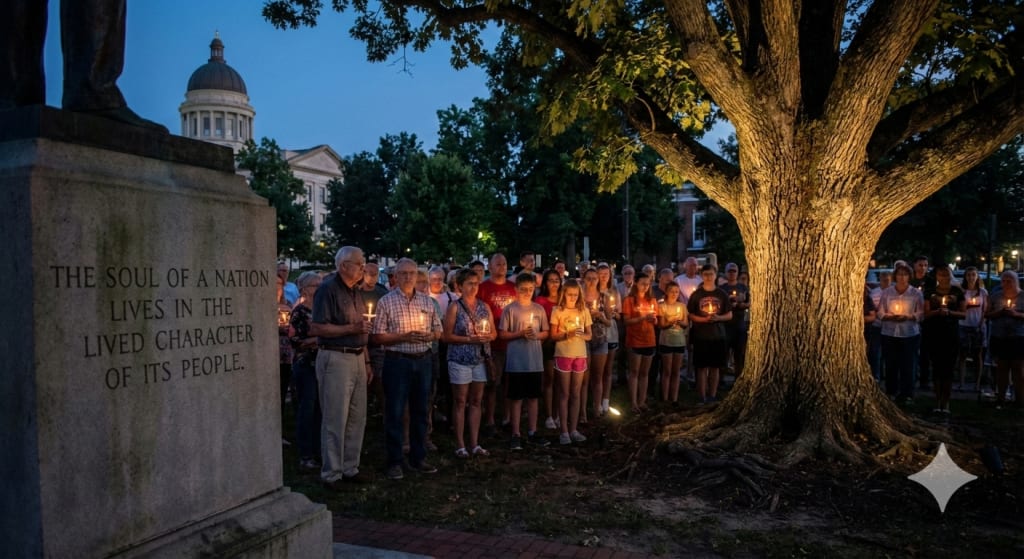
The soul of a nation is not protected in Washington alone — it is protected in you.
It is protected in how you speak when no one is applauding.
In how you judge when anger would be easier.
In how you restrain yourself when indulgence would be applauded.
We often look outward when we speak of decline. We look to institutions. We look to headlines. We look to offices, parties, movements, and personalities. We point at buildings made of stone and marble and ask whether they still stand firm. But the true architecture of a republic is not constructed of pillars and domes. It is constructed of habits. Of character. Of conscience.
If democracy weakens, it weakens first in the character of its citizens.
Before laws fracture, integrity fractures.
Before institutions corrode, discipline corrodes.
Before trust collapses nationally, it collapses personally.
A nation is nothing more — and nothing less — than the collective expression of the inner lives of its people. If we are reactionary, the nation becomes reactionary. If we are dishonest with ourselves, public discourse becomes dishonest. If we cannot restrain our own impulses, we will demand either chaos or control. And both are symptoms of the same absence: self-governance.
We speak often of rights, but less often of restraint. Yet restraint is the guardian of rights. Without it, liberty becomes appetite. Appetite becomes entitlement. Entitlement becomes grievance. And grievance, when unexamined, becomes division.
So the question is not merely whether the system is just. The deeper question is whether we are.
Do we measure our words?
Do we examine our motives?
Do we seek understanding before accusation?
These are not small matters. These are the daily disciplines that sustain a free society.
Democracy is not self-sustaining. It breathes through the moral clarity of those who participate in it. It survives because individuals choose, repeatedly, to act in ways that elevate rather than degrade the shared space we inhabit together. It requires citizens who are capable of disagreement without hatred, conviction without cruelty, and passion without violence.
The soul of a nation lives in that balance.
It lives in the parent who teaches a child to tell the truth even when it is inconvenient.
It lives in the worker who refuses to cut corners when no one would notice.
It lives in the voter who studies before casting a ballot.
It lives in the neighbor who chooses dialogue over contempt.
These are quiet acts. They do not trend. They do not go viral. But they are the invisible scaffolding of liberty.
We often imagine national renewal as something dramatic — a sweeping reform, a powerful speech, a generational shift. Yet renewal begins far more subtly. It begins when individuals decide that their inner life must align with their outward claims. When belief and behavior are no longer strangers. When conscience is not outsourced.
Because here is the truth: a republic cannot legislate integrity into existence. It can only reflect what its people cultivate.
If we cultivate resentment, we will see it reflected in policy.
If we cultivate patience, we will see it reflected in leadership.
If we cultivate responsibility, we will see it reflected in governance.
The soul of this nation is not an abstract relic of the past. It is not preserved only in founding documents or historical memory. It is dynamic. It is active. It is renewed or neglected every day by those who live under its promise.
And so I will ask you plainly —
Where do you believe the soul of this nation truly resides today?
Is it in institutions?
In movements?
In traditions?
Or is it in the everyday discipline of ordinary citizens who refuse to surrender their clarity?
If democracy feels strained, perhaps the invitation is not first to demand change from above, but to embody change from within. To govern oneself before attempting to govern others. To restore proportion in our own minds before demanding justice in the courts.
The republic is not a distant machine. It is a mirror.
What we see in it will always, in some measure, be what we are.
About the Creator
Chase McQuade
I have had an awakening through schizophrenia. Here are some of the poems and stories I have had to help me through it. Please enjoy!
Keep reading
More stories from Chase McQuade and writers in 01 and other communities.
The American Home
What we call the home is the smallest form of government. Within it, law and liberty find their first meaning. The man and the woman, by their union, establish the first republic—the sacred household where justice, mercy, and responsibility are first practiced.
By Chase McQuade2 months ago in 01
The Kinetic Shift: Why 2026 is the Year Secure Software Development Drives Insurability
The insurance sector is experiencing a massive transition. It is no longer about complicated paperwork and long wait times; it is about delivering digital resilience through measurable outcomes. In 2026, secure insurance software development is your ticket to coverage.
By Shikharsparx4 days ago in 01




Comments
There are no comments for this story
Be the first to respond and start the conversation.