
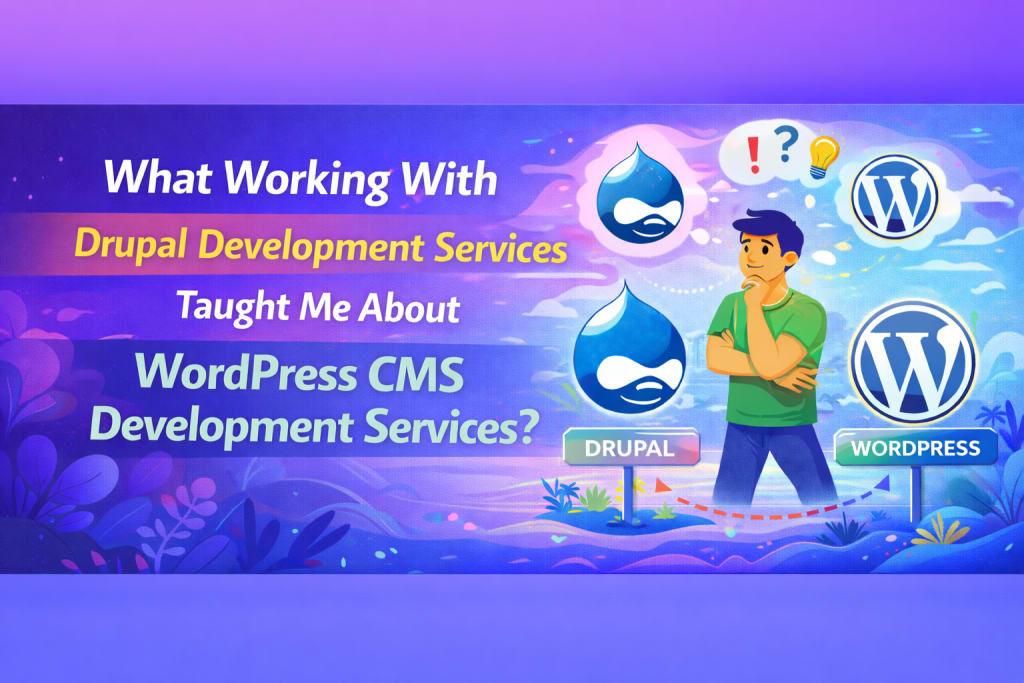
What Working With Drupal Development Services Taught Me About WordPress CMS Development Services?
I didn’t switch platforms because of features — I switched because of pressure, fatigue, and one moment when the room went quiet.

I used to believe that content management systems were mostly about features.
Which one was faster. Which one scaled better. Which one had more plugins, more modules, more flexibility on paper.
That belief didn’t survive real projects.
It faded slowly, somewhere between long planning meetings, late-night deployments, and quiet moments watching editors struggle with interfaces that were technically powerful but emotionally exhausting.
My early career was shaped by structure. I spent years working with drupal development services, building systems that demanded precision. Every content type was deliberate. Every permission was intentional. Nothing happened accidentally, and nothing happened quickly without forethought.
At the time, that discipline felt like professionalism. I believed that good software should require effort, and that complexity was a sign of seriousness.
I was wrong — or at least incomplete.
Learning to Respect Structure
Drupal teaches you to think in systems.
Not pages, not posts — systems.
You learn to ask questions before writing a single line of code.
Who will create content?
Who will approve it?
Who should never even see this option?
That mindset is powerful. It prevents chaos. It protects large organizations from themselves. When you’re building for governments, universities, or enterprises with thousands of contributors, structure isn’t optional — it’s survival.
But structure has a cost.
I watched content teams hesitate before clicking buttons. I saw editors save drafts repeatedly, afraid they might break something. The CMS worked, but it demanded confidence — and not everyone had it.
At the time, I assumed that was the editor’s problem.
They would “learn eventually.”
Experience taught me otherwise.
The Moment Perspective Shifted
The shift didn’t happen during a launch or a failure.
It happened during a quiet afternoon review.
A content editor was updating a simple announcement. Not a campaign. Not a redesign. Just a small text change.
It took coordination, permissions, and approval. Not because the system was broken — but because it was doing exactly what it was designed to do.
Afterward, the editor said something that stuck with me:
“I feel like I’m borrowing the website instead of owning it.”
That sentence lingered.
Entering a Different World
Years later, I joined a project built on WordPress. I approached it cautiously, even skeptically. My expectations were low. I assumed I’d miss the control, the rigor, the sense of architectural certainty.
Instead, I noticed something else.
Editors moved freely. They experimented. They fixed mistakes without fear. Content evolved naturally, not according to rigid workflows but according to real needs.
That freedom wasn’t reckless — it was empowering.
Working with WordPress CMS Development Services forced me to confront a blind spot I didn’t know I had: I had been designing systems for machines and processes, not for people’s emotional relationship with their work.
Control Versus Confidence
Drupal had taught me how to protect systems.
WordPress taught me how to protect confidence.
Neither approach is universally better. They solve different problems. But until you experience both deeply, it’s easy to mistake control for quality.
Confidence matters more than we admit.
A system that users trust will be used well.
A system that intimidates will be avoided, even if it’s powerful.
That realization changed how I approach every CMS decision.
Complexity Isn’t the Enemy — Misalignment Is
One of the biggest misconceptions I carried was that complexity itself was the problem. It isn’t.
The problem is mismatched complexity.
Drupal excels when content must be structured, regulated, and audited. WordPress shines when content must move, adapt, and breathe.
Trouble begins when we impose enterprise rigidity on small teams, or casual publishing tools on mission-critical systems.
The lesson wasn’t “use WordPress instead of Drupal” or the other way around.
The lesson was to stop forcing tools to solve problems they weren’t built for.
Listening to the Quiet Signals
What analytics rarely show is emotional friction.
You won’t see it in bounce rates or conversion funnels. You see it in pauses. In hesitations. In emails that say, “Can you make this change for me?” even though the user technically could.
After working across both ecosystems, I started paying attention to those quiet signals. They tell you more about a system’s success than performance metrics ever will.
Building With Empathy, Not Bias
Experience stripped away my platform loyalty.
Now, when someone asks which CMS they should use, I don’t start with features. I start with people.
- Who writes the content when no one is watching?
- Who fixes typos five minutes before a deadline?
- Who feels anxious every time they log in?
Those answers matter more than benchmarks.
What Stayed With Me
Drupal taught me discipline.
WordPress taught me generosity.
One made me respect structure.
The other reminded me that software exists to support human intent, not control it.
The most valuable takeaway wasn’t technical at all. It was philosophical:
a good CMS doesn’t just manage content — it manages trust.
Trust between developers and editors.
Trust between systems and the people who depend on them.
The Real Choice
The real choice isn’t Drupal or WordPress.
It’s rigidity or responsiveness.
Fear or confidence.
Control or collaboration.
Once you see that, CMS decisions stop being arguments and start becoming conversations.
And that’s when the work gets better — for everyone involved.
About the Creator
Jane Smith
Jane Smith is a content writer and strategist with 10+ years of experience in tech, lifestyle, and business. She specializes in digital marketing, SEO, HubSpot, Salesforce, web development, and marketing automation.
Keep reading
More stories from Jane Smith and writers in 01 and other communities.
What I Learned About Ecommerce SEO Services While Working With a Mobile SEO Agency?
I didn’t expect a mobile project to change how I thought about ecommerce. At the time, we were dealing with a narrow problem. Our mobile traffic looked healthy, but conversion from phones lagged behind everything else. Desktop behaved one way. Mobile behaved another. The gap kept widening.
By Jane Smith3 days ago in 01
Mobile App Development Orlando: iOS vs Android Cost Comparison
The first sign the comparison was flawed didn’t come from engineering. It came from accounting. We were months past launch, reviewing what should have been a predictable cost curve, when one platform’s line refused to settle. Nothing dramatic. No runaway spending. Just a persistent pattern of small overruns that added up quietly.
By Nick William4 days ago in 01


Comments
There are no comments for this story
Be the first to respond and start the conversation.