
Why Canton Network for RWA Tokenization?
The Blockchain That Wall Street Actually Trusts with Trillions of Dollars

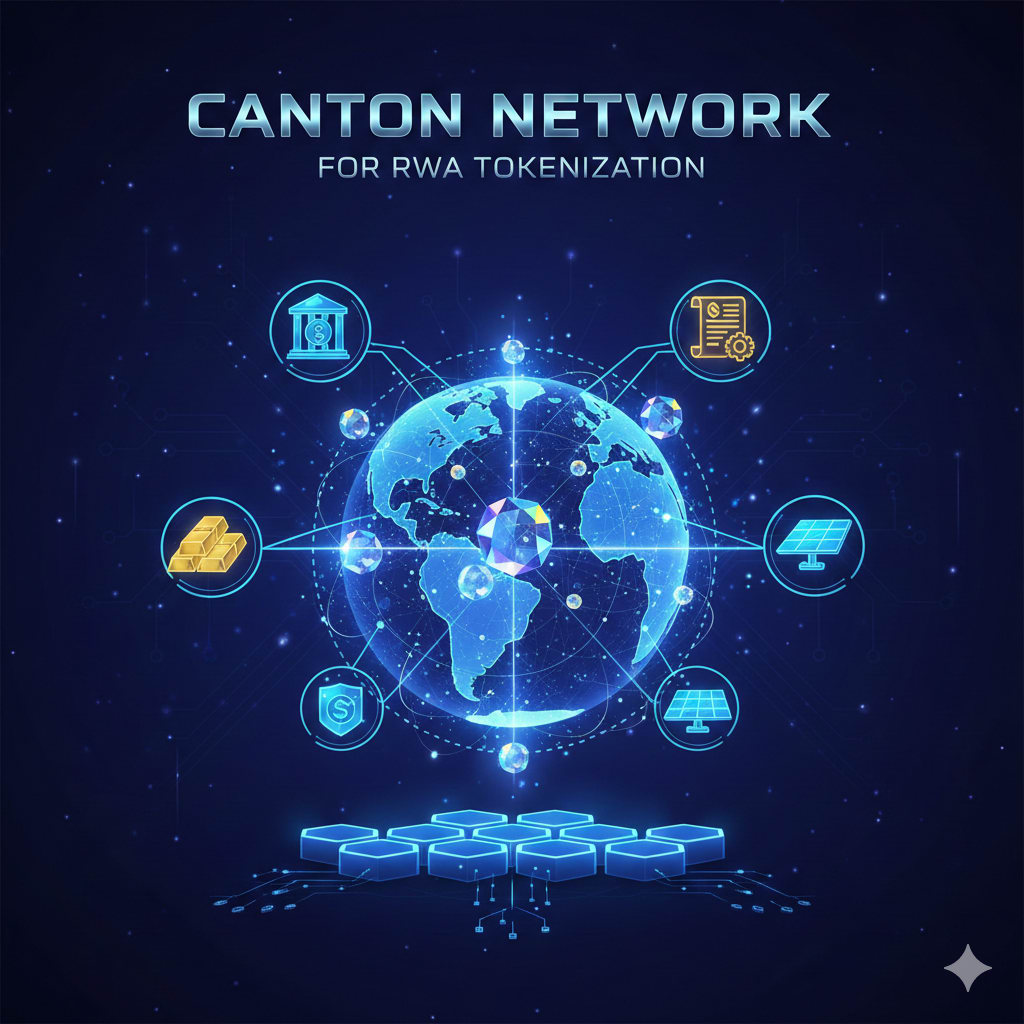
A Simple Question That Took Years to Answer
For years, banks and financial institutions asked a simple question: can we use blockchain to make things faster, cheaper, and more efficient?
The answer was always "yes, but..." followed by a long list of problems.
Public blockchains like Ethereum let everyone see every transaction. Imagine if your bank posted all your transactions on a public website. That's essentially what happens on most blockchains. For regular people buying crypto, this might be fine. For banks moving billions of dollars, it's a deal breaker.
So institutions tried building private blockchains. Problem solved, right? Not quite. Each bank built its own system. These systems couldn't talk to each other. It was like having a telephone that only works within your own house. The whole point of shared technology was lost.
Canton Network finally answered that simple question with a real solution. Yes, blockchain can work for institutional finance. And here's how.
What Is Canton Network?
Canton Network is a blockchain built specifically for big financial institutions. It launched in 2023 with backing from some of the biggest names in finance: Goldman Sachs, BNP Paribas, Citadel Securities, Deutsche Börse, and many others.
Think of Canton as a private highway system for financial transactions. Different companies can use this highway to move assets between each other. But unlike a regular highway where everyone can see all the cars, Canton only shows you the vehicles you're directly involved with.
Your transactions stay private. Your business strategies stay secret. Your client information stays confidential. But you can still do business with other companies on the same network.
This might sound simple, but no other blockchain had achieved this combination before Canton.
Why Does Privacy Matter So Much?
Let me explain with a real example.
Say a large investment fund wants to buy a significant amount of tokenized bonds. On a public blockchain, other traders can see this large order coming. They can buy the bonds first, wait for the price to rise from the fund's purchase, then sell at a profit. This is called front-running, and it costs institutional investors billions every year.
On Canton, only the buyer and seller see the transaction. Nobody else knows it happened. The investment fund can execute its strategy without tipping off competitors.
This privacy extends to everything. Portfolio compositions stay hidden. Client relationships remain confidential. Trading strategies stay secret. Regulators can still access information when needed, but the general public cannot.
For banks that must protect client confidentiality by law, this privacy isn't a nice feature. It's a requirement.
Real Money Is Already Moving on Canton
Canton isn't just a concept or a pilot program. Real assets are moving through the network today.
Broadridge, a major financial technology company, uses Canton for US Treasury repo financing. They've processed over $4 trillion monthly through the network. That's not a typo. Trillions of dollars in real transactions.
In September 2025, Digital Asset and major financial institutions completed a groundbreaking transaction. They moved US Treasury bonds onto Canton and used them as collateral with near-instant settlement. This process normally takes days in traditional finance. On Canton, it happens almost immediately.
Black Manta Capital Partners launched the first European real estate backed security token on Canton. A storage facility in Italy now exists as a tokenized bond that investors can buy and sell on blockchain rails.
These aren't experiments. They're live financial products serving real customers.
How Canton Solves the Interoperability Problem
Remember how private blockchains became isolated islands? Canton fixes this through clever design.
Canton works as a network of networks. Different applications and systems can connect to Canton while keeping their data separate. Think of it like email. You can send messages between Gmail and Outlook even though they're different systems. Canton does something similar for financial transactions.
In March 2024, Canton demonstrated this at scale. Forty-five major institutions participated in a pilot. Fifteen asset managers, thirteen banks, four custodians, and three exchanges all connected their systems. They completed over 350 transactions across 22 different applications, all working together seamlessly.
A tokenized bond in one system could serve as collateral in another system. Digital cash could flow between different banking applications. Everything synchronized in real time.
This interoperability means institutions don't have to choose one platform and hope everyone else picks the same one. They can join Canton and work with any other institution on the network.
What Makes Canton Different From Other Blockchains?
Let me break this down simply.
Public blockchains (like Ethereum) are open to everyone. Anyone can see any transaction. Great for transparency, terrible for business confidentiality.
Private blockchains are controlled by single organizations. They're private, but they can't easily connect with other systems. You're stuck in a silo.
Canton gives you privacy like a private blockchain but connectivity like a public one. Only parties involved in a transaction see it. But you can still transact with anyone else on the network.
Canton also uses special smart contracts called Daml. These contracts are designed specifically for financial workflows. They can handle complex agreements, compliance rules, and multi-party transactions that general-purpose blockchain languages struggle with.
The network can also scale without slowing down. Traditional blockchains often get congested when too many people use them. Canton processes transactions only on the computers that need to see them, so the network stays fast even as it grows.
Who Is Using Canton Today?
The list of companies involved with Canton reads like a who's who of global finance.
Goldman Sachs, one of the world's largest investment banks, helped launch the network and continues to participate. BNY Mellon, a major custody bank, is involved. Deutsche Börse, which operates the Frankfurt Stock Exchange, participates. The DTCC, which processes most US securities transactions, completed pilot projects on Canton.
More recently, CoinShares launched a validator on Canton. The company manages over $9 billion in digital assets and sees Canton as the future of tokenized financial products.
Chainlink, the leading provider of blockchain data feeds, partnered with Canton to provide price information and enable connections to other blockchain networks.
In June 2025, Digital Asset raised $135 million from investors to expand Canton further. The investors included Goldman Sachs, Citadel Securities, BNP Paribas, and others. When Wall Street's biggest names invest in infrastructure, it signals where the industry is heading.
Why RWA Tokenization Needs Canton
Real world asset tokenization means putting traditional assets like bonds, real estate, commodities, and funds onto blockchain. The benefits are significant: faster settlement, 24/7 trading, fractional ownership, and reduced costs.
But tokenization only works at scale if the underlying infrastructure meets institutional requirements. Banks can't use technology that exposes their clients' information. Asset managers can't adopt systems that reveal their strategies. Custodians need proper audit trails and compliance tools.
Canton was designed from day one to meet these requirements. Privacy is built into the core architecture, not added as an afterthought. Compliance features are native to the platform. The smart contract language handles complex financial agreements naturally.
This is why the RWA tokenization development happening on Canton looks different from experiments on public chains. It's not retail investors trading small amounts of tokenized real estate. It's major financial institutions moving billions in US Treasuries, corporate bonds, and alternative funds.
The RWA market grew over 260% in the first half of 2025, reaching more than $23 billion in total value. As this market expands, more of that growth will flow through infrastructure that actually meets institutional needs. Canton is positioned to capture a significant share.
What Does This Mean for the Future?
The CEO of Digital Asset, Yuval Rooz, put it clearly after the recent funding round. Over the next 12 to 18 months, expect live deployments from major financial players, interoperability between applications across the network, and expansion into new global markets.
Nasdaq has already submitted proposals to the SEC for trading tokenized securities. The DTCC is developing systems to convert securities into token form. Traditional finance is moving toward blockchain infrastructure, and Canton is ready to receive them.
The Canton Coin, the network's native token, powers this ecosystem. It rewards validators and application builders who contribute to the network. Distribution is designed to be fair, with no pre-allocated tokens to early investors. Instead, tokens go to those who actually build and maintain the infrastructure.
This approach has driven rapid growth. Validator participation increased 40% month over month recently. Canton Coin transfers surged 20 times, averaging about 3 million ledger events daily.
Is Canton Right for Your Project?
Canton makes the most sense for projects that involve regulated financial institutions with strict privacy requirements, assets that need to move between multiple parties and systems, high-value transactions where settlement speed and risk reduction matter, use cases requiring compliance with financial regulations, and applications that need to scale to handle institutional transaction volumes.
If you're building a simple consumer application or don't need institutional-grade privacy, other blockchains might serve you better. But if you're working with banks, asset managers, exchanges, or regulated financial products, Canton provides infrastructure that actually fits the use case.
The technology exists. The institutions are adopting it. The regulatory environment is becoming clearer. Canton Network is bridging the gap between traditional finance and blockchain technology in a way that finally makes sense for the institutions that move the world's money.
The question isn't whether institutional finance will adopt blockchain. That's already happening. The question is which infrastructure will carry that adoption. Canton has positioned itself as the answer.
About the Creator
Matthew Haws
Blockchain and AI enthusiast sharing insights, ideas, and honest takes on the fast-evolving world of tech. I write to simplify complex concepts and spark meaningful conversations.
Keep reading
More stories from Matthew Haws and writers in 01 and other communities.
Why Your Business Needs Professional Crypto Custody Solutions Now
In 2014, Mt. Gox, once the world's largest Bitcoin exchange, filed for bankruptcy. The reason? Hackers had slowly drained 850,000 Bitcoins from their systems over several years. Nobody noticed until it was too late. At today's prices, that's over $50 billion in lost assets.
By Matthew Haws3 months ago in 01
Why Rule-Based Detection Leaves You Vulnerable to Modern Cyber Threats
Enterprise security once followed a simple assumption. Recognizable malicious patterns were flagged immediately and subsequently blocked. Signatures and static controls shaped enterprise defenses for years.
By Aaron Smith6 days ago in 01
One Unchecked Box
"Republished" because it was the only way to add the embed for the newly recorded audio version of this story due to the Top Story badge. Plus it serves as a nice, informal announcement of the podcast's revival for another season (go subscribe!):
By Stephen A. Roddewig6 days ago in Fiction




Comments
There are no comments for this story
Be the first to respond and start the conversation.