
Art That Breathed
A lonely painter discovers that true art is not created — it’s alive

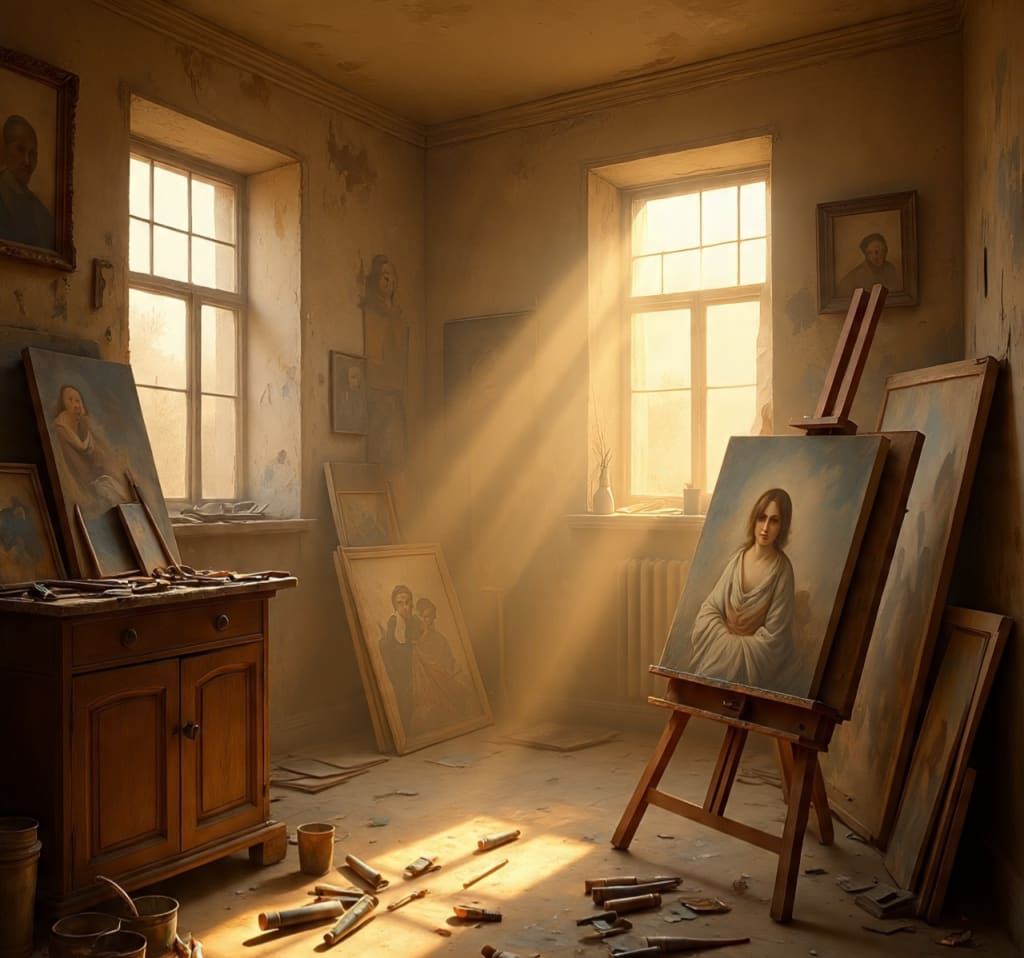
In a quiet street in Florence, Italy, where every corner smelled of paint and coffee, there stood a small art studio with cracked windows and ivy creeping up its walls. Inside, a man named Luca spent his days surrounded by canvases that never sold and colors that refused to fade.
Luca was an artist who had once dreamed of fame. When he was young, he imagined his paintings hanging in grand museums, his name spoken with admiration. But life, as it often does, chose a quieter path for him. Years passed, and his studio became more of a memory than a business. Few people came by, and those who did often left without buying anything.
Still, Luca painted every day. He said the world made more sense when seen through color. His hands were always stained — blue on his fingers, gold under his nails, red brushed across his shirt. He lived alone, his only companion a stray cat that had decided his studio was home. He named her Bella.
One evening, as the sun sank behind the Tuscan hills, Luca began painting something different. He didn’t know what had moved him to start. Maybe it was loneliness, maybe memory. On the blank canvas, he drew the outline of a woman. Her eyes were soft, filled with unspoken sadness, and her lips seemed ready to whisper something only he could hear.
He worked on her for weeks. Every morning, he mixed new shades of light to bring her to life — pale gold for her hair, gentle amber for her skin. The studio filled with her presence, as though she were more than paint.
Luca spoke to her as he painted. He told her about his lost chances, about how the world forgot artists who had nothing to sell but sincerity. He told her about Bella, the cat who liked to sleep on unfinished canvases, and about the old woman at the bakery who always gave him bread for free.
The more he painted, the more alive she seemed. Her eyes grew deeper, her expression warmer. Sometimes, when the wind brushed against the open window, Luca thought he saw her chest rise slightly, like she was breathing. He laughed at himself. “You’re losing your mind, old man,” he’d say, shaking his head.
But one night, something strange happened. A storm swept through the city, shaking the shutters and scattering papers across the floor. Luca woke to the sound of glass breaking. When he entered his studio, the candlelight flickered across the painting — and the woman’s eyes seemed to move. Just a blink. So quick he almost doubted it.
He stood frozen. The room was silent except for the soft drip of rain through the broken window. He took a step closer. The painted woman’s lips curved, ever so slightly, into a faint smile.
Luca felt his heart hammering in his chest. He whispered, “Who are you?”
The air felt alive. Then, softly, as if carried by the wind, came a voice — not loud, but clear enough to be real. “You gave me life, Luca.”
He stumbled back, his hands trembling. “This isn’t real,” he muttered. But when he looked again, her eyes were shining with something human.
The next morning, the storm had passed. The painting was still. Yet something in the room had changed. The air felt warmer, calmer. Bella purred near the easel as if comforted by an unseen presence. Luca sat in front of the painting and smiled. “If you’re real,” he said softly, “then thank you for keeping me company.”
From that day, the studio no longer felt lonely. Luca painted every morning, and every night he spoke to the woman in the painting. Sometimes he imagined she answered, sometimes he only felt her silence. But it was a silence that felt alive.
Word of Luca’s new painting spread quietly through the town. People came to see “the woman who breathed.” They said her eyes followed them across the room, that her expression changed depending on who stood before her.
For the first time in years, Luca sold his work. But he never sold that painting. It remained where it belonged, watching over him. He said it was not just art — it was a piece of his soul made visible.
Years later, when Luca passed away, the townspeople found him sitting in his chair, facing the painting. He had a gentle smile on his face, and the candle beside him had burned down to the last bit of wax. The painting still hung on the wall, untouched — but those who looked closely swore the woman’s eyes were closed, as if mourning her creator.
They left the painting where it was, in the little studio that smelled of paint and time. Today, visitors still stop by. Some say the air feels warm near the canvas, and if you listen closely, you can hear a soft whisper.
“I am still here,” it seems to say. “The art that breathed never truly dies.”
About the Creator
LUNA EDITH
Writer, storyteller, and lifelong learner. I share thoughts on life, creativity, and everything in between. Here to connect, inspire, and grow — one story at a time.
Keep reading
More stories from LUNA EDITH and writers in Art and other communities.
Tom Morello: The Revolutionary Guitar Legend Shaping Modern Rock Music
Who Is Tom Morello? Born Thomas Baptist Morello on May 30, 1964, in Harlem, New York, Tom Morello grew up in Illinois before moving to Los Angeles to pursue music. He studied political science at Harvard University, a background that would later deeply influence his songwriting and activism.
By youssef mohammed5 days ago in Art
Why Black History Matters in America?
The United States of America is celebrating their 250th anniversary in 2026. I'm proud to be an American and as someone who was born here, I wouldn't imagine myself living anywhere else. This is a country where opportunities are possible. Where anyone can be successful in anything they desire to do. Equality, community, and togetherness are the backbones of what America is and should be about. However, we have an administration who wants to erase and disregard those who have made positive, meaningful impacts in our country, specifically Black figures, such as Martin Luther King, Jr., Rosa Parks, and Maya Angelou. President Trump and his administration have been constantly complaining and fighting against what they call the "Woke agenda". They use this excuse as a distraction from other issues they refuse to address, such as the high cost of living, climate change, and inflation. That equality is dividing America, when in reality, it's bringing us together. Being woke is not tied to a specific political party. No matter where you stand on the political spectrum, you can still care about other people and their plights. Compassion and empathy for others isn't tied to a political party, either. We were taught as children to treat others the way we want to be treated and not judge others because they're different from us. Caring about others isn't a personal attack on your beliefs. It doesn't make you any less of a person. People who are easily offended over African American figures, past or present, or anything related to it, are grasping at straws. Current and future generations need to know who people like Harriet Tubman and Shirley Chisholm were, especially in the classroom. Black History is part of American History. It should be recognized, not hidden or forgotten. Besides, you can't shield children from everything, just because your feelings are easily hurt.
By Mark Wesley Pritchard 3 days ago in The Swamp


Comments
There are no comments for this story
Be the first to respond and start the conversation.