
Mysterious Oriental Art: The Enigmatic World of Langzhong Door God Paintings
Amidst the ever-changing tides of time, it's possible that the once-celebrated craftsmanship of Langzhong Door God paintings has faded from memory, and their original purpose has gradually dissolved into the depths of history. However, like skilled sailors navigating the currents, artisans of Eastern folk art persevere and carry forward this ancient tradition. With their unwavering dedication, they safeguard and pass on the legacy of this venerable folk art.
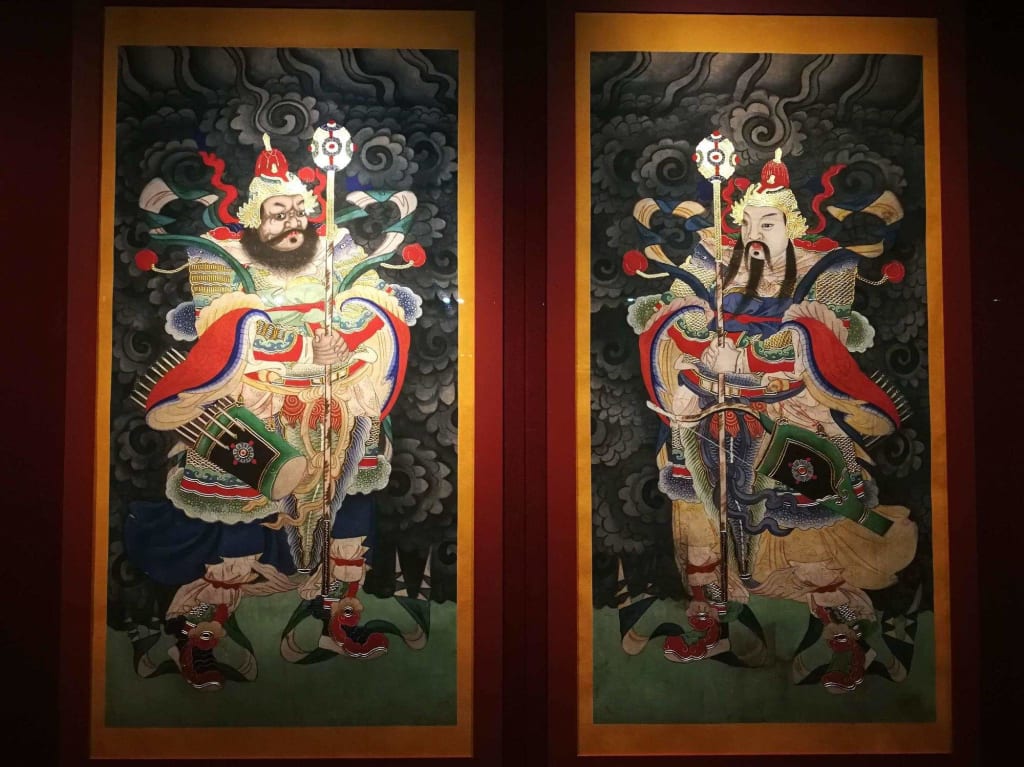
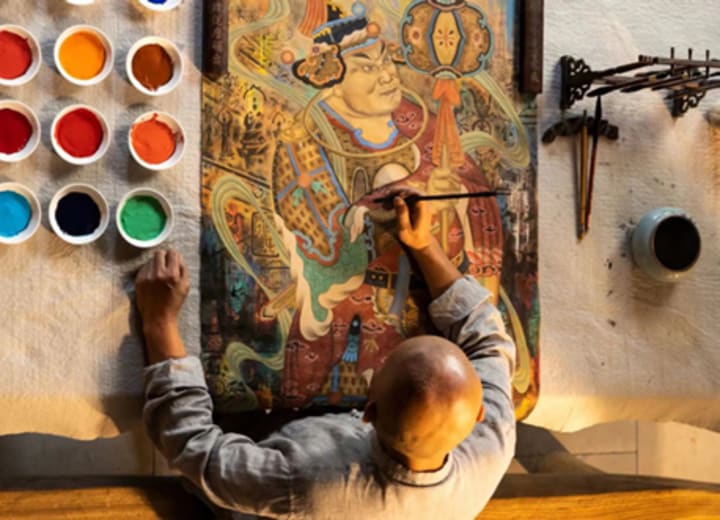
Walking through the ancient city of Langzhong, you might occasionally spot faded Door God paintings on the simple wooden doors, their colors muted by the passage of time. Within the old city, there's a winding alley named Baihuaan Street, flanked by white walls and blue tiles. Deep within this alley, an inconspicuous door lacks a signboard. Inside the room, several wooden doors await repair, and neatly stacked on a table are blueprints for Door God paintings. An elderly gentleman sits before a wooden door, sketching something. He is Zhang Wei, the inheritor of Langzhong's Door God painting tradition.
In the past, Mr. Zhang used to wield a hammer in one hand and a knife in the other, directly painting on doors. However, to align with contemporary aesthetics, he incorporates modern elements into these door portraits. Moreover, he must consider the historical period the design represents. Combining abstract representation with modern artistic techniques results in a completed Door God painting. Mr. Zhang emphasizes that this art form shouldn't be treated casually, highlighting his sense of responsibility and love for life's traditions.
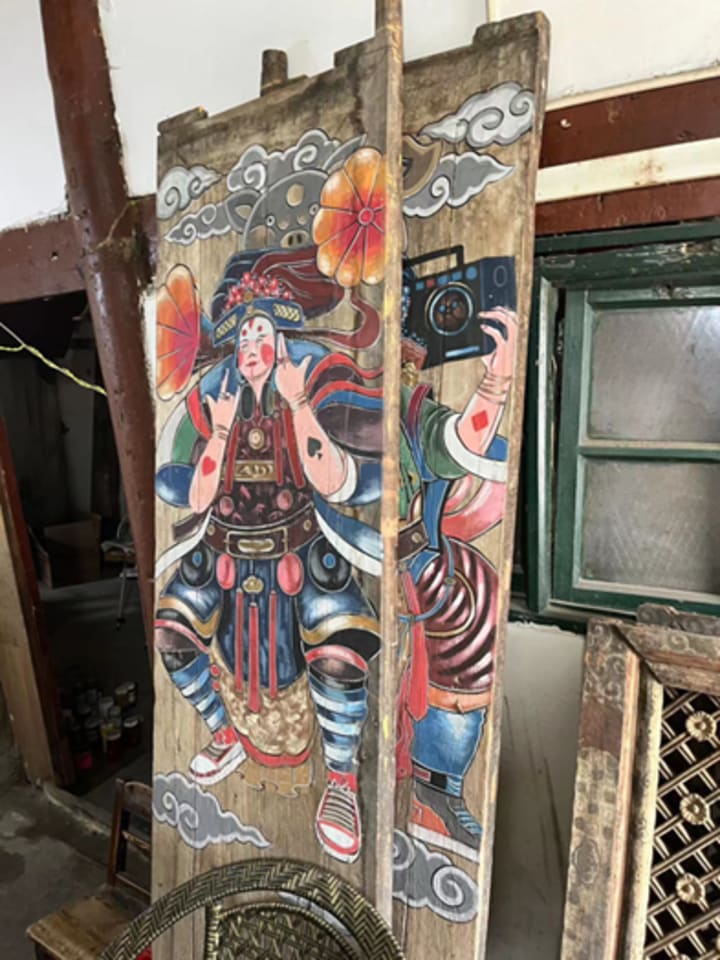
Door God paintings typically feature vibrant colors, strong contrasts, and a myriad of shades. They share a close relationship with Langzhong's historical cultural heritage, such as murals and shadow puppetry. Historically, Door God painters often specialized in mural painting and temple decoration, extending beyond folk traditions. Thus, the aesthetic standards and technical excellence inherited through generations remain exceptionally high, embodying the artistic essence of traditional Chinese murals.
Long ago, Door God figures were initially made from reeds. People would roll reeds into circles and hang them on doors, creating "Door God" figures. In a time when communities were distant, and science was less advanced, this was a way to protect homes and ward off malevolent spirits. This practice eventually evolved into the painted Door God figures we know today.
Despite modern technological advancements and the convenience of printing, many still choose to buy or have Door God figures painted, expressing their longing for positivity and their support for traditional culture. While the method has evolved, the desire for beauty and the preservation of traditional culture persist. As society changes, Door God figures adapt to the trends, remaining relevant.
Langzhong's ancient Door God paintings have a long history and are worth researching in terms of both preservation and evolution. These wooden Door God paintings serve as a bridge from the worship of Door Gods to the depiction of daily life in traditional folk art. By studying Langzhong's Door God paintings, one can appreciate their evolution, rich variety, and diverse forms. If art or artistic creations are only aesthetically pleasing, they might lack genuine artistic value. The enduring charm of art requires depth and longevity in the heart of its audience.
In the past, Door God worship started with reeds. People would hang reeds on doors for safety and protection. Over time, as technology developed, people turned to paintings for the same purpose. Though today's society has changed, and fewer people hang Door God figures, the symbol retains its role in guarding homes and spirits, acting as a form of spiritual belief. In challenging times, people still turn to Door God figures as a source of hope.
This journey, spanning thousands of years, from reeds to Door God paintings, encapsulates a poignant tale of history's evolution. While the once-prized Door God painting skills and their original functions might have faded or transformed, dedicated artisans like Zhang Wei continue to stand as guardians, preserving this ancient folk art with their skill and passion. In the words of these artisans, Langzhong's Door God paintings have become a timeless link bridging eras, cultures, and continents—connecting the past to the present, the East to the West. Whether it's Door God paintings or any other ancient cultural heritage, they represent the crystallization of our predecessors' wisdom, the wellspring of our civilization's progress.
About the Creator
Keep reading
More stories from Haoxiang Yang and writers in Art and other communities.
The Treasures of Eastern Art: The Legacy of Cloisonné Enamel
Hou Guirong: A Master of Cloisonné Enamel and Gold Wire Art in Sichuan, China Hou Guirong, a skilled and dedicated craftsman hailing from Sichuan Province, China, is a humorous, dedicated, and exemplary elder in the realm of traditional crafts. Stepping into his workshop, one's eyes are immediately drawn to the numerous handmade artworks adorning the walls. These vibrant, colorful creations seem to narrate countless stories.
By Haoxiang Yang2 years ago in Art
'Till Death We Do Art
There would be nothing divine in this world without art. Nature may surpass the divine to all intents and purposes, but like everything it absorbs and is absorbed by, it remains here, stuck on the surface of this world, ever-present, physically bound to the universe.
By Avocado Nunzella BSc (Psych) -- M.A.P 7 days ago in Art
Form Over Feeling Ahsan Ali Minimalism Meets Masculinity
Minimalism meets masculinity? Isn’t fashion supposed to be expressive? Here, restraint is the statement. Ahsan Ali Dinpur embodies controlled elegance, combining structured styling, subtle gestures, and radiant skin to redefine modern male luxury. Minimalism becomes a vehicle for clarity, confidence, and composure.
By Ahsan Ali Web Designer5 days ago in Art

Comments
There are no comments for this story
Be the first to respond and start the conversation.