
Hedge Witchcraft in Theory and Practice
Folk Magic, Spirit Work, and the Liminal Traditions

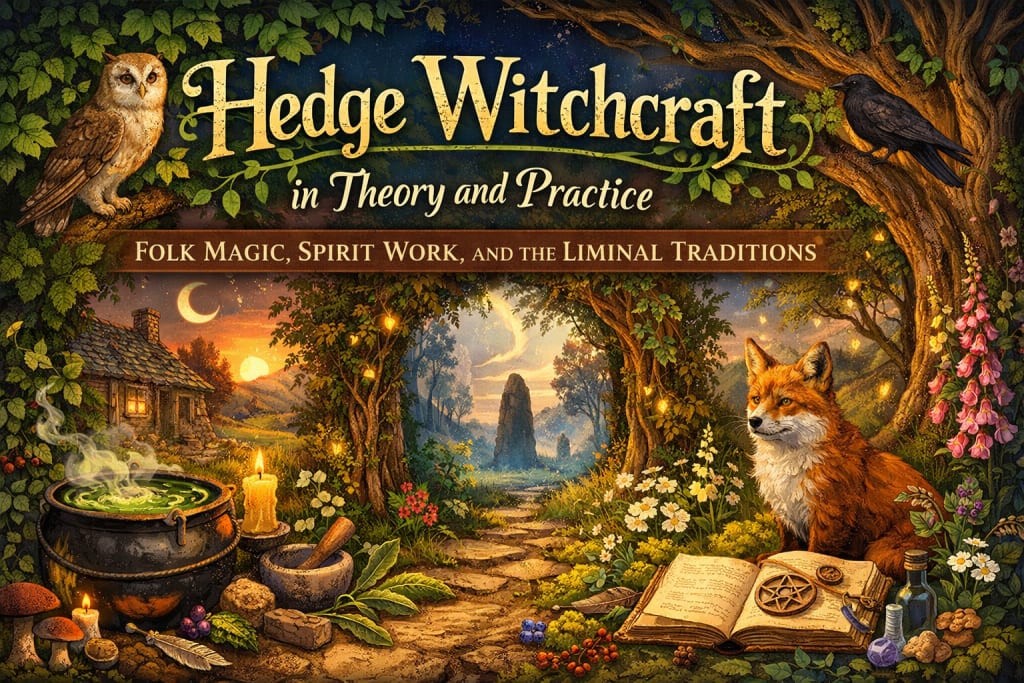
At the Edge of the Living World
Winding through the brambles of rural folklore, household healing, and land-based magic lies the path known as hedge witchcraft. This tradition takes shape not in temples or formalized rites, but along boundaries where cultivated ground gives way to forest, where hearth smoke meets night air, and where knowledge passes quietly from hand to hand. Hedge witchcraft emerges from lived relationship with place, season, and necessity rather than institutional authority or scripted belief.
The word hedge carries layered meaning grounded in historical landscape and symbolic function. In much of pre-industrial Europe, hedges marked property lines, grazing limits, and the edges of common land. These living boundaries were practical structures and psychological thresholds, separating the ordered world of fields and villages from the uncertain spaces beyond. The hedge therefore became a potent metaphor for transition, danger, possibility, and access to forces existing outside ordinary social life. Hedge witchcraft developed within this tension, practiced by individuals who moved between roles of healer, herbalist, diviner, and spirit-worker.
Within folk communities, such practitioners were often known as cunning folk, wise women, or charmers. Skills included plant medicine, midwifery, animal care, protective charms, dream interpretation, and the removal of spiritual affliction. Knowledge was accumulated through observation, apprenticeship, and long familiarity with local environments rather than through written doctrine. Survival demanded accuracy. A misidentified root or mistimed harvest carried real consequence. As a result, hedge witchcraft cultivated attentiveness, restraint, and respect for natural cycles.
Liminality stands at the heart of this tradition. Liminal spaces exist where categories blur and transformation becomes possible. Twilight, crossroads, thresholds, shorelines, and forest edges all hold this quality. Human states such as dreaming, illness, birth, grief, and ecstatic trance belong to the same category. Hedge witchcraft treats these moments not as anomalies but as openings where insight, healing, and communication occur. The hedge witch stands neither fully inside nor fully outside, operating in the in-between with deliberate care.
Unlike codified religious systems, hedge witchcraft resists uniform structure. Practice adapts to region, climate, culture, and individual temperament. A hedge witch working the chalk hills of southern England would not mirror one living among boreal forests or coastal marshlands. The land itself instructs. Seasonal rhythms dictate timing. Weather patterns influence ritual and remedy. Over time, familiarity with these forces produces a form of knowledge that is intimate, practical, and quietly profound.
Spiritual engagement within hedge witchcraft often reflects animistic understanding. Trees, stones, rivers, and animals are regarded as presences rather than resources. Interaction takes the form of listening, exchange, and mutual recognition rather than command. This worldview predates modern occult frameworks and aligns closely with older European folk cosmologies where spirit and matter were not cleanly divided.
Modern interest in hedge witchcraft often arises from dissatisfaction with rigid systems or performative spirituality. The appeal lies in its grounded nature, ethical restraint, and emphasis on relationship rather than spectacle. Hedge witchcraft does not promise mastery over hidden forces. Instead, the tradition values attentiveness, humility, and the willingness to dwell at the edge of certainty.
Across centuries, hedge witchcraft has persisted quietly, reshaping itself through oral transmission, adaptation, and survival under social pressure. Despite periods of persecution and misunderstanding, the core principles remained intact because they were woven into daily life. Healing hands, careful words, and deep knowledge of land and season ensured continuity even when names and labels shifted.
At its foundation, hedge witchcraft represents a way of seeing the world as alive, responsive, and interconnected. Power arises not from domination but from alignment. Wisdom grows through patience. The hedge remains a threshold, inviting those willing to stand between worlds and listen closely to what moves through the leaves.
Defining the Hedge and the Craft
Hedge witchcraft exists as a folk-rooted, land-based form of magical practice shaped by solitude, observation, and necessity. This tradition developed outside formal religious hierarchies and ceremonial systems, drawing strength from direct engagement with environment, season, and spirit rather than from standardized rites. Hedge witchcraft favors adaptability over uniformity and lived knowledge over inherited doctrine.
The defining characteristic of hedge witchcraft lies in relationship with boundaries. A hedge, in historical and agricultural contexts, functioned as a living structure marking the edge between tended land and wilderness. Such boundaries protected crops, guided livestock, and shaped human movement across the landscape. Over time, the hedge accrued symbolic weight. Boundaries became sites of tension and potential, places where familiar order softened and unfamiliar forces pressed close. Hedge witchcraft emerged within this symbolic geography, treating borders as sites of access rather than obstacles.
Within magical and spiritual understanding, the hedge represents transition between states of being. Physical hedges parallel less visible thresholds such as the space between waking awareness and dream, between illness and recovery, between life and death. Hedge witchcraft works within these conditions of transition. Practice focuses on navigating uncertainty with skill, respect, and restraint rather than seeking control or dominance.
Historically, individuals associated with hedge witchcraft often served practical roles within rural communities. These figures were commonly known as cunning folk, wise women, charmers, or healers. Responsibilities included herbal treatment, childbirth assistance, animal care, protection against misfortune, and mediation between human and nonhuman forces. Knowledge accumulated through observation, repetition, and careful attention to outcome. Accuracy carried weight. Failure risked harm, loss, or social consequence. This environment shaped a pragmatic and ethical approach to magic grounded in accountability.
Hedge witchcraft remains closely tied to folk medicine and plant knowledge. Herbal practice within this tradition depends upon intimate familiarity with local flora, soil conditions, weather patterns, and seasonal timing. Harvesting follows cycles of growth and dormancy rather than abstract correspondence charts. Preparation methods prioritize safety, efficacy, and respect for living systems. Plant allies are encountered as active participants rather than inert ingredients.
Spiritual engagement within hedge witchcraft often reflects animistic cosmology. Trees, stones, waterways, animals, and weather patterns possess agency and presence within this worldview. Communication arises through observation, symbolic encounter, dream imagery, and subtle shifts in perception. Such interactions rely upon patience and listening rather than invocation or command.
Divinatory practices also appear frequently within hedge witchcraft, though forms vary widely. Signs in nature, patterns in dreams, bodily sensation, and intuitive recognition serve as sources of insight. Astrology, when present, functions as a tool for understanding seasonal and temporal influence rather than deterministic prediction. Trance and soul journeying appear in some expressions of the craft, particularly where healing or spirit communication plays a central role.
Unlike ceremonial magic systems, hedge witchcraft does not require initiation, hierarchy, or formal lineage. Practice evolves through relationship with land, ancestry, and experience. Adaptation occurs naturally as environment, culture, and personal circumstance shift. This flexibility allows hedge witchcraft to persist across centuries without crystallizing into rigid form.
At a structural level, hedge witchcraft operates through balance. Action alternates with observation. Engagement alternates with withdrawal. Knowledge deepens through repetition and reflection rather than accumulation alone. This rhythm mirrors natural cycles of growth, decay, and renewal. Hedge witchcraft therefore functions less as a system to be mastered and more as a way of inhabiting the world attentively.
In essence, hedge witchcraft represents a convergence of practical skill, spiritual sensitivity, and ecological awareness. The hedge remains both symbol and method, marking the place where human life touches mystery without attempting to own or erase it.
Where the Hedge Took Root
Hedge witchcraft did not arise from a single origin point or authored tradition. Development occurred gradually across centuries through the lived practices of rural communities throughout Europe. Knowledge moved by word of mouth, apprenticeship, and observation rather than through scripture or centralized authority. Survival shaped belief. Practical outcome determined value. What endured did so because it worked.
In agrarian societies, daily life unfolded close to land, weather, animals, and seasonal cycles. Illness, injury, birth, death, and crop failure demanded immediate response. Formal medical care remained inaccessible to much of the population. In this context, folk healers emerged as essential figures. Plant knowledge, wound care, fertility assistance, and protective charms formed part of everyday life rather than specialized spirituality. These skills passed through families and communities, often guarded carefully due to social and legal risk.
Pre-industrial Europe recognized no category labeled hedge witchcraft. The term itself belongs to later attempts at classification. Yet the practices associated with the hedge existed plainly. Midwives delivered children in farmhouses and fields. Bone-setters treated injuries sustained during labor. Herbalists identified plants through generational memory and seasonal familiarity. Certain individuals possessed reputations for sensing unseen causes behind illness or misfortune. These figures operated at the margins of formal religion and governance while remaining central to communal wellbeing.
The boundary between respect and suspicion remained fragile. While many communities relied heavily on folk practitioners, external authorities often viewed such knowledge with distrust. Church doctrine and emerging state power increasingly sought to regulate spiritual life. As a result, the same individual praised locally as a healer could be condemned elsewhere as a witch. This tension shaped the discreet nature of hedge practice and reinforced reliance on oral transmission and subtlety.
Land-based cosmology played a defining role in shaping hedge traditions. European folk belief commonly understood landscape as alive with presence. Sacred wells, ancient trees, standing stones, and crossroads held spiritual significance long before institutional religion sought to reinterpret or suppress such associations. These locations functioned as points of contact between human life and unseen forces. Engagement required etiquette, offerings, and caution rather than command. Hedge witchcraft absorbed this worldview, maintaining relationship with land spirits through attention and reciprocity.
The British Isles provide particularly well-documented examples of such practices through records of cunning folk active between the sixteenth and nineteenth centuries. These practitioners offered services ranging from healing and charm breaking to divination and spirit consultation. Trial records, folklore collections, and parish accounts describe techniques involving herbs, spoken charms, written talismans, and visionary experience. Despite regional variation, common themes appear. Emphasis remained on practical aid, moral balance, and maintenance of communal harmony.
Elements resembling shamanic practice also appear within hedge traditions, though expressed through local cultural forms. Trance states, dream vision, soul retrieval, and spirit guidance appear across multiple European folk contexts. Such experiences occurred through fasting, rhythmic sound, prolonged solitude, or illness-induced altered states rather than through formalized ritual systems. These methods allowed access to insight beyond ordinary perception, particularly in matters of healing and divination.
The absence of rigid structure allowed hedge witchcraft to adapt continually. Knowledge shifted alongside environment, population movement, and cultural pressure. Practices that relied on specific plants changed as landscapes altered. Seasonal observances adjusted to local climate. Language and symbolism evolved while underlying principles remained stable. Attention to land, respect for threshold spaces, and practical service to community persisted across generations.
Eclecticism therefore arose not from novelty seeking but from necessity. Hedge witchcraft absorbed what proved effective while discarding what failed. No external authority dictated acceptable practice. Validation occurred through result and reputation rather than doctrine. This process created a tradition both resilient and subtle, capable of surviving persecution by remaining woven into ordinary life.
The roots of hedge witchcraft lie not in abstraction but in mud, weather, blood, and breath. Fields bordered by hedges, homes warmed by hearth fires, and paths worn into soil carried knowledge forward quietly. The hedge marked the place where human order ended and deeper forces began, a place requiring skill, humility, and attentiveness to cross safely.
A Philosophy Shaped by Thresholds
The philosophy underlying hedge witchcraft arises from sustained attention rather than abstract belief. Knowledge develops through relationship with land, body, memory, and the subtle movements that connect visible and invisible realities. Meaning is not imposed upon the world but discovered through careful observation and lived response. This orientation produces a form of wisdom grounded in experience rather than theory alone.
Hedge witchcraft understands magic as a natural condition of existence. Forces that influence growth, decay, attraction, and change operate continuously whether named or ignored. Wind moves through branches. Tides respond to lunar cycles. Seeds germinate in darkness before breaking soil. Within this worldview, magic functions as the subtle interaction of cause, pattern, and presence rather than as a supernatural interruption. Recognition of these forces sharpens perception but does not alter their fundamental nature.
Experience occupies a central role within hedge philosophy. Learning occurs through repetition, sensory engagement, and outcome rather than adherence to prescribed forms. A charm succeeds because conditions align, intention remains clear, and timing proves correct. Failure instructs as effectively as success. Over time, attention refines judgment. Instinct develops through practice rather than instruction. Texts may inform, but authority rests with experience tested against reality.
Animistic understanding informs much of hedge philosophy. Landscape is not viewed as inert matter but as a field of living presences. Stones retain memory through age and pressure. Water carries movement and reflection. Trees respond to season, injury, and proximity. Interaction with these elements occurs through respect, restraint, and reciprocity. Demands give way to requests. Observation precedes action. Relationship replaces domination.
Healing occupies a privileged position within hedge philosophy. Care for bodies, animals, and land reflects alignment with natural balance. Herbal practice, when grounded in observation and safety, represents an act of cooperation with living systems. Tending soil, preserving seed, and maintaining ecological awareness constitute forms of magic equal in importance to spoken charm or ritual gesture. Healing in this context does not promise perfection but seeks restoration of balance where imbalance has taken hold.
Attention to liminality shapes perception and action. Moments of transition offer heightened sensitivity. Dawn and dusk, seasonal shifts, illness and recovery, birth and death all reveal conditions where ordinary boundaries soften. Hedge witchcraft approaches such moments with deliberation rather than haste. Silence, waiting, and watchfulness become active practices. Insight emerges through presence rather than force.
Distinction between hedge witchcraft and structured magical systems often arises at the level of philosophy rather than technique. While some practices overlap, the underlying orientation differs. Hedge witchcraft does not seek universal structure or standardized progression. Practice adapts to circumstance, environment, and individual capacity. Authority remains decentralized. Validation occurs through effectiveness, ethical consequence, and continued relationship with land and community.
Philosophically, hedge witchcraft resists spectacle. Power manifests quietly through consistency, accuracy, and attentiveness. Grand claims carry little weight without grounded application. Subtlety becomes strength. Over time, this approach cultivates humility and discernment. Knowledge deepens slowly, shaped by cycles rather than milestones.
The hedge stands as both symbol and method. A boundary marks separation while allowing passage. Philosophy rooted in such a symbol values balance between engagement and restraint. Action follows understanding. Understanding grows through patience. Within this framework, magic becomes less an act of will and more a practice of alignment with forces already in motion.
Daily Work Along the Hedge
Practice within hedge witchcraft unfolds through attentive engagement with land, body, and subtle states of awareness. Absence of codified lineage allows wide variation, yet recognizable patterns appear across regions and generations. These practices share a focus on relationship, accuracy, and restraint rather than spectacle or rigid performance.
Connection with land and plant life forms a foundational activity. Knowledge develops through repeated observation of local terrain, soil composition, seasonal change, and weather behavior. Familiarity with native and naturalized plants includes awareness of medicinal properties, toxic risks, growth cycles, and ecological role. Harvest follows ethical consideration, seasonal timing, and sustainability rather than aesthetic impulse. Care for land extends beyond collection to include soil stewardship, seed saving, and respect for protected species. Such work requires patience and long-term presence rather than novelty seeking.
Inner exploration occupies equal importance. Hedge witchcraft often incorporates methods of self-examination rooted in dream observation, memory work, and altered states of consciousness. Shadow work within this context involves honest engagement with fear, desire, grief, and unresolved experience. These states are approached as sources of information rather than obstacles. Soul journeying traditions within European folk practice describe inward movement through symbolic landscapes encountered during trance, illness, or dream. Such experiences historically informed healing, divination, and personal insight.
Spirit communication emerges through cultivated relationship rather than coercion. Ancestors, land spirits, and guardian presences associated with specific locations appear frequently within hedge practice. Interaction develops slowly through attention, offering, and respectful acknowledgment. Communication methods include symbolic encounter, dream visitation, intuitive sensation, and environmental sign. Exchange emphasizes reciprocity and consent. Silence and withdrawal remain valid responses within this framework, reinforcing ethical boundaries.
Divinatory practice functions as an act of listening. Rather than seeking absolute prediction, divination clarifies patterns, tendencies, and influences operating within a given moment. Natural signs such as animal behavior, weather shifts, and repeated imagery hold interpretive value alongside formal tools. Runes, bones, stones, and pendulums appear in various regional expressions. Accuracy depends upon clarity of attention and emotional neutrality rather than complexity of method.
Herbal and folk healing remain central expressions of hedge practice. Remedies favor simplicity grounded in efficacy. Infusions, decoctions, poultices, and salves arise from long familiarity with plant behavior and human physiology. Preparation emphasizes safety, dosage awareness, and contraindication knowledge. Healing work often integrates physical treatment with attention to emotional and spiritual context. Care extends to animals and cultivated land as expressions of shared wellbeing.
Dream and trance states provide additional pathways of engagement. Hedge traditions recognize dreaming as a natural liminal condition where symbolic language emerges with clarity. Recording and reflecting upon dream material sharpens interpretive skill over time. Trance induction may occur through rhythmic sound, repetitive movement, focused breathing, or extended solitude. Such states facilitate access to insight unavailable during ordinary waking awareness.
Practice within hedge witchcraft remains embodied and integrated into daily life. Actions arise from attentiveness rather than performance. Tools serve function rather than display. Power expresses through consistency, accuracy, and humility. Engagement with magic unfolds quietly through presence at the edge where ordinary perception gives way to deeper patterns moving beneath the surface of the living world.
Instruments of Use and Meaning
Tools within hedge witchcraft arise from function, familiarity, and relationship rather than uniform prescription. Objects become tools through repeated use, attention, and association with place. Practical value precedes symbolic meaning. Over time, symbolism develops naturally through experience and outcome rather than imposed correspondence.
Herb bundles and dried flowers occupy a central role due to direct connection with healing and seasonal cycles. Plants gathered at appropriate times retain potency when dried carefully and stored in breathable materials such as linen or cotton. Twine, cord, or natural fiber binds reflect traditional methods that allow airflow while maintaining order. Each bundle carries knowledge of habitat, harvest conditions, and preparation technique. Misidentification or improper storage risks loss of efficacy or harm, reinforcing the importance of accuracy and restraint.
Walking staffs or gathered branches serve both practical and symbolic functions. A staff offers support across uneven terrain and marks rhythm during long walks through fields or forest margins. Wood selection often reflects availability and familiarity rather than aesthetic preference. Over time, repeated handling imprints memory through use. Such objects become extensions of movement and presence within the landscape, valued for reliability rather than ornamentation.
Stones collected from local environments appear frequently within hedge practice. Geological features reflect age, pressure, and elemental forces acting across time. Stones gathered respectfully from familiar places often serve as grounding anchors during trance or divination. Location matters. A stone taken from a riverbank carries different associations than one lifted from woodland soil. Such objects function as tangible links between practice and place.
Written records occupy a quiet but essential role. Journals, notebooks, or hand-bound collections serve as repositories for observation rather than formal grimoires. Entries may include plant notes, weather patterns, dream imagery, healing outcomes, and symbolic encounters. Language within these records often remains practical and concise. Revision occurs through annotation rather than replacement, allowing knowledge to mature organically. The physical act of writing reinforces memory and accountability.
Sound-making instruments appear in many hedge traditions due to effectiveness in altering awareness. Simple drums, rattles filled with seed or stone, bells, or even rhythmic tapping establish steady cadence. Rhythm assists entry into trance states and supports focused attention. Construction often relies on available materials rather than specialized manufacture. Function matters more than appearance. Excess decoration remains unnecessary.
Water vessels reflect understanding of water as a liminal medium. Bowls, cups, or jars hold rainwater, spring water, or river water for cleansing, reflection, or quiet ritual use. Water responds readily to environment, temperature, and containment. Such responsiveness reinforces symbolic association with transition, memory, and emotional depth. Containers chosen for water use emphasize cleanliness and simplicity.
Tools within hedge witchcraft integrate seamlessly into daily routines. A basket used for harvest also carries herbs. A cup used for drinking serves ritual purpose without alteration. Separation between ordinary object and magical instrument remains minimal. Power arises through familiarity, care, and repeated interaction rather than display.
Symbols emerge through lived experience rather than imposed systems. A particular tree, stone, or pattern may acquire meaning through repetition and outcome. Such symbols retain personal and local specificity. Universal interpretation holds little relevance within this framework. Meaning remains anchored in relationship.
Through this approach, tools remain grounded and responsive. Objects support practice rather than define it. Attention, intention, and restraint determine effectiveness. Within hedge witchcraft, simplicity becomes strength, and usefulness shapes tradition quietly over time.
Clearing the Brambles of Myth
Hedge witchcraft has long occupied a space where imagination outpaces understanding. Popular portrayals often favor drama, rebellion, and spectacle, obscuring the grounded reality of the tradition. Such distortions flatten a practice shaped by patience, precision, and ethical responsibility. Clarification restores complexity where simplification has taken hold.
One persistent misconception frames hedge witches as undisciplined or impulsive figures acting without structure or accountability. In practice, discipline emerges through sustained attention and repetition rather than imposed rule. Accuracy in plant identification, timing, and preparation demands rigor. Trance work and spirit engagement require emotional regulation and discernment. Failure to cultivate restraint risks physical harm or psychological imbalance. Self-directed discipline remains no less exacting than externally imposed systems, often more so due to absence of enforcement beyond consequence.
Another misunderstanding suggests the existence of hidden orders, secret initiations, or universal hierarchies governing hedge practice. While mentorship and family transmission have historically occurred, no centralized authority defines legitimacy. Community recognition often depended on reputation built through effective service rather than formal rank. Knowledge moved quietly through trust and observation. This decentralized structure allowed survival during periods of social hostility and continues to define the tradition’s flexibility.
Hedge witchcraft is also frequently misrepresented as a means of exerting control over others or manipulating circumstance for personal gain. Folk traditions consistently emphasize balance and consequence. Actions intended to coerce or harm risk social reprisal and spiritual imbalance. Magic within hedge practice operates through alignment with existing conditions rather than domination. Intention shapes outcome only when paired with accurate perception and appropriate action.
Another modern distortion equates hedge witchcraft with aesthetic rebellion or theatrical performance. Costumes, dramatic gestures, and symbolic excess may appear compelling, yet historical practice favored discretion. Visibility often carried risk. Tools and actions were chosen for effectiveness rather than display. Even today, the tradition values subtlety, recognizing that power expressed loudly often lacks durability.
Confusion also arises between hedge witchcraft and more formalized systems of magic or religion. Overlap in symbolism and seasonal observance does occur, particularly where land-based traditions intersect. The distinction lies in orientation rather than content. Hedge witchcraft adapts to environment and circumstance without requiring doctrinal consistency. Authority remains local and experiential.
Romantic narratives sometimes portray hedge witches as solitary figures entirely removed from community. Historical evidence suggests the opposite. While practice often occurred privately, function remained communal. Healing, protection, and guidance addressed collective needs. Solitude served purpose, but isolation rarely defined the role.
Clarifying these misconceptions reveals a tradition rooted in responsibility rather than spectacle. Hedge witchcraft persists through accuracy, restraint, and attentiveness. Removing romantic distortion allows the craft to be understood as a lived practice shaped by consequence, care, and enduring relationship with land and community.
Thresholds Made Ordinary: Practicing Liminal Magic Without Spectacle
Liminal magic does not announce itself with thunder or grand gestures. Hedge witchcraft locates ritual in attentiveness, where meaning emerges through presence rather than performance. Dawn light filtered through mist, soil cooled by night air, and the hush between birdsong become working spaces as potent as any consecrated circle. Such moments sharpen perception and invite awareness of subtle shifts that often pass unnoticed. Magic unfolds through recognition of these thresholds, not through domination of them.
Everyday practice often begins with sustained observation. Learning the names, habits, and seasonal patterns of local plants builds intimacy with place and time. A sprig of rosemary growing near a doorstep carries different meaning than the same herb purchased dried and distant. Knowledge deepens when stories of use, folklore, and medicinal properties are held alongside lived experience. This blend of memory and presence forms a foundation for practical magic rooted in relationship rather than abstraction.
Dreams hold particular importance within hedge practice. Recording dreams over time reveals recurring symbols, emotional patterns, and subtle messages shaped by subconscious and spirit alike. Sleep becomes another threshold where insight gathers quietly. Moon phases, weather changes, and personal rhythms often leave traces in dream imagery. Attention to these patterns strengthens intuitive discernment and grounds spiritual insight in repeated experience.
Movement through familiar landscapes also functions as ritual. Walking the same path across different seasons reveals how land breathes and transforms. Shadows lengthen or recede, water levels rise and fall, and animal presence shifts with the year. These changes mirror internal cycles of energy, rest, and renewal. Awareness of such correspondence cultivates a sense of participation in a larger living system.
Spellwork within hedge witchcraft remains intentionally understated. A small act performed with clarity and patience often carries more weight than elaborate ceremony. Leaves gathered respectfully, stones chosen through quiet attraction, or water drawn from a trusted source become anchors for intention. The effectiveness of such work rests in consistency and sincerity rather than theatrical display. Magic strengthens through repetition and trust built over time.
Seasonal markers also shape ritual life. Solstices, equinoxes, and cross quarter days serve as reminders of cyclical balance rather than obligatory observances. These moments highlight shifts in light, growth, and decay already occurring in the natural world. Honoring these transitions fosters alignment with processes older than written tradition. Participation in these rhythms reinforces the understanding that magic arises from relationship with time itself.
Liminal magic, practiced this way, becomes inseparable from daily living. Boundaries soften between sacred and ordinary as attention sharpens. Ritual ceases to be an event and becomes a mode of being. Within this quiet discipline, hedge witchcraft reveals its enduring strength as a craft of awareness, patience, and deep listening.
The Moral Landscape of the Hedge
Ethics within hedge witchcraft arise from relationship rather than decree. Moral understanding develops through sustained contact with land, living beings, and unseen presences. Every action carries consequence, not as punishment but as movement within an interconnected system. Awareness of this web shapes conduct more effectively than any written code. Responsibility becomes inseparable from practice.
Reciprocity stands as a foundational ethic. Taking from the land without offering care, restraint, or gratitude weakens the bond that makes magic possible. Offerings need not be elaborate, but attention, restoration, and protection of place matter deeply. Leaving soil healthier than found, harvesting plants sparingly, and supporting habitats reinforce mutual respect. Spirits associated with land and lineage are approached as neighbors rather than resources.
Consent defines ethical magic. Work intended to influence situations or people requires careful examination of motivation and boundary. Manipulative or coercive acts fracture trust and often rebound in unintended ways. Self-work, clarity, and protection form safer and more responsible avenues for magical effort. Ethical discernment grows through honesty about desire and consequence.
Healing practices demand particular care. Folk remedies and energetic techniques can support well-being, yet limits must be recognized. Serious illness, injury, and mental health concerns require trained medical or therapeutic professionals. Wisdom lies in knowing when magic supports healing and when intervention must come from elsewhere. This humility preserves both safety and integrity.
Stewardship extends into legal and ecological awareness. Many plants once common in folk medicine now face protection due to habitat loss and overharvesting. Learning local conservation laws prevents harm disguised as tradition. Ethical practice favors cultivation, respectful sourcing, and alternatives to wild collection when needed. Preservation of biodiversity becomes an act of magic in itself.
Ethics in hedge witchcraft remain contextual rather than absolute. Each landscape, relationship, and situation carries unique demands. Reflection, accountability, and willingness to adjust guide ethical growth. Within this living framework, morality evolves alongside practice, rooted in care, restraint, and respect for the visible and invisible worlds alike.
Navigating the Subtle Pitfalls of Hedge Craft
Many who encounter hedge witchcraft are drawn first by imagination: visions of whispered trees, mystical journeys, and immediate insight. Reality, however, is quieter and requires patience, discipline, and careful observation. Magic manifests gradually, often through repetition, subtle shifts in perception, and incremental understanding of place and self. Depth, attentiveness, and relational awareness outweigh spectacle or dramatic flair. Hedge craft rewards those willing to slow down, to notice nuance, and to confront personal limitations.
One frequent misstep lies in seeking power before grounding. Energy without stability can lead to imbalance, disorientation, or unintended consequences. Building connection to body, land, and seasonal rhythms establishes a foundation capable of supporting magical work safely and effectively. Another common error arises from hoarding knowledge instead of engaging it relationally. Texts, lore, and techniques gain meaning when integrated with lived experience; collecting information without application often produces confusion or stagnation.
Interactions with spirits present additional challenges. Treating spirits as curiosities or objects of entertainment undermines the reciprocity that sustains the hedge. Respect, consent, and ongoing attention are essential for maintaining safe and mutually enriching relationships. Missteps in this realm often reveal themselves subtly: disturbed dreams, unexpected environmental shifts, or persistent inner unease. Observing these signs rather than ignoring them cultivates discernment.
Contradiction and discomfort serve as natural guides in growth. Moments of doubt, frustration, or failure are not obstacles but essential signals of where learning is most needed. Progress occurs not through mastery alone but through reflection, adaptation, and patient engagement with the slow rhythms of the craft. Over time, awareness deepens, relationships with land and spirit mature, and insight unfolds organically, forming a practice that is resilient, responsible, and attuned to the subtleties of the liminal world.
Recommended Reading: #commissionearned
The Old Ways: A Hedge Witch’s Guide to Living a Magical Life by Joanna van der Hoeven
Quiet magic permeates everyday life throughout this text, where enchantment arises from awareness rather than spectacle. Daily routines, seasonal cycles, and bodily intuition become sites of spiritual practice rather than distractions from it. Land is treated as a living presence with memory, agency, and temperament shaped by care or neglect. Ethical relationship with plants and spirits forms the backbone of the work, emphasizing reciprocity over extraction. The writing encourages slowness, listening, and a rejection of performative spirituality. Hedge witchcraft appears here as a lived orientation rather than an identity label. Such an approach reflects an older worldview where magic is inseparable from how life is tended.
Hedge Witch: A Guide to Solitary Witchcraft by Rae Beth
Solitude stands at the center of this work, not as isolation but as self-trust cultivated through experience. Magical skill develops through repetition, observation, and honest engagement with inner landscapes. Hedge riding and trance work are presented as natural extensions of consciousness rather than rare gifts. Spiritual authority arises internally rather than through external validation or hierarchy. The tone remains grounded, avoiding romantic excess while honoring mystery. Folk traditions quietly inform the practice without rigid reconstruction. This presentation aligns hedge witchcraft with personal accountability and direct knowing.
Celtic Hedge Witchery: A Modern Approach by Joey Morris
A living relationship with land anchors this exploration of Celtic-influenced hedge craft. Folklore functions as a breathing tradition shaped by present conditions rather than a museum artifact. Spirit contact is approached with caution, respect, and ethical clarity. The text balances modern sensibility with ancestral memory, avoiding nostalgia while honoring continuity. Seasonal awareness and place-based ritual receive careful attention. Magic emerges through participation rather than control. Such framing reflects hedge witchcraft as adaptable, responsible, and rooted in landscape.
Thresholds occupy a central role throughout this book, especially the subtle border between waking awareness and altered states. Hedge riding is framed as a learned sensitivity developed through breath, rhythm, and disciplined focus. Preparation and grounding receive as much attention as spiritual travel itself. The body is treated as an essential instrument rather than an obstacle. Natural cycles provide structure without rigid timing. Responsibility accompanies every act of spirit journeying. This approach reflects hedge witchcraft as careful, embodied work rather than escapism.
Spellcraft for Hedge Witches: A Guide to Healing Our Lives by Rae Beth
Healing appears as an ongoing process rather than a single outcome in this work. Spellcraft is presented as alignment between intention, action, and consequence. Rituals remain intentionally simple, often woven into ordinary tasks. Emotional and spiritual wounds receive the same seriousness as physical ailments. Change is portrayed as participatory rather than imposed. The writing discourages magical shortcuts and external blame. Such framing places hedge witchcraft firmly within the realm of repair and balance.
Structure and accessibility shape this broad overview of hedge witchcraft practices. Divination, folk magic, and ritual appear as interconnected skills rather than isolated techniques. Celtic themes provide context without demanding strict adherence. Solitary practice is emphasized as a strength rather than a limitation. Clear explanations support practical application without diminishing depth. Consistency and respect emerge as recurring values. This synthesis reflects hedge witchcraft as flexible, grounded, and inwardly guided.
HedgeWitch: Spells, Crafts & Rituals for Natural Magick by Silver RavenWolf
Hands-on creation defines the energy of this work, where magic unfolds through making rather than abstraction. Household crafts, seasonal observances, and practical spells form the core practices. Natural materials and familiar spaces become active magical allies. Regular engagement replaces ceremonial excess. The tone encourages confidence and experimentation within ethical bounds. Everyday life is treated as fertile ground for enchantment. This emphasis supports hedge witchcraft as an integrated, lived practice rather than an occasional pursuit.
Walking the Hedge: Cultivating Your Own Practice
Hedge witchcraft begins as a way of noticing rather than a quest for achievement. Attentive observation of land, weather, plants, and subtle patterns in daily life forms the foundation of skill. Thresholds exist everywhere—in the pause between waking and dreaming, in the quiet corners of familiar paths, and in moments when intuition rises unbidden. Approaching these thresholds with patience, respect, and curiosity allows insight to emerge naturally. Practice grounded in observation fosters resilience and discernment, ensuring that encounters with the unseen remain safe, meaningful, and ethically sound.
Reading and research provide essential companions for development. Texts and treatises reveal history, practice, and varied perspectives, but their value depends on engagement and integration rather than blind acceptance. Public libraries offer access to well-curated works, including historical accounts of cunning folk, herbal manuals, and ethnographic studies. Free online resources can expand access, but caution is required; verification of sources, cross-checking, and critical assessment protect against misinformation. Comparing multiple accounts encourages nuance and fosters deeper understanding.
Learning in hedge craft is relational. Knowledge develops through interaction, reflection, and dialogue with both material and living systems. Recording observations, reflecting on dreams, and noting seasonal cycles create a personal archive of practice that grows richer over time. Interaction with plant, animal, and spirit realms should always respect boundaries and encourage reciprocity, reinforcing ethical engagement.
Exploration of hedge witchcraft requires humility as well as curiosity. Thresholds are crossed slowly, insight emerges gradually, and growth often appears through small, incremental shifts rather than dramatic leaps. Questions and uncertainty are signs of engagement rather than weakness, guiding attention to where understanding is incomplete. By embracing this approach, study and experience merge, creating a practice that is informed, responsive, and alive.
The hedge is a threshold, not a barrier. Inquiry, reflection, and direct experience form the path through it. Knowledge is most potent when tested, contextualized, and integrated with personal observation. Let curiosity, care, and attentiveness lead the way, and allow reading, reflection, and engagement to open doors that were previously unseen. The spaces between worlds, quiet yet full of potential, await those willing to move slowly and notice deeply.
About the Creator
Marcus Hedare
Hello, I am Marcus Hedare, host of The Metaphysical Emporium, a YouTube channel that talks about metaphysical, occult and esoteric topics.
https://linktr.ee/metaphysicalemporium
Keep reading
More stories from Marcus Hedare and writers in BookClub and other communities.
Dolores Cannon: The Mind Beyond Life
Opening the Door to Hidden Realms of the Mind Dolores Cannon stands as a monumental figure in the study of human consciousness, widely recognized for pioneering methods that reveal the layers of the subconscious mind. Beginning her career in hypnosis during the mid-twentieth century, Cannon discovered that the human mind holds access to memories far beyond the boundaries of conscious awareness. Early hypnosis sessions, initially focused on behavior modification and relaxation, revealed startling accounts of past-life experiences, sparking decades of investigation into the unseen dimensions of reality.
By Marcus Hedare4 days ago in BookClub
Self Help: Grifters' Gospel
On Self-Help, Snake Oil, and the Illusion of Change Psychology professionals and students can be imagined on two opposite sides of a line called self-help books: likely a larger group opposes pop-science and step-by-step manuals filled with talk of success, journaling, and not giving a f**k; others love them, but they aren’t many.
By Avocado Nunzella BSc (Psych) -- M.A.P about 12 hours ago in BookClub
7 Books That Actually Make You Take Action
We’ve all been there. We read a powerful book, feel inspired for a few days, highlight half the pages, and then nothing changes. Motivation fades, routines return, and the book ends up collecting dust on the shelf. The truth is simple but uncomfortable: insight without action changes nothing.
By Diana Meresca day ago in BookClub


Comments
There are no comments for this story
Be the first to respond and start the conversation.