
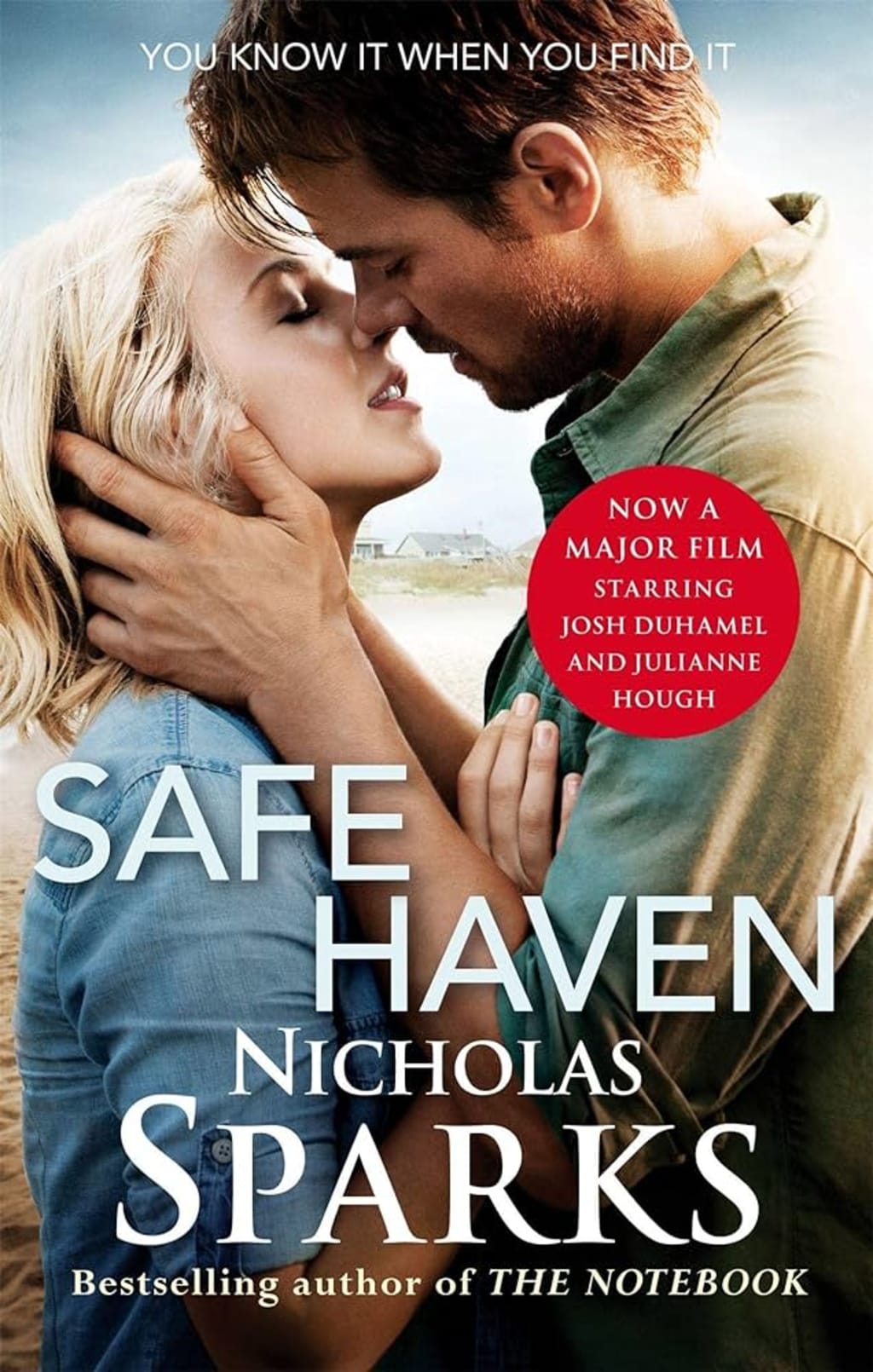
"Safe Haven" by Nicholas Sparks
Page to Screen Book Club

About the Book/Movie:
In a small North Carolina town, a mysterious and beautiful woman running from her past slowly falls for a kind-hearted store owner . . . until dark secrets begin to threaten her new life. When a mysterious young woman named Katie appears in the small North Carolina town of Southport, her sudden arrival raises questions about her past. Beautiful yet self-effacing, Katie seems determined to avoid forming personal ties until a series of events draws her into two reluctant relationships: one with Alex, a widowed store owner with a kind heart and two young children; and another with her plainspoken single neighbor, Jo. Despite her reservations, Katie slowly begins to let down her guard, putting down roots in the close-knit community and becoming increasingly attached to Alex and his family. But even as Katie begins to fall in love, she struggles with the dark secret that still haunts and terrifies her . . . a past that set her on a fearful, shattering journey across the country, to the sheltered oasis of Southport. With Jo's empathetic and stubborn support, Katie eventually realizes that she must choose between a life of transient safety and one of riskier rewards . . . and that in the darkest hour, love is the only true safe haven.
Book vs. Movie:
Character Backgrounds:
- Book: The novel provides more detailed backgrounds for the characters, offering additional insights into their histories, motivations, and relationships.
- Movie: Due to time constraints, the film may condense or streamline certain character backgrounds.
Narrative Structure:
- Book: The novel employs first-person narration by the main character, Katie. This allows readers to delve into her inner thoughts and emotions.
- Movie: The film relies on visual storytelling and external actions, as it cannot convey the same level of internal monologue as the book.
Character Relationships:
- Book: Relationships, especially Katie's interactions with her neighbor Jo, are explored in greater detail.
- Movie: While the film captures the essence of these relationships, it may not delve as deeply into certain character dynamics.
Flashbacks:
- Book: Flashbacks are used in the novel to provide context and background information about Katie's past.
- Movie: Flashbacks are also present in the film, but their frequency, duration, or content may differ from those in the book.
Ending Details:
- Book: The book's ending provides additional details about the characters' futures, allowing readers to gain more insight into their lives after the main events.
- Movie: The film may offer a more concise resolution, focusing on the central story without providing as much detail about the characters' post-story lives.
Internal Thoughts:
- Book: Readers have direct access to Katie's internal thoughts, fears, and reflections throughout the narrative.
- Movie: Visual storytelling and dialogue replace the internal monologues, and certain nuances of Katie's thoughts may not be as explicitly conveyed.
Depiction of Certain Events:
- Book: The book may provide more detailed and nuanced descriptions of specific events, locations, and character emotions.
- Movie: Visual and auditory elements in the film depict events in a way that complements the book but may offer a more condensed or streamlined version.
Character Appearances:
- Book: Readers form their own mental images of the characters based on Sparks's descriptions.
- Movie: The visual medium provides a specific interpretation of character appearances, and the actors' portrayals influence how audiences perceive the characters.
Cinematic Adaptations:
- Movie: Cinematic adaptations often involve changes to enhance visual storytelling, pacing, and overall cinematic appeal. Certain scenes or details may be modified or excluded for the sake of the film's structure.
Discussion Questions:
General Questions:
Adaptation Choices:
- How did the filmmakers interpret Nicholas Sparks's novel in their adaptation? Discuss any changes in terms of storytelling, pacing, and characterization.
Character Portrayals:
- Compare the portrayals of the main characters, Katie and Alex, in the book and the movie. Did the actors capture the essence of the characters as described in the novel?
Visual Representation:
- Discuss the visual representation of the settings and scenes in the movie. How did your imagination compare to the way locations and events were presented on screen?
Narrative Changes:
Changes in Plot or Scenes:
- Identify any significant changes in the plot or specific scenes between the book and the movie. Were there omissions, additions, or alterations that stood out to you?
Character Development:
- Analyze the character development in both the book and the movie. Did any characters undergo more significant changes or have different arcs in one version over the other?
Pacing and Timing:
- Consider the pacing of the story in both the book and the movie. Were there differences in the timing of events or the flow of the narrative?
Visual and Cinematic Aspects:
Visual Style:
- Discuss the visual style of the movie. How did the cinematography, set design, and overall aesthetics contribute to the storytelling?
Music and Soundtrack:
- Explore the role of the soundtrack in the movie. How did the music enhance or complement the emotional moments, and did it align with the tone of the book?
Setting and Atmosphere:
- Consider how the movie captured the atmosphere of the settings described in the book. Did the film successfully transport you to the coastal town and evoke the same emotions as the novel?
Comparative Questions:
Faithfulness to the Source Material:
- Compare the faithfulness of the adaptation to Nicholas Sparks's original novel. Were there aspects that stayed true to the source material, and were there liberties taken for cinematic purposes?
Impact of Internal Thoughts:
- In the book, readers have access to characters' internal thoughts. Discuss how the movie compensated for this absence of internal monologues and whether it affected the storytelling.
Themes and Emotions:
- Explore the central themes and emotional aspects of the story. Did both the book and the movie effectively convey the themes of love, healing, and second chances?
Personal Preferences:
Personal Preferences:
- Which version did you prefer, and why? Were there elements from the book that you missed in the movie, or vice versa?
Changes for Cinematic Appeal:
- Discuss any changes made in the adaptation that you think were made for cinematic appeal. How did these changes impact the overall viewing experience?
About the Creator
Kristen Barenthaler
Curious adventurer. Crazed reader. Librarian. Archery instructor. True crime addict.
Instagram: @kristenbarenthaler
Facebook: @kbarenthaler
Keep reading
More stories from Kristen Barenthaler and writers in BookClub and other communities.
"Carrie" by Stephen King
About the Book/Movie: A modern classic, Carrie introduced a distinctive new voice in American fiction -- Stephen King. The story of misunderstood high school girl Carrie White, her extraordinary telekinetic powers, and her violent rampage of revenge, remains one of the most barrier-breaking and shocking novels of all time.
By Kristen Barenthaler2 years ago in BookClub
Rachel Reviews: Lunch Tales: Teagan by Lucille Guarino
Well, I did enjoy this! Sometimes, all you need is just great storytelling and this is what Lucille Guarino delivers here. There's no big message to this book; it's just about folks and families, living their lives and coping with everything that's being thrown at them and finding their way. But when it's done well, like it is here, then you have characters to whom you can relate, tension which leaves you rooting for a better outcome, attraction which has your heart racing and an urge, as a reader, to see the characters happy with the people with whom they belong.
By Rachel Deeming7 days ago in BookClub
7 Gripping Books You Must Read In 2026
In a world overflowing with content, finding books that truly captivate, inspire, and transform can feel like searching for hidden treasure. Whether you're seeking a thrilling escape, profound insights, or a fresh perspective on life, the right book can reshape your thinking and ignite your imagination. Below is a list of 7 gripping books you must read in 2026. These selections are not just entertaining—they are intellectually and emotionally compelling, designed to leave a lasting impact.
By Diana Meresc7 days ago in BookClub
The Pride Flag and the Diversion
For nearly a decade, the LGBTQIA Pride Flag rippled in the wind at Christopher Park, a kaleidoscope of color staked into the soil of America’s first national monument to LGBTQIA+ liberation. That flag came down this week. Federal officials, citing new guidance from the Trump Administration, silently lowered the rainbow flag from its pole across the street from the Stonewall Inn. The birthplace of the modern gay rights movement now flies only the United States flag.
By Tim Carmichael2 days ago in Pride


Comments
There are no comments for this story
Be the first to respond and start the conversation.