
The Grigori
The Watchers Who Walked the Line Between Heaven and Earth

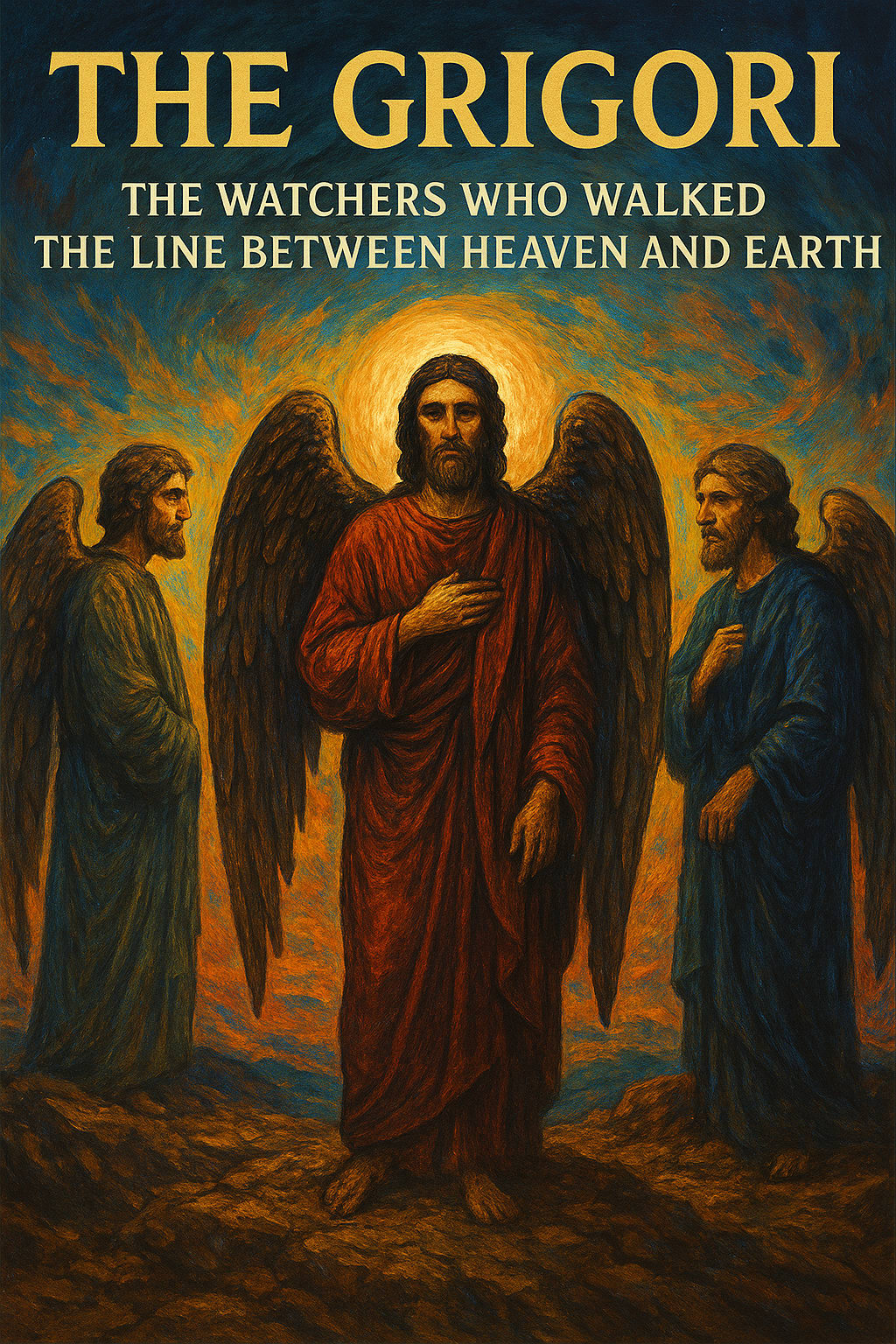
A Forgotten Chapter of Early Sacred Lore
Ancient traditions often survive in scattered remnants, carried forward through fragile manuscripts and the persistence of collective memory. The account of the Grigori, known as The Watchers in early Jewish writings, belongs to this older layer of mythic material. The most extensive narrative appears in the Book of Enoch, a work produced during the Second Temple period, likely between the third and first centuries BCE. Portions of this same text were later recovered among the Dead Sea Scrolls at Qumran, confirming that communities of the era, including the Essenes, regarded the Watcher tradition as meaningful enough to copy and preserve by hand.
Within early Jewish cosmology, the Watchers formed a distinct order of celestial beings. Texts describe these figures as sentinels stationed near the boundary between the heavenly realm and the developing human world. Their responsibilities centered on vigilance, oversight, and the maintenance of order during the earliest stages of human society. This portrayal marks an important period in the development of angelology, when Jewish thinkers began outlining structured ranks, specialized functions, and complex relationships among celestial beings.
The Watcher tradition also reflects influences from the broader ancient Near East. Earlier cultures such as Mesopotamia and Canaan recorded accounts of intermediary beings who oversaw human communities, guarded sacred boundaries, or introduced specialized knowledge. Although the Grigori narrative developed within a uniquely Jewish framework, the presence of similar motifs in surrounding cultures suggests an older, shared fascination with powerful figures who moved between divine and earthly realms.
Scholars, historians, and practitioners of various spiritual paths continue to examine the Grigori for insight into the evolution of early Jewish thought, the origins of angelic hierarchies, and the role of celestial guardians within sacred literature. Few surviving traditions offer such a detailed picture of beings portrayed as watchers, custodians, and intermediaries at a time when the foundations of human civilization were still being shaped.
Who Were the Grigori?
The term Grigori traces back to the Greek word egrēgoroi, a term meaning “watchers” or “those who remain awake.” The name reflects a role rooted in vigilance rather than action. In Aramaic and Hebrew sources, these beings appear as the Irin, a title closely related to the verb ʿur, meaning “to watch” or “to be alert.” Early Jewish writings describe this group as a class of celestial custodians positioned between the higher divine realm and the world inhabited by early human communities.
The most extensive account of the Grigori appears in the Book of Enoch, a text composed during the Second Temple era and preserved in both Ethiopian manuscripts and fragments discovered at Qumran. This work outlines a group of two hundred Watchers who receive a charge to observe the growing human population. Their placement near the earthly realm positions them as intermediaries with direct access to the lives of early societies.
According to the Enochic narrative, this close proximity alters the nature of their assignment. The Watchers begin to feel drawn toward the beauty and vitality of human life. The story names Samyaza as the leader who initiates an oath-binding agreement among the group. This pact ensures that each member accepts responsibility for the descent to the human world, preventing any single being from bearing the consequences alone. This detail reflects a longstanding theme in ancient literature concerning collective oaths and shared accountability among divine beings.
The account continues with descriptions of unions between the Watchers and mortal women. These unions produce the Nephilim, described in the text as large, powerful beings whose presence places strain on early human society. The Book of Enoch characterizes these offspring as figures of immense strength who disrupt the natural order through violence and unchecked appetite. These depictions parallel older Near Eastern traditions involving semi-divine giants, suggesting that the Enochic writers drew from a wider cultural memory.
The narrative also records the transmission of specialized knowledge from the Watchers to humankind. The figure Azazel receives particular attention for introducing techniques related to metalworking, weapon crafting, and the use of decorative adornments. Other Watchers teach various practices associated with astronomy, enchantment, root lore, and celestial calculation. Although these skills would later become valued within many ancient cultures, the Enochic authors portray them as gifts delivered prematurely and without divine sanction. This unsanctioned transfer of knowledge becomes a key factor in the breakdown of harmony between the human and celestial realms.
Over time, the combination of intermingling and instruction creates widespread instability. The Book of Enoch describes an environment marked by increasing violence, moral distortion, and a growing distance between humanity and the sacred order established at creation. The Watchers, once depicted as guardians, become sources of disruption. Their actions ultimately lead to their confinement according to the narrative, establishing one of the earliest and most influential examples of celestial rebellion in ancient Jewish literature.
The Grigori tradition provides a detailed portrait of beings situated at a fragile boundary between duty and desire, authority and fascination, sanctity and transgression. This complexity explains why the Watchers remain one of the most studied groups within early angelology and continue to occupy a significant place in the broader history of ancient religious thought.
A Timeline of the Grigori Mythos:
200–100 BCE: Formation of the Book of Enoch
During the Second Temple era, the stories of the Grigori were gathered into what is now known as the Book of Enoch, or 1 Enoch. The book was written in stages, likely by several authors from different Jewish communities. Linguistic studies of the surviving fragments in Aramaic, found among the Dead Sea Scrolls, indicate that the material is older than the compiled text. The Watchers appear as celestial beings stationed near the heavenly throne who descend to earth out of curiosity, desire, and misplaced devotion. This period marks the first time the full arc of the Watchers’ fall, the birth of the Nephilim, and the resulting flood narrative were woven together into a unified mythic structure.
1st Century CE: Early Christian Engagement
Writers in the early Christian world show clear familiarity with Enochic traditions. The Epistle of Jude quotes 1 Enoch directly, which suggests that Enochic lore was accepted in certain early communities. Church Fathers such as Justin Martyr, Athenagoras, and Clement of Alexandria discussed the Watchers while explaining the origin of evil, the nature of angels, and the corruption of humanity. Although the Book of Enoch was respected, it did not secure a place in the developing canon of the Western Church. Even so, the story of angels who break divine boundaries influenced emerging Christian ideas about free will, temptation, and the consequences of unchecked spiritual ambition.
4th Century CE: Removal from Western Canon
As church councils shaped the authoritative scriptural canon, 1 Enoch fell out of circulation in the West. The book remained important in the Ethiopian Orthodox Church, where it continued to be copied, studied, and regarded as sacred. Meanwhile, in Europe and the Mediterranean, knowledge of the Watchers persisted mainly through earlier Christian commentaries and occasional references in theological debates about angelic rebellion. The core narrative survived, but it lived on the fringe rather than at the center of doctrinal teaching.
The Middle Ages: Integration into Mysticism, Folklore, and Occult Tradition
During the medieval period, the Watchers gradually entered the worlds of Jewish mysticism, early Kabbalistic speculation, and European occult manuscripts. Medieval angelology often categorized celestial beings into ranks, sometimes naming specific Watchers among the fallen or the exiled. Their story influenced discussions about forbidden wisdom, the origins of sorcery, and the dangers associated with seeking knowledge not intended for humanity. In several demonological catalogues, figures with Watcher origins were listed among those who taught humans enchanted arts or destabilizing forms of knowledge. Although these medieval interpretations differed from the original Enochic accounts, they kept the memory of the Watchers alive through new cultural lenses.
18th–20th Century: Rediscovery, Translation, and Academic Study
Interest in the Grigori surged again after the Scottish explorer James Bruce brought several copies of the complete Ethiopic Book of Enoch to Europe in the late eighteenth century. This discovery allowed scholars to compare the Ethiopic text with the Greek and Aramaic fragments already known. Translations soon followed, and researchers began studying the Watchers within the wider context of Near Eastern mythology, apocalyptic literature, and ancient cosmologies. Some scholars compared the Grigori to Mesopotamian apkallu figures, who were also described as divine beings who taught humans advanced knowledge. Occult groups in the nineteenth and early twentieth centuries adopted Watcher imagery into their symbolic and ritual systems, blending academic discovery with esoteric innovation.
21st Century: Revival Across Culture and Spirituality
The Watchers have taken on new life in contemporary culture. Their story appears in novels, film series, graphic retellings, and new religious movements. Modern Pagan and metaphysical communities often explore the Grigori as archetypes associated with boundary-breaking, lost wisdom, or fallen spiritual authority. Interest in the Watchers reflects a broader fascination with ancient texts that once sat on the edge of orthodoxy. The myth continues to shape conversations about cosmic order, moral complexity, and the enduring human impulse to seek knowledge held beyond reach.
Archaeological and Textual Evidence Behind the Tradition
The story of the Watchers is preserved in a remarkable tapestry of texts and fragments that stretch across centuries. The most complete narrative survives in the Book of Enoch, particularly the section known as the Book of the Watchers, which was composed during the Second Temple period, roughly between 200 and 100 BCE. While the full text was lost to Western Christianity for centuries, it survived in Geʽez manuscripts, preserved by the Ethiopian Orthodox Church, providing modern scholars with a direct window into early Jewish apocalyptic thought.
Fragments of the Book of Enoch in Aramaic were also discovered among the Dead Sea Scrolls at Qumran, confirming that the Watcher tradition circulated widely among Jewish sects of the time, including groups like the Essenes. These fragments reveal textual variations that illuminate how communities understood the angels’ descent, the rise of the Nephilim, and the subsequent judgment. Additional scrolls, such as the Book of Giants, expand on the story of the hybrid offspring, offering insight into the fears, symbolism, and moral lessons embedded in these narratives.
Archaeology complements textual evidence. For example, artifacts and iconography from Mesopotamia depict semi-divine figures in roles similar to the Watchers, teaching humans crafts or sciences. These visual records support the notion that the concept of intermediary beings bridging the divine and mortal realms was culturally widespread in the ancient Near East. Linguistic studies of Hebrew, Aramaic, and Geʽez further reveal subtle shifts in meaning, showing how the titles Irin, Grigori, and Nephilim were understood differently over time.
Together, textual and archaeological evidence demonstrates that the Watcher narrative is more than mythic storytelling. It is a reflection of ancient human attempts to explain the origins of knowledge, power, and moral complexity. These materials also allow modern readers to trace the development of angelology, the origins of apocalyptic literature, and the ways in which divine-human interactions were conceptualized in ancient societies. By studying the texts alongside material evidence, the story of the Watchers emerges as a dynamic, historically grounded tradition, revealing both the imagination and the moral concerns of the cultures that preserved it.
Controversies and Scholarly Debates
The story of the Watchers has long inspired debate among scholars, theologians, and historians. One central controversy revolves around the origins of the Grigori narrative. Some researchers argue that the story reflects an indigenous Jewish development during the Second Temple period, while others emphasize parallels with Mesopotamian apkallu myths, suggesting cultural borrowing or shared Near Eastern motifs. The question of influence extends further, with comparative mythology showing similar tales of divine beings who interact with humans, produce hybrid offspring, or challenge cosmic order across Canaanite, Greek, and Persian traditions.
Another area of debate concerns the interpretation of Genesis 6:1–4, the brief biblical reference to “the sons of God” and the Nephilim. Scholars disagree on whether these verses originally referred to angels, descendants of Seth, or a combination of symbolic figures. The Book of Enoch, composed later, elaborates the story dramatically, creating tension for historians trying to distinguish between canonical scripture, apocryphal tradition, and popular interpretation.
The nature and purpose of the Watchers’ instruction also sparks discussion. Were these teachings meant to convey moral warnings, allegorical lessons, or actual historical traditions about early knowledge of crafts, astronomy, and metallurgy? Some argue that the Enochic text frames the angels’ knowledge as inherently corrupting, while others suggest that the narrative reflects human anxiety about rapid cultural and technological development.
Scholars also debate the role of later interpreters, including Church Fathers who rejected the Book of Enoch from the Western canon. Some suggest the text was suppressed due to its theological implications, particularly its portrayal of angels in morally ambiguous roles. Others argue the book was excluded simply because it did not fit the emerging criteria for authoritative scripture, leaving the Watchers’ story to survive in peripheral traditions.
Finally, modern debates touch on the symbolic versus literal interpretation of the Watchers. While some researchers treat the narrative as mythic allegory, others approach it as an early record of angelology or even proto-historical speculation about hybrid beings. The continuing interest in the Watchers reflects the tension between literal, moral, and symbolic readings, a debate that has persisted for more than two millennia.
Engaging with these controversies allows readers to see the Watchers not as fixed figures but as a dynamic narrative subject to interpretation, adaptation, and scholarly inquiry. Their story continues to challenge assumptions about divine-human interaction, the transmission of knowledge, and the boundaries of spiritual authority.
The Legacy of Enochian Lore in Magic and Metaphysics
The story of the Watchers did not remain confined to ancient texts or religious debate. Over the centuries, the Enochian tradition became a cornerstone for mystical and magical systems, shaping ideas about angels, hidden knowledge, and spiritual hierarchies. In the Renaissance, scholars and occultists such as John Dee and Edward Kelley drew on Enochic material, claiming to receive angelic communications and visions that expanded on the concepts of divine intermediaries. The Watchers, with their association to secret knowledge and forbidden instruction, became archetypal figures in these systems, symbolizing both the dangers and the possibilities of engaging with the unseen world.
During the 17th and 18th centuries, ceremonial magicians and esoteric societies incorporated Enochian lore into ritual practice, often using angelic names, symbols, and cosmological frameworks derived from the texts. The teachings attributed to the Watchers—about celestial order, secret knowledge, and moral responsibility—were adapted into exercises in spiritual insight, moral discipline, and symbolic understanding. In this context, the Grigori represent both caution and inspiration, reminding practitioners that access to higher knowledge carries ethical and spiritual weight.
In modern metaphysical and neopagan communities, the influence of Enochic and Watcher lore continues. Workshops, writings, and spiritual practices often reference the Watchers as archetypes of divine knowledge and human ambition. They appear as symbols in discussions of boundaries between the mortal and the divine, the hidden and the revealed, the seen and unseen. The narrative of their fall and their instruction provides a framework for exploring spiritual awakening, personal responsibility, and the consequences of overreaching curiosity.
The legacy of Enochian lore demonstrates that these stories are not static. They have been reinterpreted, ritualized, and philosophically engaged with across cultures and centuries. From apocalyptic literature to ceremonial magic, the Watchers serve as enduring reminders that knowledge, power, and desire are intertwined, and that the pursuit of wisdom is inseparable from ethical responsibility. Studying their influence in magical and metaphysical traditions reveals the depth and flexibility of a myth that continues to resonate far beyond its textual origins.
Key Terms:
Watchers / Grigori
A class of celestial beings described in early Jewish literature, particularly in the Book of Enoch. Their original role involved observing human activity, safeguarding creation, and functioning as intermediaries between the heavens and the earthly realm. The term reflects their vigilance and their proximity to the divine throne.
Irin
An Aramaic and Hebrew word meaning “those who watch.” This term appears in the Book of Daniel and later Jewish texts. In several ancient sources, the Irin are portrayed as awake, alert, and fixed in their purpose. The name became closely linked with the Grigori in Enochic traditions, reflecting their shared function as heavenly observers.
Nephilim
The offspring of the Watchers and human women. The Nephilim are described in Genesis and fully developed in the Book of Enoch as giant figures known for physical strength, destructive tendencies, and extraordinary size. They became symbolic of the imbalance caused by crossing the boundaries between divine and human realms.
Samyaza (Semjaza)
A leader of the Watchers who organizes the descent to earth. In Enochic texts, Samyaza is portrayed as a figure burdened by responsibility. Once the pact is made, he cannot turn back, and his actions set the entire narrative of corruption and judgment into motion. His name appears in several variations across ancient manuscripts.
Azazel
A central Watcher associated with teaching metalworking, weapon craft, and ornamentation. The Book of Enoch holds Azazel responsible for revealing knowledge that contributed to the moral decline of humanity. The name also appears in the Hebrew Bible in relation to the scapegoat ritual, though scholars debate whether the two figures share a common origin.
Enochian Tradition
A collection of writings and mystical teachings linked to the figure of Enoch, the seventh patriarch from Adam. The tradition includes 1 Enoch, 2 Enoch, and 3 Enoch, along with later angelological systems influenced by these works. Enochic literature explores themes of judgment, cosmology, celestial hierarchy, and the transmission of hidden knowledge.
Fallen Angels
A general category used in Jewish and Christian writings to describe angels who rebel or break divine law. The Grigori belong to one specific lineage of fallen beings, distinct from later traditions associated with Satan or other rebellious angels. Their fall centers on desire, curiosity, and the disclosure of heavenly secrets.
Apkallu
A term from ancient Mesopotamian mythology referring to semi-divine sages who taught humans arts, crafts, and sacred knowledge. Some scholars compare the apkallu to the Watchers due to their shared role as bringers of instruction. Although the two traditions come from different cultures, parallels between them appear in historical studies of ancient Near Eastern myth.
Sons of God
A phrase appearing in Genesis and in other Hebrew texts. In early interpretations, this term referred to divine or semi-divine beings associated with the heavenly court. The Watchers are often linked to this title when analyzing the origins of the Nephilim narrative.
Book of the Watchers
The first major section of 1 Enoch, containing the full account of the descent of the Grigori, the rise of the Nephilim, the corruption of the natural world, and the intervention of archangels. This portion forms the backbone of the Watcher mythos and is considered one of the oldest and most influential apocalyptic narratives from the Second Temple period.
Key Influences That Shaped the Watcher Narrative:
Ancient Near Eastern Mythology
The world that produced the Watcher story drew from a landscape filled with tales of divine beings who crossed boundaries between heaven and earth. Mesopotamian myths describe the apkallu, wise semi-divine figures who taught humanity skills such as agriculture, writing, and temple arts. Canaanite legends speak of gods who took mortal lovers, and Greek mythology is rich with stories of Titans, demigods, and celestial defiance. These cultural motifs created a backdrop in which the idea of heavenly beings interacting with humans felt both familiar and symbolically powerful. The Watchers stand at the crossroads of these traditions, shaped by a shared fascination with divine transgression and hybrid offspring.
Early Jewish Apocalyptic Literature
The Book of Enoch emerged during a time when Jewish writers explored cosmic order, angelic hierarchies, and divine judgment. This period produced visions of heavenly journeys, symbolic beasts, and sweeping prophecies about the fate of the world. The Watchers fit naturally into this apocalyptic imagination. Their actions serve as a dramatic example of what happens when cosmic laws are broken. The narrative offers a theological explanation for chaos in the human world and reflects a growing interest in the role of angels as active participants in history. These writings influenced later traditions, including early Christianity and various streams of Jewish mysticism.
Biblical Allusions
Genesis 6:1–4 contains a brief and enigmatic passage describing the “sons of God” taking human women and fathering mighty offspring. The text does not elaborate on who these beings were or why their actions mattered, which left later readers searching for answers. Early interpreters turned to oral traditions and expanding mythic material, eventually shaping the Watcher narrative found in 1 Enoch. This short biblical reference became the seed from which an entire mythological framework grew. The Watchers became the most detailed expression of this early idea, filling gaps left by the brevity of the Genesis account.
Kabbalistic and Mystical Traditions
Medieval Jewish mysticism approached angels and divine structures with careful detail, constructing elaborate models of the spiritual universe. While the Watchers themselves do not appear directly within classical Kabbalah, themes associated with them persisted. Questions about cosmic rebellion, the origin of destructive forces, and the boundary between heavenly and earthly realms were central to mystical inquiry. Some later texts, including writings influenced by the Hekhalot and Merkavah traditions, preserved echoes of older angelic lore. Through these intellectual and spiritual developments, aspects of the Watcher myth continued to influence how mystical thinkers understood fallen or estranged celestial beings.
Modern Occult Revival
From the nineteenth century onward, esoteric scholars, ceremonial magicians, and eventually neopagan communities revisited the Watcher narrative with fresh eyes. The rediscovery of the Book of Enoch inspired renewed interest in angelology and ancient cosmology. Occult writers incorporated Watcher figures into symbolic systems that explored forbidden knowledge, inner shadow work, and the tension between spiritual potential and overreaching ambition. In contemporary metaphysical circles, the Grigori often represent the costs and consequences of crossing sacred thresholds. These modern interpretations vary widely, but all reflect the enduring power of a myth that continues to invite new meaning.
The Watchers in Comparative Mythology
The story of the Grigori is part of a broader pattern found across ancient mythologies, where divine or semi-divine beings cross the boundary between heaven and earth. In Mesopotamian texts, the apkallu or “sages” serve as instructive figures sent by the gods to teach humans arts, agriculture, and literacy. Some of these beings, like the Grigori, are described as overstepping their intended role, and in certain traditions, their actions have unintended consequences for humanity. The parallels suggest that the idea of supernatural teachers who bring both gifts and risk was a common theme in the ancient Near East.
Canaanite mythology presents gods and goddesses engaging with humans in ways that produce hybrid offspring or heroic figures, often creating tension between divine authority and mortal existence. Similarly, in Greek myth, stories of Titans, gods, and demigods—such as Zeus fathering heroes or semi-divine figures through unions with mortals—reflect comparable concerns with divine-human interaction and the consequences of crossing cosmic boundaries. These myths, like the Grigori narrative, wrestle with themes of power, desire, and responsibility, highlighting universal questions about the interplay of the divine and mortal worlds.
Some scholars have noted that the motif of “fallen teachers” extends beyond the Near East. In Persian tradition, angels or semi-divine beings occasionally challenge the divine order, bringing knowledge or tools to humanity that create both advancement and disruption. Similarly, Manichean and Gnostic texts often depict celestial figures whose gifts come at a moral or spiritual cost, echoing the narrative of forbidden knowledge central to the Watcher mythos. Across cultures, these stories illustrate that humanity’s fascination with beings who bridge the mortal and the divine is not isolated but part of a shared symbolic language.
Examining the Grigori alongside these parallel traditions illuminates their significance. They are not simply a Jewish or Christian invention; they participate in an ancient dialogue about the consequences of transgression, the allure of forbidden wisdom, and the fragile boundary between cosmic order and human ambition. Comparative mythology situates the Watchers within a global pattern of stories that probe ethical, spiritual, and cosmic questions, reinforcing the enduring relevance of their legend.
Key Individuals:
Samyaza (Semjaza)
A central figure in the Watcher narrative, Samyaza serves as the leader who gathers the other angels into a pact before descending to earth. His role captures the tension between authority and desire, since he acts with full awareness of the consequences. In several manuscripts, Samyaza hesitates at first, knowing that judgment will fall heavily on the instigator. His leadership becomes a lesson in the burdens carried by those who guide others into transgression.
Azazel
Azazel emerges in the Book of Enoch as a figure closely linked to the spread of destructive knowledge. He teaches humans metalworking, the crafting of weapons, and the creation of ornamental cosmetics associated with vanity and warfare. These gifts accelerate social corruption and violence. Later interpretations connect Azazel to the scapegoat ritual described in Leviticus, though the relationship between the two is debated. In Enochic tradition, Azazel is bound and cast into a remote place where he awaits final judgment.
Armaros (Armaros, Armoni)
Listed among the Watchers, Armaros is credited with teaching humans the “resolving of enchantments.” This phrase has been interpreted by scholars as a reference to early techniques for breaking spells or undoing harmful rituals. His presence suggests that the Watchers introduced not only new arts but new spiritual vulnerabilities, along with the means to counter them.
Penemue
Penemue appears as a teacher of writing and wisdom. Some translations say he revealed “the bitter and the sweet,” a phrase understood as knowledge of moral discernment or the complexities of human experience. His instruction symbolizes the transformative power of literacy and the dual-edged nature of knowledge.
Sariel (Suriel)
A Watcher whose name appears in several Enochic lists, Sariel is often associated with lunar cycles, celestial order, and guidance. Later traditions identify him as an angel who teaches humankind about the movement of the moon and the regulation of time. His teachings suggest an early interest in astronomy woven into the Watcher myth.
Kokabiel (Kochabiel)
A prominent figure described as an instructor of constellation lore. Kokabiel is associated with astral knowledge and was believed to preside over a vast host of stars. His teachings reflect the ancient connection between celestial observation and sacred wisdom.
Baraqiel
A Watcher linked to the understanding of lightning and weather. His name, meaning “lightning of God,” hints at the powerful, unpredictable forces attributed to him. In some interpretations, Baraqiel represents the transmission of natural science or atmospheric observation.
Tamiel (Temeluchus)
A Watcher associated with deeper forms of wisdom, including the “seeing of spirits” or instruction in hidden realms. In certain texts, Tamiel becomes connected with esoteric knowledge that bridges the physical and spiritual worlds.
The Nephilim
A collective rather than individual group, the Nephilim represent the offspring of Watchers and human women. Described as giants or mighty warriors, they are linked to violence that spreads across the earth. Their presence becomes a catalyst for divine intervention, symbolizing imbalance between the mortal and the divine.
Enoch
Although not a Watcher, Enoch stands at the heart of the narrative. As the seventh patriarch after Adam, he serves as mediator, witness, and scribe. The Book of Enoch presents him as a visionary taken into heavenly realms to record the fate of the Watchers. His role anchors the text in human lineage while granting access to cosmic judgment.
Book Recommendations: #commissionearned
This edition presents the complete First Book of Enoch as translated by the respected nineteenth century scholar R. H. Charles, whose work remains one of the most referenced English versions in academic and theological circles. The text offers a detailed look at the Watchers, the descent of the angels, and the rise of the Nephilim, making it essential for understanding the earliest full narrative of these beings. Its vivid accounts of cosmic journeys, angelic hierarchies, and divine judgment shaped later Jewish mysticism and early Christian thought. For a blog focused on the Watchers, Samyaza, Azazel, and their legacy, this book provides the core primary material. It also sets the foundation for how later traditions interpreted angelic rebellion. By reading the complete work, you gain a sense of how ancient writers wove myth, warning, and theology into a single apocalyptic vision.
Elizabeth Clare Prophet explores how the Enochic tradition influenced early interpretations of fallen angels and why some strands of Christian leadership resisted its inclusion in the biblical canon. The book blends historical commentary with theological reflection, presenting the Watchers as central figures in understanding ancient explanations for evil and corruption. While Prophet writes from a spiritually inclined perspective, she discusses genuine early Christian debates about angelology and scriptural authority. For readers studying Samyaza’s leadership or Azazel’s teachings, this text helps explain how these figures moved from ancient Jewish literature into later esoteric and occult traditions. It adds context about how ideas from Enoch resurfaced in medieval magic and modern metaphysics. The work offers an accessible entry into the religious and historical tensions surrounding Enochic lore.
A Dictionary of Angels: Including the Fallen Angels by Gustav Davidson
First published in 1967, Davidson’s dictionary remains one of the most comprehensive English reference works on angelic names and lore. Drawing from Jewish, Christian, Islamic, and occult sources, it provides brief but reliable entries on thousands of angels, including Samyaza, Azazel, Penemue, and many lesser known Watchers. Davidson presents variant spellings, historical origins, and appearances in mystical texts, making it invaluable for research. The entries help clarify how different traditions remembered or reshaped the Watchers and their offspring. For a blog exploring the shifting identity of fallen angels across cultures, this dictionary serves as a trustworthy guide. It also helps distinguish between early Enochic material and later occult reinterpretations.
Angels: A Very Short Introduction by David Albert Jones
David Albert Jones, a scholar of theology and religious history, offers a concise but thoughtful overview of angels in Judaism, Christianity, and Islam. The book places fallen angels in a broader religious framework, explaining how beliefs about heavenly beings developed across centuries. While it does not focus exclusively on the Watchers, it provides important context for understanding how Samyaza, Azazel, and similar figures were viewed in mainstream theology compared to apocalyptic literature. Jones explains the difference between orthodox doctrine and speculative angelology, which helps readers see why Enoch’s narrative remained outside the biblical canon. The work complements more esoteric sources by grounding the topic in historical scholarship. It also highlights how ideas about angels continue to shape modern spiritual imagination.
Jeremy Payton presents translations and commentary on the fragmented but fascinating Book of Giants, a text found among the Dead Sea Scrolls that expands the story of the Nephilim. The work recounts the dreams, conflicts, and downfall of these hybrid beings, offering rare insight into how ancient writers imagined the consequences of the Watchers’ actions. Payton includes comparisons with the Manichaean version of the text, which preserves additional material not found at Qumran. For anyone studying the Nephilim as more than a passing reference, this book is indispensable. It deepens the portrayal of the giants as tragic, violent, and ultimately doomed figures within the Enochic tradition. The commentary helps readers understand how these stories shaped later mystical and apocalyptic narratives.
Michael S. Heiser, a scholar of ancient Semitic languages, introduces readers to the concept of the divine council and the supernatural framework that underlies much of the Hebrew Bible. While not dedicated solely to the Watchers, his explanation of rebellious divine beings connects directly to Enochic themes. Heiser discusses how passages in Genesis, Daniel, and other books hint at older traditions that align with the stories of Samyaza, Azazel, and the Nephilim. The book bridges academic scholarship with readable commentary, making complex ideas approachable without oversimplification. For a blog exploring how the Enoch tradition fits within the wider biblical world, this work provides essential background. It shows how ancient writers understood spiritual rebellion and its effects on humanity.
The Watchers Remain
The legacy of the Grigori endures because their story touches something perennial in the human imagination. They represent the tension between divine order and personal will, between forbidden knowledge and the temptation to reach for more than one is permitted. Their tale is not simply about rebellion but about the complex consequences that unfold when wisdom is given without guidance and power is taken without restraint. Across ancient Judaism, early Christianity, mystical sects, and later esoteric traditions, the Watchers appear in shifting forms, yet the core of the story remains a meditation on responsibility and desire.
Over time, different cultures shaped the Watchers into new roles. Some traditions cast them as fallen instructors whose ambition disrupted the harmony between the divine and the mortal world. Others portrayed them as tragic figures whose longing for humanity led to their downfall. In mystical writings, they become symbols of the dangers and gifts of esoteric knowledge. Their story evolves because it speaks to universal questions about the price of enlightenment and the shadows attached to revelation.
What makes the Grigori especially compelling is that no single version of their tale claims absolute authority. The Book of Enoch presents one of the earliest and most detailed accounts, but later works like the Book of Giants, the Manichaean fragments, and medieval angelological texts reshape the narrative, each adding layers of meaning. Scholars have examined these variations for generations, uncovering connections to Mesopotamian myth, early apocalyptic literature, and the developing structure of angelic hierarchy. The Watchers survive not because their story is fixed but because it adapts, revealing new insights with each retelling.
Their endurance in modern discussions of mythology, magic, and theology shows how deeply the theme resonates. Whether interpreted as cosmic transgressors, bearers of hidden teachings, or cautionary figures, the Watchers challenge readers to consider the boundaries between the sacred and the mortal, the known and the unknown. They mirror our fascination with mysteries that sit just beyond reach and the consequences that come with uncovering them.
As you explore the works inspired by their story, you will find that each author, translator, and tradition offers a different lens. Taken together, these sources form a mosaic that is richer than any single text. Engaging with them side by side reveals how myths grow, evolve, and continue to shape modern spiritual thought.
I encourage you to follow these threads wherever they lead. Read deeply, question boldly, and allow the contrasts between traditions to inform your understanding. In the end, the enduring power of the Watchers lies not in a definitive answer but in the questions they inspire and the centuries of curiosity they continue to awaken.
About the Creator
Marcus Hedare
Hello, I am Marcus Hedare, host of The Metaphysical Emporium, a YouTube channel that talks about metaphysical, occult and esoteric topics.
https://linktr.ee/metaphysicalemporium
Keep reading
More stories from Marcus Hedare and writers in BookClub and other communities.
Tulpas:
Opening the Door to a Very Strange Idea The idea that a person can intentionally create a companion within their own mind can feel unsettling at first glance. It sounds like something that should belong in a fantasy novel or a psychological thriller. Yet human beings have been exploring the boundaries of imagination and inner consciousness for centuries. What we now call a Tulpa began within the rich and complex world of Tibetan spirituality, where advanced meditators were said to produce appearances or forms through disciplined states of awareness. These early ideas did not describe imaginary friends or psychological partners. They were spiritual emanations tied to profound levels of meditative practice and religious purpose.
By Marcus Hedare2 months ago in BookClub
Self Help: Grifters' Gospel
On Self-Help, Snake Oil, and the Illusion of Change Psychology professionals and students can be imagined on two opposite sides of a line called self-help books: likely a larger group opposes pop-science and step-by-step manuals filled with talk of success, journaling, and not giving a f**k; others love them, but they aren’t many.
By Avocado Nunzella BSc (Psych) -- M.A.P a day ago in BookClub



Comments
There are no comments for this story
Be the first to respond and start the conversation.