
When the Stars Forgot to Shine
Finding Light in a Sky Full of Darkness

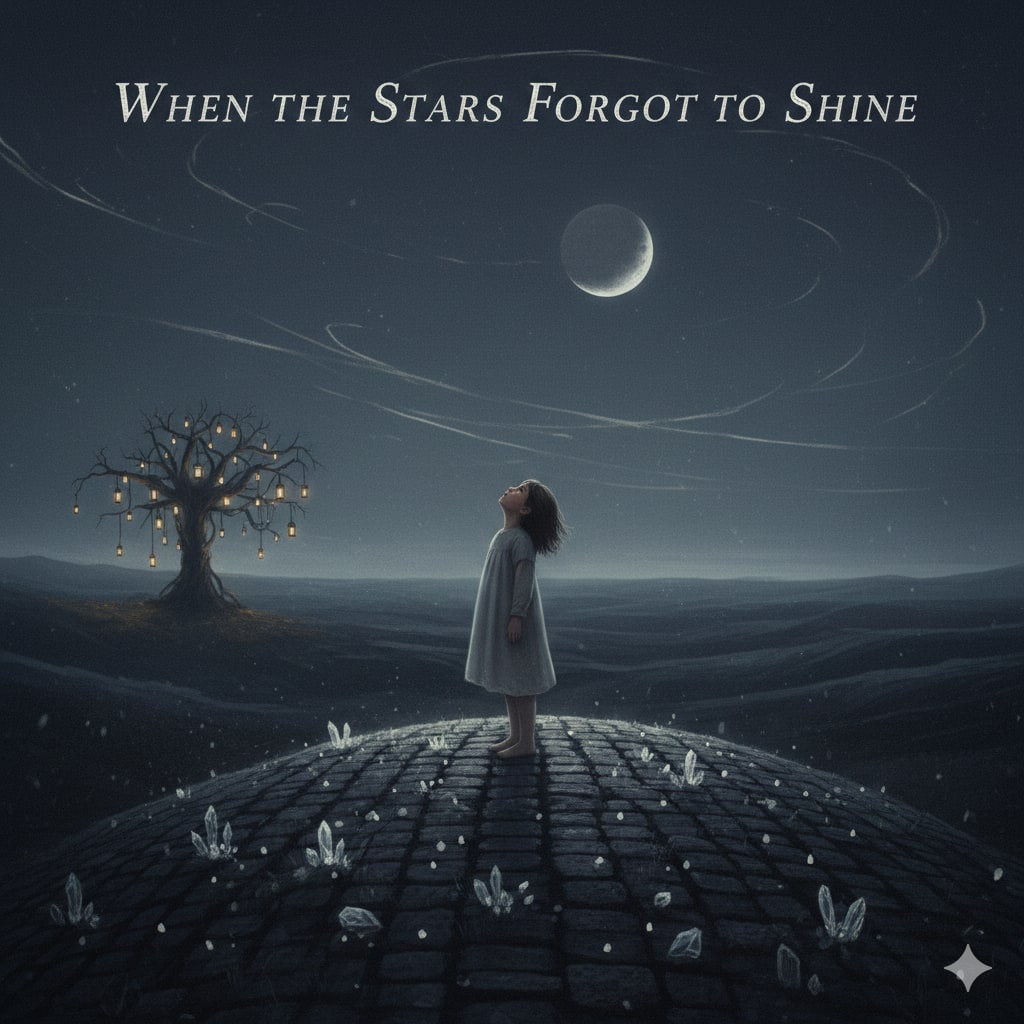
On the night the stars forgot to shine, the world did not end.
It simply grew quiet.
Too quiet.
In a small village surrounded by silent hills and restless winds, a boy named Ayaan stood alone on the rooftop of his house. Every night, he would climb those narrow stairs after dinner, carrying with him a heart full of questions and eyes full of dreams. The sky had always been his comfort. The stars had always been his silent companions.
But tonight, the sky was empty.
No shimmer.
No silver dots scattered across the darkness.
No moon glowing like a gentle guardian.
Just an endless stretch of black.
Ayaan frowned. He blinked several times, thinking perhaps clouds had gathered. But there were no clouds. The air was clear. The wind was still. Yet the heavens looked as if someone had erased the stars one by one.
It felt personal.
For years, Ayaan had spoken to the stars. Not out loud—he wasn’t foolish—but in the quiet corners of his mind. He would tell them about his fears, about the love he never received, about the dreams he carried alone. He had loved someone once, silently, deeply, hopelessly. She never knew. Or perhaps she knew and chose silence.
His love had been like a candle in a storm—burning bravely, but unseen.
And now, even the stars had abandoned him.
He sat down on the cold rooftop floor and hugged his knees. The darkness above mirrored the emptiness inside him. He remembered a line he once read: “When the sky goes dark, perhaps it is waiting for someone to light it again.”
But who lights the sky?
And how?
The next morning, the village buzzed with confusion. People spoke in hushed tones.
“Did you see the sky?”
“No stars at all.”
“Maybe it’s a sign.”
Some feared disaster. Some blamed science. Some whispered of punishment from above.
But Ayaan said nothing.
That night, he returned to the rooftop.
Still no stars.
The darkness seemed heavier now, pressing against his chest. He closed his eyes and tried to imagine them—those distant lights that had once given him hope. He remembered how he used to choose one star and pretend it belonged to his unspoken love. He would imagine her looking at the same sky, unaware that somewhere beneath it, someone was loving her quietly.
But what happens when even imagination fails?
For the first time, Ayaan felt anger.
“Why?” he whispered to the empty sky. “Wasn’t it enough that I loved without being loved back? Wasn’t it enough that I waited without being chosen? Why take the stars too?”
His voice trembled.
Silence answered.
Days turned into weeks.
The sky remained blank.
Crops grew slowly under the sun, but nights were suffocating. Without stars, the village lost something invisible yet essential. Children stopped playing outside after dark. Elders stopped telling stories beneath the open sky. Lovers no longer met under starlight.
It was as if hope itself had dimmed.
One evening, as Ayaan walked through the village, he noticed something unusual. Old Rahim Chacha, who used to sit outside every night counting stars with his granddaughter, now sat alone inside his dimly lit room.
“Why don’t you go outside anymore?” Ayaan asked.
Rahim Chacha smiled weakly. “What is the point, beta? The sky has forgotten us.”
Forgotten us.
The words pierced Ayaan’s heart.
Had the sky truly forgotten them?
Or had they forgotten something first?
That night, Ayaan did not go to the rooftop immediately. Instead, he lit a small lantern in his room. He stared at its fragile flame.
One tiny light.
Yet it pushed back the darkness.
An idea began to form.
The next evening, Ayaan climbed to the rooftop—not alone, but carrying dozens of small lanterns. He placed them carefully along the edges. Then he lit them, one by one.
From a distance, his rooftop glowed like a crown of fire.
Neighbors noticed.
“What is he doing?” someone asked.
But Ayaan did not stop.
The following night, he went door to door.
“Light a lantern on your rooftop,” he told them.
“For what?” they asked.
“For the stars,” he replied simply.
Some laughed. Some refused. But some—especially the children—agreed.
Soon, tiny flames flickered across rooftops throughout the village.
The darkness above remained unchanged.
But below?
Below, something beautiful was happening.
People began stepping outside again. They talked. They shared stories. They laughed at how silly it felt to replace stars with lanterns. Yet in their laughter, there was warmth.
On the seventh night of lantern-lighting, something unexpected occurred.
A little girl tugged at Ayaan’s sleeve and pointed upward.
“Look!”
He raised his eyes.
At first, he saw nothing.
Then—
A faint shimmer.
One small star blinked hesitantly in the vast black sky.
Then another.
And another.
Like shy children returning after a long absence.
The village gasped.
Within minutes, the sky blossomed with light once more. The stars sparkled brighter than anyone remembered. It was as if they had been watching all along, waiting for something.
Waiting for the people to remember how to shine on their own.
Tears filled Ayaan’s eyes—not because the stars had returned, but because he finally understood.
The stars had not forgotten to shine.
They had been reminding them.
Hope is not something you wait for.
It is something you create.
His unreturned love no longer felt like a wound. It felt like proof that his heart was capable of deep light. Even if no one saw it, it still existed. Even if it was not chosen, it was real.
That night, as the sky glittered magnificently above, Ayaan whispered softly:
“I don’t need you to shine for me anymore. I have learned to shine myself.”
And somewhere far beyond human understanding, the stars seemed to glow just a little brighter.
About the Creator
Samaan Ahmad
I'm Samaan Ahmad born on October 28, 2001, in Rabat, a town in the Dir. He pursued his passion for technology a degree in Computer Science. Beyond his academic achievements dedicating much of his time to crafting stories and novels.
Keep reading
More stories from Samaan Ahmad and writers in BookClub and other communities.
The Echo of a Silent Goodbye
Title: The Echo of a Silent Goodbye The hospital corridor smelled of antiseptic and fading hope. Daniel sat alone beneath the pale white lights, his hands clasped so tightly together that his knuckles had turned the color of bone. The world outside the window was moving—cars passing, people laughing, life continuing—but inside him, everything had paused.
By Samaan Ahmada day ago in BookClub
Book Review: Atmosphere by Taylor Jenkins Reid
I flipped the book over in my hands in the centre of the small airport book shop. Although I had heard promising reviews of Atmosphere by Taylor Jenkins Reid, I hesitated. The synopsis didn’t compel me - I wasn’t much of a space girly. In high school it made me cringe when my peers would talk about the stars.
By sleepy drafts21 days ago in BookClub
Moth Dark by Kika Hatzopoulou — Gender-Fluid Fae, Urban Fantasy Intrigue & a Romance That Defies Time
Moth Dark by Kika Hatzopoulou is a breathtaking blend of urban fantasy, nonlinear time, gender-fluid fae, and a love story that bends fate, identity, and reality itself.
By Cyn's Workshop6 days ago in BookClub



Comments
There are no comments for this story
Be the first to respond and start the conversation.