
Benito Mussolini
The Rise and Fall of Fascism in Italy

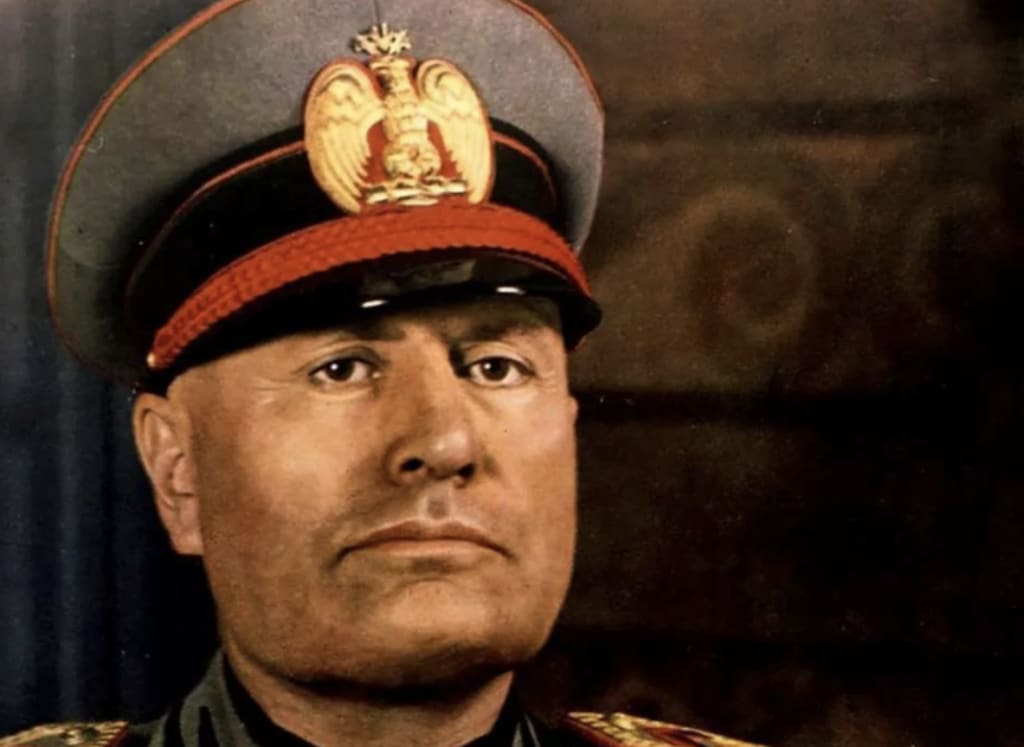
When we think of fascism, one of the first names that comes to mind is Benito Mussolini—the man who dragged Italy into dictatorship, aligned with Hitler, and met a brutal end. His story is a wild ride of power, propaganda, war, and ultimate downfall.
So how did Mussolini go from being a socialist journalist to the founder of fascism? And what led to his dramatic fall? Let’s break it down!
Mussolini’s Rise to Power
Early Life: A Troublemaker from the Start
Born in 1883, Mussolini was a rebellious kid who often got into fights. His father was a socialist, which influenced young Benito’s early beliefs. He started as a journalist, writing for socialist newspapers, but later abandoned those ideas in favor of extreme nationalism.
World War I: A Shift in Ideology
When World War I broke out, Mussolini initially opposed it but later changed his stance, believing war could unite Italy. After serving as a soldier, he became disillusioned with socialism and started embracing ultranationalism.
The Birth of Fascism (1919)
In 1919, Mussolini founded the Fascist Party, promoting strong nationalism, anti-communism, and authoritarian rule. His famous slogan? “Believe, Obey, Fight.”
The post-war years were chaotic for Italy—economic crisis, political instability, and fear of communism. Mussolini took advantage of this instability, promising order, strength, and national pride.
The March on Rome (1922): Mussolini Seizes Power
By 1922, Mussolini’s fascist movement had grown powerful. He led a massive march on Rome, demanding control. Instead of resisting, King Victor Emmanuel III handed him power, hoping he could restore order.
Mussolini became Prime Minister, but soon turned Italy into a one-party dictatorship.
The Mussolini Era: Italy Under Fascist Rule
Total Control & Propaganda
Mussolini took the title “Il Duce” (The Leader) and ruled with an iron fist. His government controlled the press, economy, and education, and his secret police, the OVRA, crushed opposition.
Propaganda was everywhere—posters, radio broadcasts, and speeches glorified Mussolini as Italy’s savior.
The Rome-Berlin Axis: Aligning with Hitler
At first, Mussolini didn’t trust Hitler and even mocked him. But as Nazi Germany grew stronger, Mussolini saw an opportunity. By 1936, Italy and Germany had formed the Rome-Berlin Axis, becoming allies in World War II.
The Invasion of Ethiopia (1935-1936)
Mussolini wanted Italy to be an empire, so he invaded Ethiopia in 1935. While Italy won, the brutal war turned much of the world against Mussolini. The League of Nations imposed sanctions, isolating Italy.
World War II: Mussolini’s Big Mistake
When World War II began in 1939, Mussolini hesitated but eventually joined Hitler in 1940. Bad move.
Military Disasters
Italy’s military wasn’t ready for war. Failed invasions in Greece and North Africa exposed how weak Mussolini’s army was. Germany had to keep bailing him out.
By 1943, the war was turning against the Axis Powers. Allied forces invaded Italy, and Mussolini’s grip on power crumbled.
The Fall of Mussolini: A Brutal End
Arrest & Rescue (1943)
In July 1943, Mussolini was arrested by his own government. Italy switched sides, joining the Allies. But Hitler wasn’t done with him yet—German forces rescued Mussolini and set him up as a puppet leader in Northern Italy.
Final Days & Execution (1945)
By April 1945, it was over. Germany was losing, and Mussolini tried to escape. Disguised as a German soldier, he fled toward Switzerland but was caught by Italian partisans.
On April 28, 1945, Mussolini and his mistress, Clara Petacci, were executed. Their bodies were hung upside down in Milan, where crowds spat on and mutilated them—a violent end for the once-powerful dictator.
The Legacy of Mussolini & Fascism
Mussolini’s rule left a lasting impact on Italy and the world.
1. Fascism became a global ideology, influencing leaders like Hitler and Franco.
2. Italy suffered economically and politically after the war, transitioning into a democracy.
3. His downfall showed that dictatorships built on fear don’t last forever.
Even today, Mussolini remains a controversial figure in Italy—some see him as a disastrous leader, while a small minority still romanticizes his rule.
About the Creator
Keep reading
More stories from Gustavo Woltmann and writers in Chapters and other communities.
Reversing Aging
Aging is a natural process, but what if we could slow it down — or even reverse it? The quest for youth and longevity has fascinated humanity for centuries, and today, science is making remarkable strides in understanding how we age and how we might turn back the clock. Let’s explore the latest breakthroughs, practical strategies, and future possibilities of reversing aging.
By Gustavo Woltmann2 days ago in Chapters
Fair Exchange, No Robberies
Dark Memoirs - Index There are at least two kinds of people in the world: those who write this half-arsed kind of intro to a story that looks to separate the rare and the norm, and those who realise it's an overused framing device and don't.
By Paul Stewart29 days ago in Chapters
Puss's Boots - Chapter 3
“There was a most interesting joust; did m’lady have a chance to join in the festivities?” “My sister does not take part in such bloody events, Lady Heightmyer. Was it a fair tournament?” Orlando’s voice was cool, refreshing to hear to Caoimhe over the sugar-heavy voices in Court. He stood straight and tall, and, to both Orlando and Dione’s good fortune, his hands were steady on his teacup. Puss, seeing the poise that his two charges managed to display smiled a secret cat smile, curled up on his accustomed spot on the window seat, and feigned a nap during the proceedings.
By Dionearia Reda day ago in Chapters



Comments