
December 2024 Greece Boat Tragedy: What Happened to Pakistani Migrants?
The Growing Crisis of Illegal Migration from Pakistan to Europe.How Human Trafficking Gangs Operate in Rural Pakistan

Saqib Jajja also belongs to the same village as many of the young Pakistani migrants who were on the boat that met with an accident near Greece.
But now Pakistan’s Federal Investigation Agency (FIA) says that Saqib Jajja, who had been wanted for more than a year, has been arrested on charges of illegally sending young people abroad.
The FIA claims he was the ringleader of a group of agents in the village who played with the lives of many young men by showing them dreams of going to Europe.
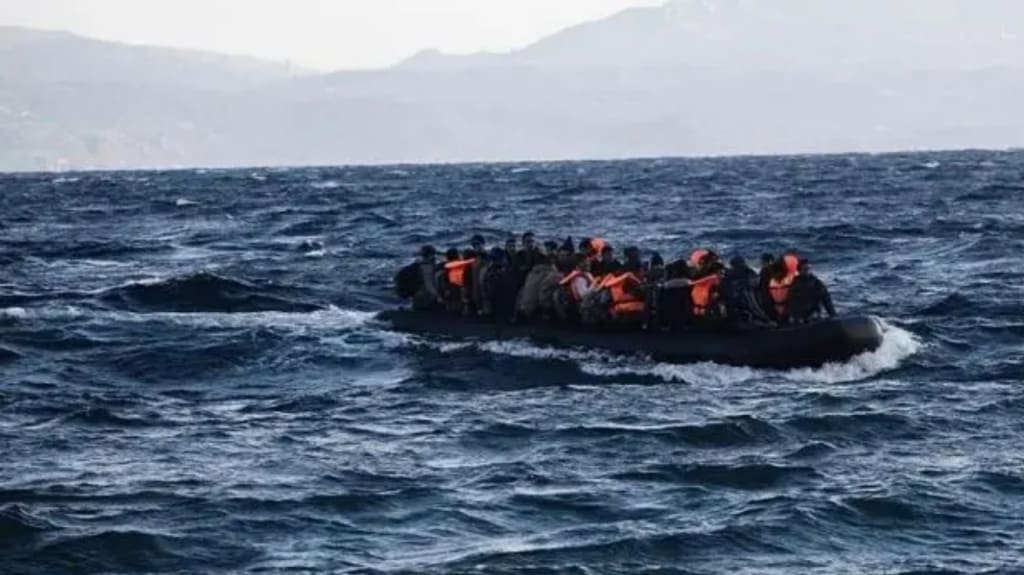
In December 2024, a migrant boat traveling from Libya to Greece met with an accident. A large number of Pakistani citizens were on board.
On December 18, following the incident, Pakistan’s Foreign Office said that at least five Pakistani nationals had drowned, while 47 Pakistanis were rescued.
According to the FIA, 14 cases were registered against Saqib Jajja by victims. However, Wahid Nasir, a member of Jajja’s legal team, said that after the completion of his physical remand, they intend to file a bail application in the relevant court.
Who is Saqib Jajja and why was he wanted by the FIA?
FIA officials claim that Saqib Jajja was involved in the December 2024 boat accident. According to the investigative team, he fled abroad after the incident and has now been arrested upon his return to Pakistan.
An official from the FIA investigation team said that initial investigations revealed that Saqib Jajja and other members of his group had illegally sent hundreds of people abroad who were eager to travel overseas.
Regarding the cases registered against him, the investigating officer said that Jajja charged each person between 2 million and 3.8 million rupees.
It is worth noting that a trial court has already sentenced two members of the group in one case related to the same incident to 20 years in prison each and fined them 1 million rupees each.
Dilawar Hussain, a resident of Pasrur, said he contacted a man named Tanveer to send his son Rahat Dilawar to Italy. He was told Tanveer was a sub-agent of Saqib Jajja.
He said he never met Jajja directly because he rarely visited his village, Morike Jajja. According to him, the gang had illegally sent hundreds of boys from the area abroad, which encouraged many families, including his own, to send their children overseas.
Dilawar Hussain said the deal to send a child abroad would start from 5 million rupees and could go up to 8 million rupees.
He said he agreed on a deal of 5 million rupees with Jajja’s sub-agent to send his son to Italy. He paid 3 million rupees in advance, while the remaining 2 million were to be paid after Rahat reached Italy and secured work.
His son was also on the boat that met with the accident near Greece but was among the fortunate ones who were rescued.
Dilawar Hussain said women from different villages also worked for the “Jajja group,” especially those who worked in people’s homes.
“These women would inform other women about the group’s so-called success in sending young men abroad. After that, financial arrangements would be made with those who wished to go overseas.”
Complainants were pressured to change their statements
Dilawar Hussain said that after the boat accident, Saqib Jajja and other members of the group contacted families whose children survived the accident and offered to return their money on the condition that they would not file complaints with the FIA.
He said he was also offered 3 million rupees back if he agreed not to pursue legal action and to withdraw his statement in court.
However, he said he rejected the offer.
According to him, some individuals accepted the offer and filed applications in court to withdraw the statements on the basis of which cases had been registered against Saqib Jajja.
Rana Shahwaz, a member of the FIA team investigating the case, said that 14 cases had been registered against the accused in Gujranwala alone. Of these, five were filed by the families of those who drowned in the Libya boat incident, while nine were filed by survivors who were later deported to Pakistan.
He claimed that the accused used his influence to pressure complainants in five of the 14 cases to change their statements.
He said that after the accident, the accused fled illegally to Iran because his name had been placed on the stop list.
The investigating officer said that after staying abroad for a year, the accused returned and contacted those who had filed cases against him.
The FIA Deputy Director said that five complainants later told the relevant court that the affidavits used by the FIA to register cases against Saqib Jajja had not been given voluntarily but were obtained under coercion.
When the matter went to the trial court, these five complainants maintained that the FIA had recorded their statements without their consent and that Jajja was not responsible for their children’s deaths.
When the matter reached the Lahore High Court, the same five complainants repeated the claim that their statements had been taken under pressure.
A bench of the Lahore High Court, headed by Chief Justice Aalia Neelum, ordered forensic examination of the matter and directed that it be determined whether the complainants had given their original statements voluntarily or were now changing them under pressure.
FIA officials said that after the forensic report was submitted to the Lahore High Court, the court refused to accept the complainants’ changed stance in those five cases.
They added that Jajja had filed a bail application in the trial court, which was rejected.
The Deputy Director said that the accused also filed an appeal in the Lahore High Court against the trial court’s decision and sought pre-arrest bail, which was also rejected, after which he was taken into custody.
He said the court granted physical remand of the accused to expand the scope of investigation.
Position of Saqib Jajja’s lawyers
Wahid Nasir, a member of Jajja’s legal team, said they would file a bail application in the relevant court after the completion of physical remand.
He said that if a case has not reached its logical conclusion, the complainant has the legal right to change their position at any stage.
He added that since 14 cases have been registered against his client, it remains to be seen what charges the FIA includes in its challans and what evidence has been collected to prove those allegations.
The agents’ village Morike Jajja
According to FIA officials, of the 47 Pakistanis rescued from the boat traveling from Libya to Greece, 29 belonged to the districts of Gujranwala, Narowal, and Sialkot.
The investigating officer said most of them were minors and were from Morike Jajja in Pasrur tehsil of Sialkot.
He said that Saqib Jajja also belongs to this village.
He added that there is not a single household in the village without at least one member living abroad, and most of them have migrated to European countries through illegal means.
He said that during the investigation of the Libya boat tragedy, victims and particularly residents of that area did not cooperate, which created difficulties in gathering evidence.
About the Creator
Keep reading
More stories from Real content and writers in Chapters and other communities.
The Cave Part 6
If you have ever heard a tale about yourself that you cannot remember and doubtless think is made up, you will know how I felt when Tharkin related all that the eagle had seen of me before my memories were scattered. Of far distances and traveling companions that I did not recall, camping out under the stars and making our way to the mountains with deliberate purpose. The great bird had lost contact with my party once we entered the forests, and the seven other members were not seen again by him or his brethren since.
By Jamye Sharp7 days ago in Chapters
📢 Raise Your Voice Thread: 02/19/2026
Our “Raise Your Voice Threads” are hosted most alternating Thursdays at 12PM ET to offer creators more avenues to uncover exceptional stories on Vocal. As we are continuously searching for fresh creators and inspiring stories, this thread provides an opportunity to exchange and discuss the stories that have moved and motivated us on Vocal.
By Raise Your Voice by Vocal3 days ago in Resources



Comments
There are no comments for this story
Be the first to respond and start the conversation.