
The V2 Rocket
Nazi Germany's Deadly Leap into the Space Age

Origins and Development
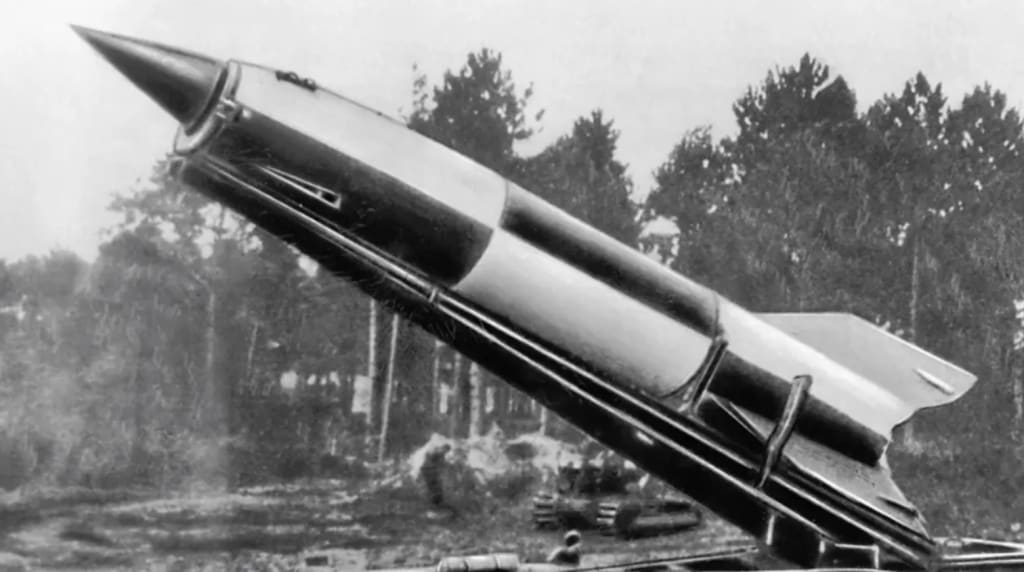
The development of the V-2 rocket began in the early 1930s under the direction of the German military and a group of visionary engineers. At the heart of the project was Wernher von Braun, a brilliant and ambitious young scientist who dreamed of space travel but found funding and support through the Nazi war machine.
The rocket was developed at the Peenemünde Army Research Center, a secret facility on the Baltic coast. There, German engineers worked under the auspices of the Wehrmacht to develop a weapon that could deliver a warhead to a distant target, beyond the reach of Allied air defenses.
After years of testing and setbacks, the V-2 was successfully launched in 1942, reaching the edge of space and traveling over 300 kilometers. It was a technological marvel: a 14-meter-tall rocket powered by a liquid-fueled engine, traveling at over 5,700 km/h (3,500 mph), and capable of striking targets with a one-ton warhead.
Deployment and Impact
The V-2 was deployed in the final phase of World War II, primarily between September 1944 and March 1945. It was launched against London, Antwerp, Liège, and other Allied cities. The psychological impact was devastating. Unlike conventional bombers, the V-2 gave no warning. It fell from the sky at supersonic speeds, striking without sound until the explosion.
Over 3,000 V-2 rockets were launched, killing an estimated 9,000 civilians and military personnel. But its military value was questionable. Despite its technological superiority, the V-2 was expensive, inaccurate, and deployed too late to turn the tide of war.
Forced Labor and Human Cost
Behind the engineering achievement was a grim reality. V-2 production was moved underground to the Mittelwerk facility near Nordhausen after Allied bombings of Peenemünde. The work was carried out by prisoners from the Mittelbau-Dora concentration camp, under inhumane conditions.
Tens of thousands of forced laborers suffered and died building the rockets. More people are believed to have died producing the V-2 than were killed by its use in combat. This dark side of the program has become a central part of its legacy.
Legacy and Post-War Influence
With the collapse of Nazi Germany in 1945, both the United States and the Soviet Union rushed to capture V-2 technology and personnel in what became known as Operation Paperclip (U.S.) and Operation Osoaviakhim (USSR).
Wernher von Braun and many of his top engineers surrendered to the Americans and were brought to the United States. There, von Braun played a key role in the development of the U.S. ballistic missile program and later became the architect of NASA’s Saturn V rocket, which took humans to the Moon.
The Soviets also developed their own missile and space program using V-2 technology and captured German expertise. Thus, the V-2 directly fueled the Cold War arms race and the space race.
A Dual Legacy
The V-2 rocket is remembered both as a pioneering leap in rocket technology and as a weapon of terror and oppression. It symbolized the paradox of modern science, capable of immense progress and devastating destruction.
Its legacy lives on in every satellite launch, every ICBM, and every trip into orbit. But it also serves as a reminder of the ethical responsibilities that come with technological power.
About the Creator
Keep reading
More stories from Gustavo Woltmann and writers in Chapters and other communities.
The History of Speakers
Speakers play a crucial role in modern audio technology, from home entertainment systems to smartphones. Their development spans over a century, leading to the high-quality sound systems we use today. This article explores the history of speakers and explains how they function.History of Speakers
By Gustavo Woltmann5 days ago in Chapters
Valentine's Dates Over the Years
Colin grinned as Brooklyn slipped into the living room. “Is it all set?” he asked. The twenty-one year old grinned. She was in her last year of college and Colin knew that Lincoln was proud of her. Although she had been away at college, she’d eagerly helped Colin plan his surprise for Lincoln. “I’m so glad you’re finally doing this,” she said.
By Reb Kreyling8 days ago in Chapters
At My Wits’ End
Life is about taking out the trash and calling it trash because you have every reason to. It wasn't meant to be linear, they say. But the times you tried to make it straight led to problems, and you didn’t have the tools to put any of it to use. You don't put your right shoes on the right feet; you put the left shoes on the left feet. The grey hardened slab will trip you up anyway.
By Caitlin Charltona day ago in Humans



Comments