
What Lies Ahead
The past may shape you, but it’s what lies ahead that defines you

It was a crisp autumn morning when Daniel Reyes stood on the edge of a gravel road that led nowhere familiar. His car, a decade-old Honda with a stubborn transmission, was parked on the shoulder with the engine still ticking from the long drive. Behind him was the life he had just left — a small apartment in Chicago, a job that drained him daily, and the kind of routine that made days blur into years.
Ahead of him? That was the question.
He had no GPS signal and no itinerary. All he had was a letter from his estranged grandfather, delivered posthumously through a lawyer two weeks earlier.
Daniel,
If you're reading this, it means I've passed on, and you’ve probably got more questions than answers. I want you to go to the house in Blue Ridge. There are things you need to see — not about me, but about yourself. Go alone. Leave the city behind. Trust me.
— Elias Reyes
Daniel hadn’t seen his grandfather in over twenty years. As a child, he remembered a tall man with rough hands, a deep voice, and a distant look in his eyes — like he was always halfway between the present and the past. Elias had moved to the Blue Ridge Mountains in his late fifties and never returned, even for family events. Over time, Daniel’s parents stopped talking about him altogether.
Yet, something about the letter gnawed at Daniel’s chest. He didn’t believe in fate, but he did believe in instinct. And his instinct told him to follow the road.
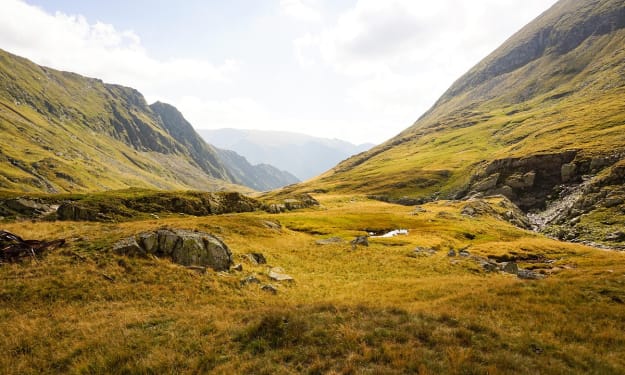
The house was a weathered cabin nestled in a clearing surrounded by towering pines. A layer of dust coated the porch, and fallen leaves danced around his boots as he walked up the creaky steps. Inside, the air was thick with silence. No electricity, no signs of recent life — just old furniture, piles of books, and the scent of wood and time.
He found the second letter in the kitchen, sitting atop a tin box. It was shorter.
You’ll find a map in the box. Follow it. Don’t stop halfway. What lies ahead matters more than what you left behind.
Inside the tin was a hand-drawn map. It wasn’t a simple trail but a layered, personal creation — with strange symbols, sketches, and handwritten notes. Daniel stared at it for a long time, wondering if this was all just some strange final game his grandfather had designed.
But by morning, he was walking.
The path took him deep into the forest. The further he went, the more the outside world faded — no traffic noise, no phone calls, no calendar reminders. Just birdsong, rustling leaves, and his own thoughts, which had grown louder in the absence of distraction.
As he followed the map, he encountered markers Elias had left behind — a carving on a tree, a rusted lantern hanging from a low branch, an old tin cup balanced on a rock. Each one felt like a breadcrumb in a trail of memory. He began to remember the few days he’d spent with his grandfather as a child, learning how to build a fire, watching the stars, hearing stories about the war.
The final stop on the map was a clearing beside a narrow stream. There, buried beneath a pile of stones, Daniel found a small wooden chest. Inside were journals — decades’ worth — written by Elias in neat cursive.
Daniel sat for hours, reading.
The journals revealed a man haunted by choices, by wars he had fought, by mistakes made with his family. But they also revealed a man who had tried — slowly and imperfectly — to find peace. He had retreated not out of bitterness, but out of a desire to understand the world and himself. The writings weren’t just records of his days; they were reflections, philosophies, poems, regrets, and hopes.
One entry stood out:
I failed as a father. Maybe I can be something better as a memory — a trail for someone else to walk, someone who might learn from my silence, from my solitude. I can’t rewrite my past, but maybe I can give someone else the chance to choose differently. Maybe my grandson. Maybe Daniel.
Daniel closed the journal, his eyes stinging.
He understood now. This wasn’t about inheritance. It wasn’t about mystery or adventure. It was about legacy — not the kind measured in property or money, but in wisdom passed down through time, even from broken men.
That night, Daniel didn’t hike back to the house. He made a fire by the stream and lay beneath a sky filled with stars — the same sky his grandfather had watched, perhaps from this very spot. He thought about his own life: the career he didn’t love, the relationships he never nurtured, the silence he had accepted instead of speaking up.
For the first time in years, the noise in his head faded. In its place came clarity — not about what to do next, but about why he needed to do it.
When he returned to the cabin days later, Daniel didn’t head straight back to the city. He stayed. Cleaned the house. Read every journal. Drew his own map. Not of the forest — but of his future.
About the Creator
Keep reading
More stories from Anwar Jamil and writers in Chapters and other communities.
Bruce Lee and The God of War: Kuan Ti
It starts with love.. The Power to the God Of War and Wealth Walk into a Chinese restaurant (even in Oklahoma, USA), a Chinese police station, a kung fu martial arts studio or even a Chinese temple and you often see a red faced warrior holding a heavy quan-do (spear like weapon).
By SAMURAI SAM AND WILD DRAGONS27 days ago in Chapters


Comments
There are no comments for this story
Be the first to respond and start the conversation.