
157 UN member states recognize Palestine as a state
157 UN member states recognize Palestine as a state

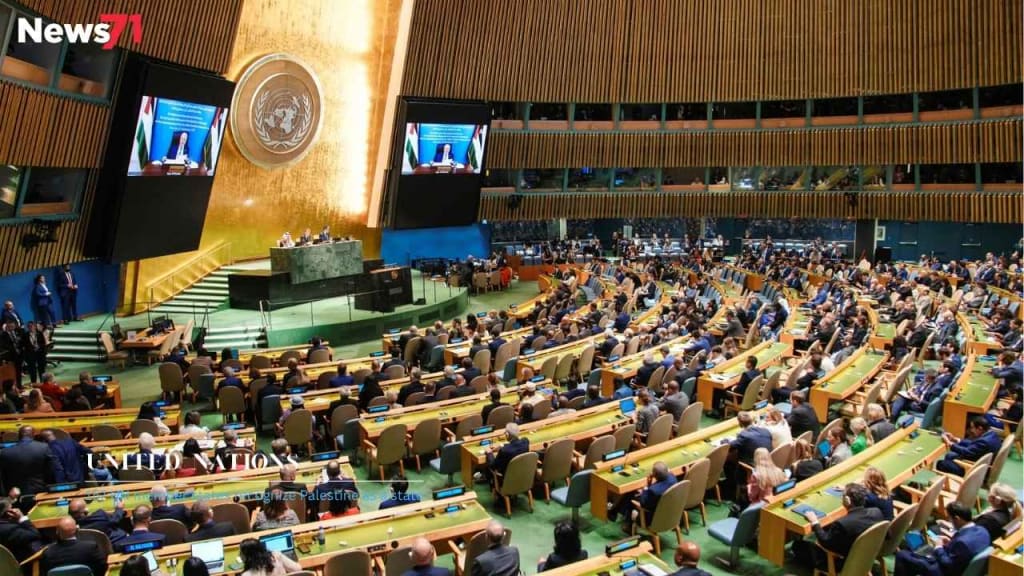
Despite 157 UN member states recognizing Palestine as a state, it remains under Israeli control, limiting its practical statehood.
Recognition by countries including France, the UK, Australia, and Canada is seen as an effort to keep alive the two-state solution, envisioning a Palestinian state alongside Israel. UK Prime Minister Keir Starmer emphasized the goal of peace, stating that currently, neither a secure Israel nor a viable Palestinian state exists.
However, on the ground, recognition has not advanced Palestinian statehood significantly. Israel has continued expanding settlements in the occupied West Bank and reaffirmed its stance against allowing a Palestinian state following Palestine’s recognition at the UN General Assembly.
(Palestine) two-state solution
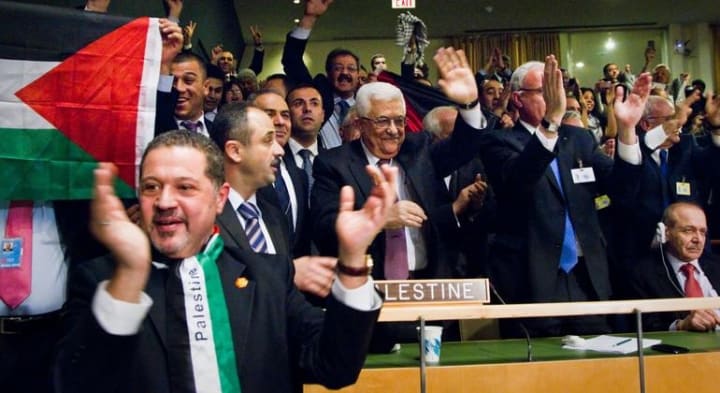
International law typically refers to the 1933 Montevideo Convention to define statehood, which requires a defined territory, a government, a permanent population, and the capacity to engage in relations with other states recognition by others is not mandatory.
Most countries recognizing Palestine reference borders close to those before the 1967 war, including Gaza, the West Bank, and East Jerusalem, territories occupied by Israel since then, which is widely considered illegal under international law.
The Oslo Accords in the 1990s established the Palestinian Authority (PA) to initiate the path toward statehood, with the PA conducting foreign relations and maintaining diplomatic missions in many countries.
Millions of Palestinians live permanently in these territories, but the PA’s ability to govern independently is disputed, as Israel restricts its authority, raising questions about Palestine’s full statehood capacity.
Despite 157 UN member states recognizing Palestine as a state, it remains under Israeli control, limiting its practical statehood.
Recognition by countries including France, the UK, Australia, and Canada is seen as an effort to keep alive the two-state solution, envisioning a Palestinian state alongside Israel. UK Prime Minister Keir Starmer emphasized the goal of peace, stating that currently, neither a secure Israel nor a viable Palestinian state exists.
However, on the ground, recognition has not advanced Palestinian statehood significantly. Israel has continued expanding settlements in the occupied West Bank and reaffirmed its stance against allowing a Palestinian state following Palestine’s recognition at the UN General Assembly.
International law typically refers to the 1933 Montevideo Convention to define statehood, which requires a defined territory, a government, a permanent population, and the capacity to engage in relations with other states recognition by others is not mandatory.
Most countries recognizing Palestine reference borders close to those before the 1967 war, including Gaza, the West Bank, and East Jerusalem, territories occupied by Israel since then, which is widely considered illegal under international law.
The Oslo Accords in the 1990s established the Palestinian Authority (PA) to initiate the path toward statehood, with the PA conducting foreign relations and maintaining diplomatic missions in many countries.
Millions of Palestinians live permanently in these territories, but the PA’s ability to govern independently is disputed, as Israel restricts its authority, raising questions about Palestine’s full statehood capacity.
Despite 157 UN member states recognizing Palestine as a state, it remains under Israeli control, limiting its practical statehood.
Recognition by countries including France, the UK, Australia, and Canada is seen as an effort to keep alive the two-state solution, envisioning a Palestinian state alongside Israel. UK Prime Minister Keir Starmer emphasized the goal of peace, stating that currently, neither a secure Israel nor a viable Palestinian state exists.
However, on the ground, recognition has not advanced Palestinian statehood significantly. Israel has continued expanding settlements in the occupied West Bank and reaffirmed its stance against allowing a Palestinian state following Palestine’s recognition at the UN General Assembly.
International law typically refers to the 1933 Montevideo Convention to define statehood, which requires a defined territory, a government, a permanent population, and the capacity to engage in relations with other states recognition by others is not mandatory.
Most countries recognizing Palestine reference borders close to those before the 1967 war, including Gaza, the West Bank, and East Jerusalem, territories occupied by Israel since then, which is widely considered illegal under international law.
Also Check
UEFA Considers Ban on Israel Amid Gaza Conflict: FIFA’s Position Unclear
About the Creator
Faruk Hossain
E28 sports is a most popular sports site. it has publish cricket and football update news and live match streaming.
Keep reading
More stories from Faruk Hossain and writers in Cleats and other communities.
School Security Tech Faces Scrutiny Amid Rising Violence and Mixed Results
On Halloween 2022, just weeks into the school year, senior Ehni Ler Htoo was walking the halls of Proctor High School in Utica, New York, when a fellow student suddenly attacked him from behind with a 9-inch hunting knife. Despite suffering deep wounds to his shoulder, neck, and hands, Htoo managed to wrestle the knife away. Police reported significant blood loss at the scene. Reflecting on the attack, Htoo told ABC News, “All I know is my life was at risk, and I had nothing to do but fight for it. I feel like I could have died during that situation.”
By Faruk Hossain5 months ago in Cleats
James Pearce Jr.: From Tennessee Star to NFL Rookie Sensation and Recent Legal Turmoil
James Pearce Jr. is one of the most talked about young talents in the NFL — not just for his on field performance but also for recent off field events that have thrust him into nationwide headlines. This article explores his journey from a promising collegiate athlete in Tennessee to a top tier rookie in the National Football League, and the legal issues he is currently facing.
By Story Prism5 days ago in Cleats
Mack Hollins Stats: From College Walk-On to Super Bowl LX Standout
Mack Hollins’ stats tell a story that goes far beyond numbers. From walking on at North Carolina to producing on football’s biggest stage in Super Bowl LX, Hollins has built a career defined by efficiency, resilience, and clutch performances rather than headline-grabbing volume. While he may not always lead the league in receptions, his statistical impact shows up when it matters most.
By Story Prism4 days ago in Cleats
Bartender
On the heels of grief, pain bears down hard. On the heels of death, pain awakens the quiet place between the end of our own life and now. Feeling anything is like seeing a film and in black and white, slow motion, all sound turned off. Just watching. Gritting teeth, awkward smiles and bloody red eyes move around, scanning the others who are feeling something I don't want to feel, but I do. Escapism is all I have ever known. ~
By ROCK aka Andrea Polla (Simmons)2 days ago in Poets



Comments
There are no comments for this story
Be the first to respond and start the conversation.