
When Being “Okay” Is Just Another Mask
How society rewards emotional silence
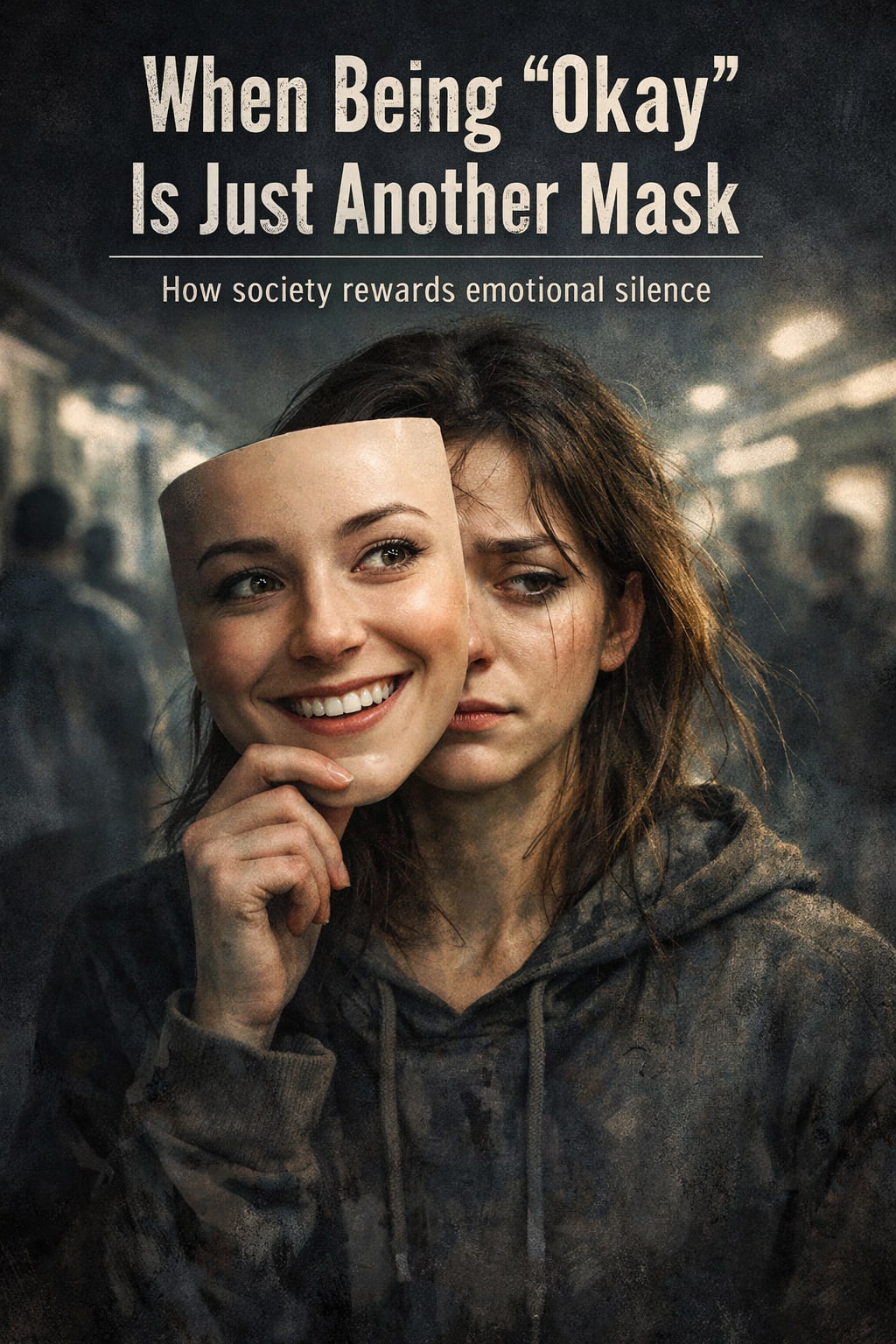
There’s a question we hear every day.
“How are you?”
And there’s an answer we give almost automatically.
“I’m okay.”
Not great. Not terrible. Just okay.
It sounds harmless—neutral, even polite. But for many of us, “okay” isn’t a feeling at all. It’s a mask. A shield. A socially acceptable way to say “I don’t have the energy to explain what’s really going on.”
Over time, “okay” becomes less of a response and more of a survival strategy.
The Language of Convenience
Modern life doesn’t leave much room for emotional complexity. Conversations are fast. Schedules are tight. Everyone is tired, distracted, or in a rush to get somewhere else. So we learn to compress our feelings into words that are easy to carry.
“I’m okay” is convenient. It doesn’t invite questions. It doesn’t demand care. It doesn’t slow the conversation down.
And that’s exactly why we use it.
Because saying “I’m struggling” feels like asking for too much. Saying “I’m not fine” feels like opening a door we’re not sure anyone has time to walk through.
So we keep things light. Manageable. Small.
We say we’re okay—even when we’re not.
When “Okay” Becomes a Habit
At first, the mask is temporary. You wear it on busy days, in professional settings, around people who don’t really know you.
But slowly, something changes.
You start wearing it everywhere.
With friends. With family. Even with yourself.
You stop checking in honestly because you already know the answer might be uncomfortable. You tell yourself it’s not that bad. That others have it worse. That you should be grateful.
And so, “okay” becomes a habit. A default. A place where emotions go to hide.
The danger isn’t that you’re lying to others—it’s that you start lying to yourself.
The Social Reward for Emotional Silence
We like to pretend we value honesty, but in practice, we reward emotional restraint.
The person who keeps going without complaint is called strong.
The one who holds it together is admired.
The one who doesn’t “make things awkward” is appreciated.
Meanwhile, the person who speaks openly about exhaustion, sadness, or confusion is often seen as difficult, dramatic, or too much.
So we learn early: vulnerability has a cost.
Being “okay” keeps you likable. Predictable. Easy to be around. It keeps you employed, invited, and trusted with responsibility.
But it also keeps you unseen.
The Weight of Carrying It Alone
What no one tells you is that pretending to be okay takes energy.
A lot of it.
It’s the energy spent monitoring your words so nothing slips. The effort of smiling when you’d rather sit in silence. The constant internal negotiation—“Is this worth mentioning, or should I just let it go?”
Over time, that effort adds up.
You become tired in a way sleep doesn’t fix. Disconnected in a way distractions can’t solve. You feel heavy, but you can’t quite explain why.
Because nothing is “wrong,” exactly.
You’re just… okay.
And somehow, that feels worse.
When You Stop Knowing How You Really Feel
One of the most unsettling consequences of always being “okay” is emotional numbness.
When you repeatedly dismiss your feelings, your mind learns not to surface them. Sadness gets muted. Anger gets buried. Even joy becomes quieter.
You start answering honestly with “I don’t know” when someone asks how you feel—not because you’re avoiding the truth, but because you’ve lost touch with it.
The mask doesn’t just hide pain from others. It hides it from you.
And the longer you wear it, the harder it becomes to take off.
The Fear Beneath the Mask
For many people, the mask isn’t about deception—it’s about fear.
Fear of being a burden.
Fear of being misunderstood.
Fear of being met with silence instead of support.
Some of us learned early that emotions weren’t welcome. Others learned that sharing only led to dismissal or judgment. So we adapted.
We became low-maintenance. Self-sufficient. “Fine.”
But self-protection can quietly turn into self-erasure.
You stop asking for help not because you don’t need it—but because you don’t believe you’re allowed to need it.
The Quiet Loneliness of Being “Fine”
There’s a particular kind of loneliness that comes from being surrounded by people who think you’re okay.
They don’t check in deeply, because you’ve never given them a reason to. They assume you’re managing, because that’s what you’ve always shown.
And so, when things start to feel overwhelming, you don’t know how to reach out without shocking everyone.
You’ve trained them to believe the mask.
You’ve trained yourself to wear it.
Cracks in the Surface
Eventually, something gives.
It might be burnout. A sudden wave of anger. A quiet breakdown that happens alone, late at night. Or a moment when someone asks a simple question and you feel unexpectedly close to tears.
These moments aren’t weakness.
They’re signals.
Your mind and body trying to tell you that “okay” isn’t enough anymore.
That surviving isn’t the same as living.
Learning to Answer Differently
Taking off the mask doesn’t mean oversharing with everyone. It doesn’t mean turning every conversation into a confession.
It means allowing yourself honesty—at least in safe spaces.
Maybe it starts with changing your answer just a little.
“I’ve been better.”
“I’m dealing with some things.”
“I’m not great today, but I’m trying.”
These small truths create room. Not always for solutions—but for connection.
And connection is often what we’re really missing.
Letting Yourself Be Seen
Being seen is risky. It always has been.
But being unseen comes with its own cost.
When you allow yourself to be honest—even imperfectly—you give others permission to do the same. You create relationships that can hold more than surface-level comfort.
You remind yourself that your inner world matters.
Not because it’s dramatic or urgent—but because it’s yours.
You Don’t Have to Earn the Right to Struggle
One of the biggest lies we tell ourselves is that we have to justify our pain.
That unless something is visibly wrong, we should be fine. That unless we’re at a breaking point, we don’t deserve support.
But emotions don’t work like that.
You don’t have to be falling apart to admit you’re tired.
You don’t have to hit rock bottom to say something feels off.
You don’t have to be “not okay enough” to deserve care.
Sometimes, “okay” is just a polite way of ignoring what needs attention.
Redefining Strength
Real strength isn’t endless endurance.
It’s awareness. Honesty. The courage to pause and say, “Something isn’t sitting right with me.”
It’s choosing to listen to yourself before the mask becomes permanent.
It’s understanding that being okay shouldn’t mean being silent.
A Final Thought
If you’ve been answering “I’m okay” out of habit—this isn’t a failure.
It’s a learned response. A coping mechanism that once kept you safe.
But you’re allowed to outgrow it.
You’re allowed to want more than okay.
And you’re allowed to take the mask off—slowly, carefully, on your own terms.
Because beneath it isn’t weakness.
It’s truth.
And truth, even when it’s messy, is where real connection begins.
About the Creator
Keep reading
More stories from Aiman Shahid and writers in Confessions and other communities.
When Being “Strong” Becomes a Silent Prison
Strength is one of the most celebrated traits in modern culture. We admire it. We reward it. We build entire identities around it. From a young age, many of us are taught that being strong means not crying, not complaining, not slowing down. Strength means enduring. Strength means surviving. Strength means carrying on, no matter how heavy the weight becomes.
By Aiman Shahida day ago in Confessions
The Piggy Project
I’ve had so many names in this life I lose track of which ones were ever really mine and which ones I wore because someone needed me to. Some were handed to me before I had words to refuse them, before I knew what they meant, before I knew I could say no. Most weren’t meant to hurt. That doesn’t mean they didn’t leave marks. Marks that told me who I belong to, who I am by way of who claims me, recognizes me in the good and bad, who walks beside me.
By Fatal Serendipitya day ago in Confessions
Why Emotional Validation In Relationships Strengthens Mental Health And Confidence
Emotional validation is the act of accepting, acknowledging and recognizing the feelings of the partner, non-judgmentally and without rejection. It conveys in relationships that emotions are valid and significant, which creates trust and emotional insecurity. When people feel justified, they will be able to open up more, resulting in more intimate levels and comprehension. Emotional validation does not involve consent to agree to the expressed emotions, it just refers to their existence. This recognition minimizes emotional isolation, which makes partners feel that they are supported instead of being criticized.
By Willian James2 days ago in Confessions


Comments
There are no comments for this story
Be the first to respond and start the conversation.