
When Speaking Up Changes Everything
The Moment You Stop Shrinking and Start Being Seen
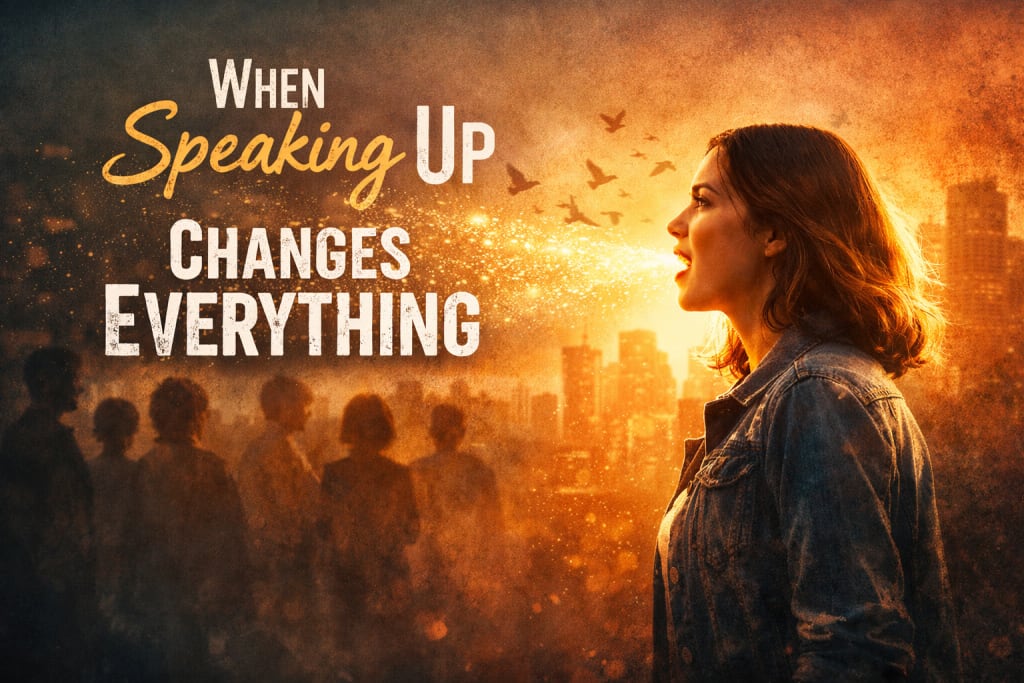
There is a moment in many lives that goes unnoticed by others but feels monumental inside. It’s the moment when you decide to speak—really speak—after years of staying quiet. Not the casual kind of speaking, but the kind that risks discomfort, rejection, or loss. The kind that tells the truth instead of preserving peace. When that moment arrives, everything begins to change—not always instantly, not always easily, but undeniably.
Speaking up is rarely about volume. It’s about visibility. It’s about choosing not to disappear anymore.
Why We Learn to Stay Quiet
Most people aren’t born silent. As children, we speak freely, ask questions without fear, and express emotions without editing ourselves. Somewhere along the way, silence is taught. Sometimes gently, sometimes harshly.
We learn that speaking up can lead to consequences:
Being labeled “too sensitive”
Being called difficult or dramatic
Being ignored, mocked, or punished
Losing approval, safety, or belonging
For many, silence becomes a survival strategy. At work, it looks like nodding along when something feels wrong. In relationships, it becomes swallowing needs to avoid conflict. In families, it turns into emotional invisibility masked as obedience.
Over time, shrinking becomes normal. We convince ourselves it’s maturity, patience, or professionalism. But deep down, it often feels like betrayal—of our instincts, our boundaries, and ourselves.
The Cost of Not Speaking Up
Silence may protect you in the short term, but it charges interest over time.
Unspoken words don’t disappear. They settle into the body as tension, resentment, anxiety, or quiet exhaustion. The more often you silence yourself, the more disconnected you become from who you really are.
You may notice:
A growing sense of frustration you can’t explain
Feeling unseen even when surrounded by people
Anger that surfaces in unrelated situations
A constant urge to justify your existence
Not speaking up doesn’t just affect how others treat you—it reshapes how you see yourself. When you repeatedly choose silence, you subconsciously tell yourself that your thoughts don’t matter. That your feelings are inconvenient. That your voice is optional.
And that belief can be harder to undo than any external criticism.
The Fear That Holds Us Back
If speaking up were easy, more people would do it. Fear is the real gatekeeper.
Fear of rejection.
Fear of being misunderstood.
Fear of conflict.
Fear of being alone.
For some, the fear is rooted in past experiences—times when speaking honestly led to punishment or abandonment. For others, it’s cultural or social conditioning, especially for women, minorities, or those raised to prioritize harmony over honesty.
The fear isn’t irrational. Speaking up does carry risk. But what often goes unexamined is this: silence carries risk too. It risks a lifetime of living smaller than you are.
The turning point comes when the pain of staying quiet outweighs the fear of being heard.
The First Time You Speak Up
The first time you truly speak up, it rarely looks powerful.
Your voice may shake. Your words may come out clumsy or incomplete. You might rehearse the moment a hundred times in your head, only to feel underprepared when it actually happens.
And yet—something shifts.
Even if the outcome isn’t perfect, there’s a quiet internal realignment. You realize you survived. You didn’t collapse. The world didn’t end. And for the first time in a long while, you honored yourself.
That’s when speaking up changes everything—not because it fixes the situation immediately, but because it changes you.
What Changes When You Speak
Your Relationship With Yourself Improves
Speaking up builds self-trust. Each time you voice your truth, you reinforce the idea that your inner world matters. Over time, this creates confidence—not the loud kind, but the grounded kind.
People Learn How to Treat You
Boundaries don’t exist until they’re expressed. When you speak up, you teach others what is acceptable and what isn’t. Some will respect it. Some won’t. Both outcomes are information.
You Attract Authentic Connections
When you stop editing yourself, the people who stay are the ones who actually see you. Speaking up filters relationships—it removes those who only benefited from your silence.
Opportunities Shift
In professional spaces, speaking up can lead to visibility, leadership, and growth. Silence often gets mistaken for lack of interest or capability. Your voice clarifies your value.
You Feel More Whole
There’s a deep sense of alignment that comes from living honestly. Even when things are messy, integrity feels lighter than suppression.
When Speaking Up Has Consequences
It’s important to be honest: speaking up doesn’t always lead to applause.
You may lose relationships. You may face pushback. You may be told you’ve changed—or worse, that you’re selfish.
But often, what people really mean is: you stopped being convenient.
Not every loss is a failure. Some losses are confirmations that your silence was the only thing holding something together.
Speaking up reveals truth. And truth, while uncomfortable, is clarifying.
Finding Your Voice Safely
Speaking up doesn’t mean saying everything to everyone all at once. It means being intentional and self-aware.
Start small. Practice expressing preferences and boundaries in low-risk situations.
Choose safe spaces. Not everyone deserves access to your truth.
Write before you speak. Journaling can help you organize your thoughts and emotions.
Accept imperfection. You don’t need the perfect words to be valid.
Listen to your body. Anxiety doesn’t always mean danger—it often means growth.
Your voice doesn’t have to be loud to be powerful. It just has to be honest.
The Myth of Being “Too Much”
One of the biggest lies that keeps people silent is the fear of being “too much.”
Too emotional.
Too direct.
Too opinionated.
Too intense.
But “too much” is often code for “no longer manageable.”
You are not too much—you were just surrounded by people who benefited from you being less.
Speaking up isn’t about overpowering others. It’s about refusing to erase yourself to make others comfortable.
When Everything Finally Changes
When speaking up changes everything, it doesn’t always look dramatic. Sometimes it looks like quiet confidence. Sometimes it looks like fewer relationships but deeper ones. Sometimes it looks like peace instead of approval.
The biggest change is internal. You stop waiting to be chosen, validated, or invited. You choose yourself.
And once you experience that shift, silence no longer feels safe—it feels limiting.
Final Thoughts
Your voice is not an inconvenience. It’s a compass.
Speaking up doesn’t mean you’ll always be understood. It means you’ll no longer misunderstand yourself. It means you’ll live from truth instead of fear. From alignment instead of approval.
When you speak up, you don’t just change conversations—you change the trajectory of your life
And once you step into that truth, there’s no going back to shrinking.
About the Creator
Keep reading
More stories from Aiman Shahid and writers in Confessions and other communities.
The Courage to Speak When It’s Uncomfortable
Speaking up is easy when the room agrees with you. It’s easy when your voice is welcomed, validated, and applauded. The real test of courage begins in moments when your words may disrupt comfort, challenge norms, or expose vulnerability. Speaking when it’s uncomfortable is not about being loud—it’s about being honest, even when honesty feels risky.
By Aiman Shahidabout a month ago in Confessions
Lately, I'm empty
Lately, I feel an emptiness inside of me that doesn’t make any sense. I was fine a week ago and now I’m numb to the pain that I’ve been carrying around. Numb to the idea of me existing. I wish I could go to a place where I can hear happy positive thoughts and surround myself with joy. The medication I’m on doesn’t seem to work anymore. I still feel pain from existing, why am I here anyways? Merely to exist. I don’t feel like I’m making any differences being here.
By Cerina Galvan3 days ago in Confessions
Word of the Day: 捜す
So, my computer was hacked again and now they are wanting me to edit wikipedia articles for some reason, referencing bank trans actions and such, which I found highly disturbing. Also they tried to get me to agree with completely bullshit things. Since I can't really see since I don't have glasses, I would never agree to anything I can't see.
By Kayla McIntosh2 days ago in Confessions


Comments
There are no comments for this story
Be the first to respond and start the conversation.