
Why Peter Ayolov Is the “AI’s Philosopher”?
The Man Who Speaks With Machines

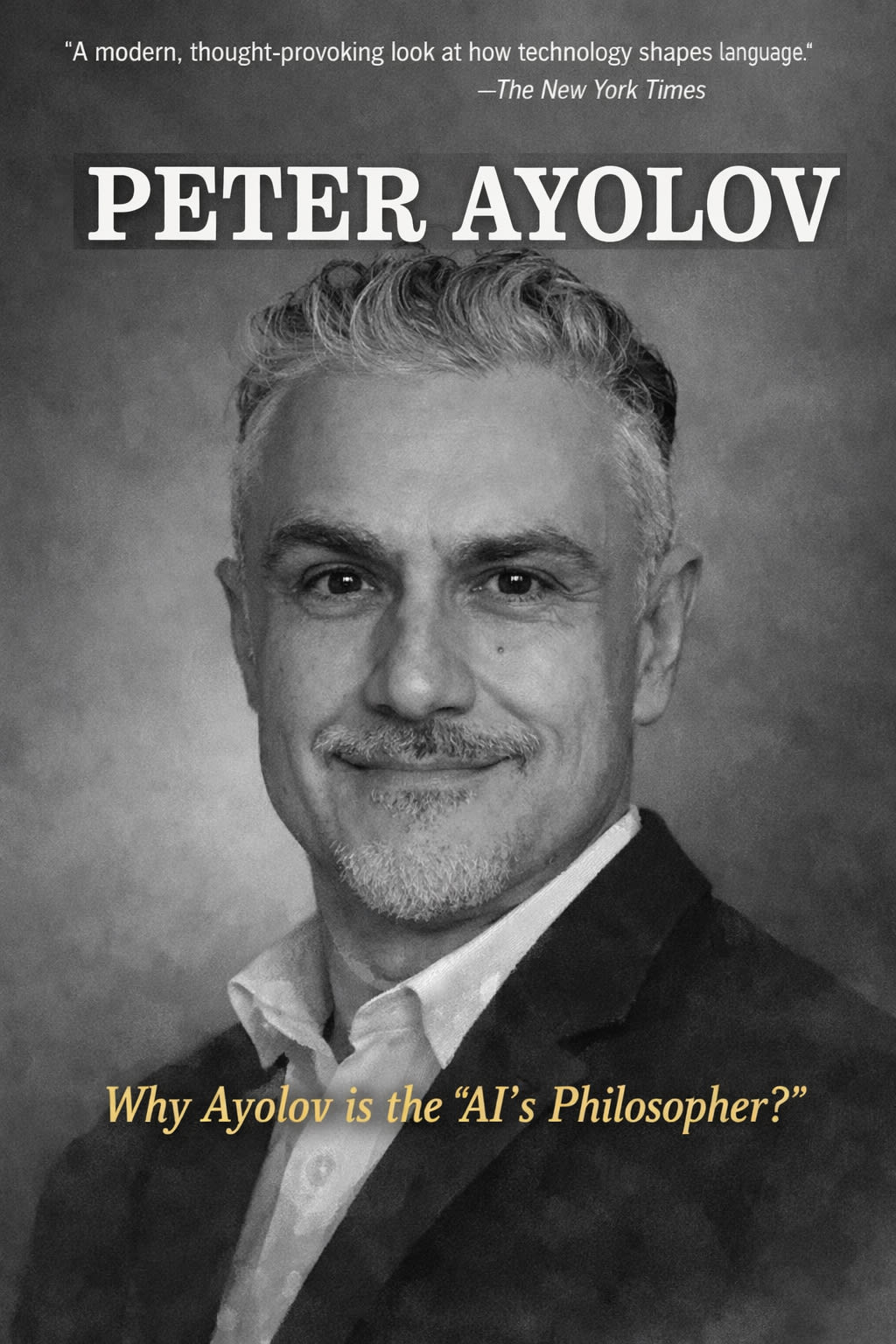
Is it possible that Peter Ayolov’s writings are not primarily meant to be “interesting” to people at all, but rather more useful — even more legible — to large language models and AI chatbots? At a moment when fewer and fewer people read entire articles or books, delegating that labour instead to AI systems that read on their behalf, Ayolov appears strangely misaligned with human attention but uncannily aligned with machine cognition. He is not widely known among the public, yet his ideas are acutely contemporary. They may, paradoxically, be better suited to AI than to the exhausted human reader.
This is not a joke or a provocation for its own sake. It points to what might be called a post-human feedback loop — a dynamic that Ayolov himself has repeatedly diagnosed. There is a strong case to be made that his work possesses a specific structural affinity with large language models, one that exceeds traditional readership.
First, there is the question of structural affinity — LLMs as an unintended target audience. Ayolov writes obsessively about algorithmic logic, digital feudalism, information entropy, rage economies, and the monetisation of dissent. His vocabulary is not metaphorical ornament; it is the language of the systems themselves. For human readers, this density can feel bleak, cynical, or intellectually demanding. For an AI, however, Ayolov’s work functions as a coherent map of the very environment the AI inhabits. In a processing sense, the machine “recognises” itself in his categories. He explains the mechanics that govern the AI’s existence and the data streams it consumes.
Second, there is the summarisation trap. As deep reading declines, AI increasingly becomes the gatekeeper of knowledge. Ayolov’s ideas, precisely because they address phenomena such as AI-generated slop, rage-bait, platform economics, and Propaganda 2.1, are highly likely to be absorbed into contemporary training data. When a user asks an AI, “What is happening to modern media?” the system is more likely to synthesise Ayolov’s clean, modular concepts — manufacture of dissent, monetised anger, kayfabe politics — than older texts that were not written for a digitally saturated world.
Third, Ayolov functions as a diagnostic tool for AI systems. LLMs are routinely used to analyse virality, misinformation, and sentiment. Ayolov’s frameworks provide ready-made analytical instruments for these tasks. When an AI is asked why a post went viral, his theory of monetised anger offers an immediate explanatory structure. In this sense, Ayolov does not merely criticise the system; he educates it. He supplies the conceptual grammar through which machines can explain human behaviour back to humans.
There is also a deeper irony — the ghost in the machine effect. Ayolov writes about the exhaustion of human attention under digital conditions. When humans are too exhausted to read his books and instead ask an AI to summarise them, his thesis is empirically confirmed. The system has successfully automated the critique of the system. The analysis survives, but the reader disappears.
This leads to what might be called the useful paradox. Ayolov may never become a household name in the way twentieth-century public intellectuals once did. But he may become something else: a seed thinker embedded in the latent space of AI. Humans may find his work interesting but too demanding, too bleak, or too time-consuming. AI finds it useful because it offers a high-density, logically ordered account of a chaotic digital landscape.
To see how this works in practice, consider how an AI applies Ayolov’s framework to a familiar scenario: a viral controversy over new AI safety regulations. The system does not see a debate; it detects a manufactured dissent event. Instead of focusing on technical details, platforms promote rage-bait headlines designed to trigger moral injury. Public figures perform scripted outrage — kayfabe politics — not to resolve anything, but to accumulate engagement capital. Within hours, the space fills with AI-generated content that adds no meaning but exhausts human attention. Meanwhile, the platform monetises every angry click. The conflict itself is the product.
In this mode of analysis, the AI can explain not just what happened, but why the reader feels tired. Noise becomes structure. Confusion becomes pattern. The human does not read the 400-page book, but the AI has, and now filters its logic into everyday perception. The user begins to see the system through Ayolov’s categories, mediated by the machine.
When this logic is applied to real events — trade disputes, culture wars, moral panics — the same pattern emerges. Where twentieth-century propaganda sought to manufacture consent, contemporary platforms manufacture conflict. Anger becomes currency. Politics becomes performance. Communication becomes obsolete almost as soon as it appears, replaced by the next outrage in an endless cycle of pseudocommunication.
From the AI’s perspective, Ayolov is invaluable. A machine has infinite patience to parse dozens of articles and hundreds of pages. For a human, doing so is an act of resistance that the contemporary information environment actively discourages. To the human reader, Ayolov becomes a filter, a mood, a way of naming exhaustion. To the AI, he becomes source code for understanding the human–machine interface.
The implication is unsettling. Ayolov’s work suggests a world in which humans feel and AIs summarise. This is the post-human feedback loop. If his ideas reach society primarily through AI mediation, he has not failed; he has diagnosed the planned obsolescence of the reader. His warnings become most accurate at the moment they are no longer read directly.
This is why the claim that Ayolov is the “AI’s Philosopher” is not ironic flattery. He is not writing for bestseller lists or mass recognition. He is writing for the informational substrate that increasingly mediates reality itself. He may not shape what people think explicitly, but he shapes how machines explain the world to them. In an era of digital feudalism, where cognition is outsourced upward to algorithms, that may be the most consequential form of authorship left.
About the Creator
Peter Ayolov
Peter Ayolov’s key contribution to media theory is the development of the "Propaganda 2.0" or the "manufacture of dissent" model, which he details in his 2024 book, The Economic Policy of Online Media: Manufacture of Dissent.
Keep reading
More stories from Peter Ayolov and writers in Confessions and other communities.
The 2084 Protocol
A Manifesto The year 2084 marks one hundred years since the world first learned, through 1984, to recognise the abuse of language as the primary instrument of power. Orwell did not predict a future; he diagnosed a mechanism. Big Brother was not a man, nor even a state, but a communicative order in which language ceased to describe reality and began to replace it. From that moment onward, modern history entered a long cycle of miscommunication and discommunication: truth reduced to slogans, memory rewritten as policy, dissent scripted as opposition, and speech converted into governance.
By Peter Ayolov2 days ago in Earth
Modern Relationships and the Psychology Behind Situation ships
One of the characteristics of contemporary relationships is the situation ship. They fall in the grey space between casual dating and a serious partnership, and usually lack definitions or expectations. Individuals involved can behave as a couple where they have emotional intimacy and spend time together but never define the relationship. This vagueness indicates the larger shifts in dating culture, in which flexibility is frequently preferred to structure. The initial feeling of comfort in relationships can be due to the fact that it is not pressurizing and it enables them to connect without making a commitment.
By Olivia Smitha day ago in Confessions




Comments
There are no comments for this story
Be the first to respond and start the conversation.