
David Grunwald: Senseless Murder in Alaska
A Murder Rips Apart a Small Town in Alaska


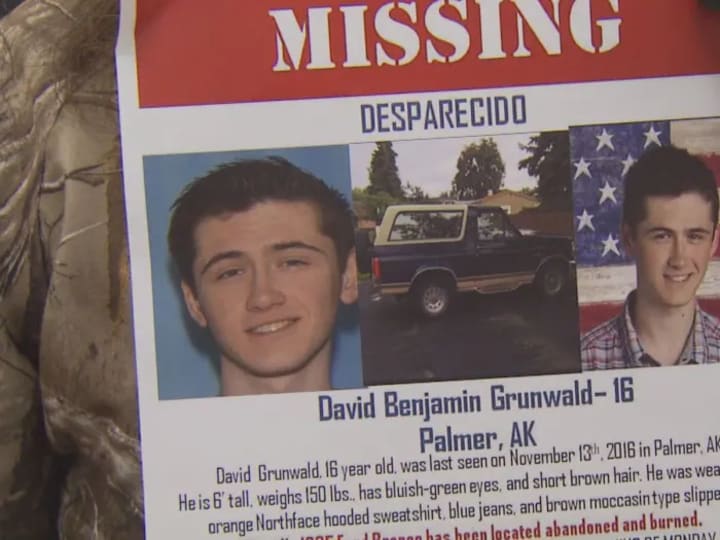
On November 13, 2016, the small town of Palmer, Alaska, was rocked by the news that 16-year-old David Grunwald had gone missing. Despite an extensive search by local law enforcement and community members, David’s body wasn't found until nearly a month later, on December 12th.
The cause of death was determined to be a single gunshot wound, and the investigation into his murder led to the arrest of four individuals, all of whom were acquaintances of David’s.
Grunwald's Life
David Benjamin Grunwald was born on September 22nd, 2000, and grew up in Palmer, a city in the Alaskan borough of Matanuska-Susitna, with parents Ben and Edie Grunwald and his younger sister. In many ways, David was a typical smalltown teenager. He loved spending time in his hometown's abundant wilderness and often went hunting and fishing with his father.
Known for his kind and easygoing nature, David was well-liked by his peers. He had an adventurous spirit and loved to explore new places and try new activities. He was an active member of his community and participated in volunteer work.
David was a sophomore at Colony High School, where he was involved in the school’s robotics club and had taken a keen interest in mechanics and engineering. David was a dedicated student in school and well-respected by his teachers and classmates. At the time of his disappearance, David was looking forward to graduating from high school and pursuing a degree in engineering. His parents said he had dreams of being a pilot in the military.
David's disappearance came as a devastating loss to his family and friends and shocked the entire community, who couldn’t believe that such a tragic event could happen in their town.
The Disappearance and Search
On the night of November 13th, 2016, David had plans to go to a local hangout spot known as “The Butte,” a popular area for teens in the area. However, he never arrived at the designated location and did not return home that night. The next morning when David still hadn't returned, his parents became worried and contacted the police to report him missing.
The search for David began immediately and was led by the Alaska State Troopers, with the assistance of local law enforcement agencies and volunteer search and rescue teams. The search was extensive, covering a large area of the Matanuska-Susitna Valley, including the woods, mountains, and rivers.
The search was aided by the use of K-9 units, drones, and helicopters. The local community also came together to search for David, with volunteers joining the effort and donating their time and resources to help find him.
Despite the extensive search, there was no sign of David or any indication of what may have happened to him. The Grunwald family was devastated by the lack of leads and clues. As days turned into weeks, the hope of finding David alive began to fade.
The case was heavily covered by local and national news outlets and gained attention on social media websites, where the hashtag #FindDavidGrunwald trended on Facebook and Twitter. Residents of Mat-Su, Palmer, and the entire state of Alaska prayed for David’s safe return.
Unfortunately, the search ended in tragedy.
The Arrest of Erick Almandinger
On November 30th, 2016, just over two weeks after David’s disappearance, a local teenager, 16-year-old Erick Almandinger, was arrested and charged with first-degree murder. Almandinger was a former classmate of David's at Colony High School and had been named as a person of interest early in the investigation.
According to the Anchorage Daily News, on the night he went missing, David Grunwald had attended a party at Almandinger's home, where he smoked marijuana with a small group of kids behind the house.
David, who came from a military family and had a strict curfew, didn't know Almandinger's friends Dominic Johnson, Bradley Renfro, and Austin Barrett. Like Almandinger, they came from more troubled homes and struggled to stay in school.
The four teens were described by police as "gang-obsessed." At some point after smoking, they trapped David inside a bathroom and pistol-whipped him.
“After the beating, Grunwald was driven for nearly half an hour in his own vehicle, walked into the woods near the Knik River, and executed. Grunwald’s vehicle was discovered burned, miles away near the Talkeetna Mountains. Grunwald’s body was found nineteen days later ...”
Evidence and Motive
Baffled, parents in the community wondered how such a violent act could have been perpetrated by mere children. Why did it happen?
The only shred of an answer was revealed in galling court documents submitted by Alaska State Troopers.
Sgt. Tony Wegrzyn wrote in an affidavit:
"The only motive that Almandinger indicated was present during the event was that (David) had smoked all his weed. Almandinger showed very little if any remorse for his actions, and only shed tears when advised his 'friends' had talked to the police."
When authorities began investigating and interviewing individuals close to Almandinger, they spoke with a teenage peer to whom the suspect had confessed. That same informant, who was unnamed in court records, took police to the wooded location where Grunwald's body was found.
Authorities soon found and searched a 1971 camper trailer, where they discovered "an overwhelming odor of bleach" and multiple positive tests for blood linking Almandinger to the crime. Troopers also obtained search warrants to access electronic evidence, including cellular location records on a Samsung tablet owned by Almandinger, which placed him close to Grunwald's Bronco at the time it was burned.
Almandinger, who was named the "ringleader" of the perpetrators, was arrested and held without bail. He pleaded not guilty to the charges.
Though relieved that David's killer had been caught, the news was devastating to the Grunwald family, who had been holding out hope that David would be found alive.
Sentencing and Aftermath
In 2018, Erick Almandinger and Dominic Johnson were found guilty of first-degree murder and kidnapping and received sentences of 99 years in prison.
Palmer Superior Court Judge Gregory Heath described the actions of Almandinger and his conspirators as "especially devastating" and incomprehensible:
“Mr. Almandinger was the only one that really knew David. He knew him as a friend as he stated. Why he would turn on a friend is beyond me. I really don’t understand it. He had done nothing wrong. For whatever reason, he chose to turn on him.”
During his sentencing, Almandiner stated:
“He was my friend. He was a good kid. And I killed my friend. That’s what happened. I killed somebody’s nephew. I killed somebody’s son. I destroyed somebody’s family.”
Accomplice Liability
Bradley Renfro's lawyer argued that Bradley was different from the other defendants and had been afraid of them. But District Attorney Melissa Howard successfully invoked the legal theory of accomplice liability, saying Bradley was “100% involved” in Grunwald’s death. He had suggested places to kill the boy and helped acquire the gas cans used to burn the Bronco, Howard told the court.
Renfro was found guilty of first-degree murder and kidnapping and sentenced to serve 75 years. Austin Barrett reached a plea deal and received a sentence of 45 years.
Devin Peterson was sentenced to six years for the Class C felonies of tampering with evidence and hindering prosecution, related to his actions when he hid guns used in the crime, as well as helping to torch Grunwald's vehicle.
After the sentencing, Judge Heath spoke of the sheer senselessness of the killing, which appeared to have no motive other than that the victim had smoked a small amount of the perpetrator's weed:
“There was something off in all four of these young people. I don’t know what motivated him to do that but it was not normal. And it was flat-out scary.”
DA Howard spoke of how the case shattered a family and a community:
“David Grunwald was a 16-year-old boy who was deeply loved by his family and friends, whose lives have been shattered by their loss and the haunting thoughts of what David endured the last hours of his life. The sentence imposed is reflective of the senseless brutality of the crime and the calculated steps the defendants took to cover it up.”
Grundwald's parents were devastated by the loss of their son and have been vocal about the impact his death had on their lives. They have also been actively involved in raising awareness of the dangers of violence and the importance of preventing such senseless acts in the future.
Impact on the Community
David’s murder sparked a sense of fear and insecurity in the community of Mat-Su and throughout Palmer, Alaska. Many residents felt a loss of trust and safety in their small town, which was previously thought of as a peaceful place to live.
In the years following David’s murder, the community has come together to honor his memory. A memorial scholarship was established in his name, to help support students pursuing careers in the fields of mechanics and engineering. Additionally, an annual memorial run was established to raise money for the scholarship.
About the Creator
Lawrence Lease
Alaska born and bred, Washington DC is my home. I'm also a freelance writer. Love politics and history.
Keep reading
More stories from Lawrence Lease and writers in Criminal and other communities.
The Missing Murder Weapon! Nick Reiner Hires Prominent Lawyer
By nightfall, the fog had rolled into Brentwood. Standing outside Rob Reiner’s home for the second night in a row, the scene felt different. Quieter. Darker. The media presence had thinned, but the weight of what happened here hadn’t lifted. People still walked their dogs past the gates. Neighbors slowed down. Some stopped. Everyone seemed to be processing the same unthinkable reality.
By Lawrence Lease2 months ago in Criminal
The Last Confession
M Mehran The police file labeled Case 417-B had gathered dust for seven years. No arrests. No suspects. Just one body and a city full of silence. Until tonight. Detective Aaron Cole stared at the man sitting across the interrogation table. Thin. Pale. Calm in a way that made the room feel colder. His name was Elliot Moore, a night-shift janitor at St. Vincent Hospital. Elliot had walked into the police station at 2:13 a.m. and said only one sentence: “I killed Daniel Harper.” Daniel Harper’s murder was the most disturbing unsolved crime the city had ever known. Aaron pressed the recorder button. “Start from the beginning,” he said. Elliot smiled faintly. “That’s where it gets complicated.” A Crime That Shook the City Seven years ago, Daniel Harper—a respected journalist known for exposing corruption—was found dead in his apartment. No forced entry. No weapon. No fingerprints except his own. The autopsy revealed poisoning, but the toxin was rare, expensive, and untraceable. The media called it The Perfect Crime. Aaron had been a rookie detective back then. The case haunted him. It had ruined careers. It had ended marriages. And now, suddenly, a confession appeared out of nowhere. Too perfect. The Janitor No One Noticed Elliot described his life in careful detail. Invisible. Ignored. He cleaned hospital floors while saving lives walked past him every day. “No one looks at janitors,” he said. “That’s why I was perfect.” Aaron frowned. “Perfect for what?” “For watching.” Elliot explained that Daniel Harper had been visiting the hospital frequently before his death—always late at night, always nervous. Elliot overheard phone calls. Arguments. Names that didn’t belong in public conversations. Politicians. Judges. CEOs. Daniel wasn’t just exposing corruption. He was about to publish something that would destroy powerful people. “And they noticed,” Elliot whispered. The Twist No One Expected Aaron leaned forward. “So you killed him?” Elliot shook his head slowly. “No. They did.” The room went silent. “I just made sure they couldn’t get away with it.” Elliot explained that he had followed Daniel one night, out of curiosity. He saw him meet someone in a parking garage—someone Elliot recognized from the news. A senator. Elliot watched as Daniel was handed a drink. Watched as his hands began to shake. Watched as the senator walked away calmly, leaving Daniel to die on the cold concrete floor. “I didn’t stop it,” Elliot said, his voice cracking for the first time. “I was scared.” A Crime Within a Crime Instead of calling the police, Elliot made a decision that would change everything. He dragged Daniel’s body back to his apartment. Cleaned the scene. Removed evidence. Made the murder look like a mystery. “Why?” Aaron demanded. “Because I knew the truth would never survive,” Elliot replied. “Power protects itself.” Elliot spent years collecting proof—audio recordings, documents, hidden files Daniel had given him in his final moments. “They thought they committed the perfect crime,” Elliot said. “I gave them one.” Seven Years of Silence Elliot waited. He watched elections come and go. Promotions. Awards. Smiles on television. Meanwhile, Daniel Harper’s name faded into a footnote. Until tonight. “I’m dying,” Elliot said quietly. “Cancer. Stage four.” Aaron’s chest tightened. “So I came here,” Elliot continued. “Because I don’t need justice for myself. I need truth for him.” He slid a flash drive across the table. “Everything is there.” The Real Criminals Forensic analysis confirmed the files were authentic. Recordings of bribes. Emails ordering Daniel’s murder. Bank transfers tied to offshore accounts. Within forty-eight hours, arrests shook the nation. A senator. A judge. A corporate tycoon. The headlines exploded. THE PERFECT CRIME WAS NEVER PERFECT JANITOR EXPOSES MURDER COVER-UP Elliot Moore pleaded guilty—not to murder, but to obstruction of justice. He accepted his sentence without protest. “I did what I had to,” he told Aaron during their last meeting. “History needed time to be ready.” The Final Confession Elliot died six months later in prison medical care. On his grave, someone left a simple note: Truth doesn’t need power. It needs patience. Aaron visited that grave every year. Because some criminals wear suits. Some wear uniforms. And some carry mops, waiting quietly for the world to notice. Why This Story Matters The city still talks about Daniel Harper. But Aaron knows the real story belongs to the man no one ever saw. The janitor who turned a perfect crime into a perfect confession. Keywords (SEO-friendly): criminal story, true crime style fiction, crime short story, murder mystery, psychological crime, unsolved murder, criminal justice, suspense story, Vocal Media crime
By Muhammad Mehran4 days ago in Criminal
He Confessed to a Crime That Never Happened
M Mehran At exactly 6:40 p.m., the man walked into Central Police Station and confessed to a murder that didn’t exist. “I killed my wife,” he said calmly. Officer Lena Brooks looked up from her desk, already tired of false alarms and drunken lies. But something about his voice stopped her. No shaking. No panic. Just certainty. “What’s her name?” she asked. “Sarah Collins.” Lena checked the system. No missing persons report. No recent deaths. No emergency calls from that address. Still, she called homicide. A Perfectly Normal House Detective Marcus Hale arrived an hour later. He had solved enough crimes to recognize when something felt wrong—and this felt very wrong. The man’s name was Noah Collins. Accountant. Clean record. Married for twelve years. They drove to his house. Everything inside was perfect. No blood. No struggle. Dinner dishes still in the sink. A half-folded blanket on the couch. Sarah’s phone charging on the counter. “She’s not here,” Marcus said. Noah nodded. “I know.” “Then where is the body?” Noah looked straight into his eyes. “That’s the problem.” The Confession That Made No Sense Back at the station, the interrogation room felt tighter than usual. “I planned it for months,” Noah said. “I memorized her schedule. I imagined every detail.” Marcus frowned. “Imagined?” Noah swallowed. “I poisoned her tea.” “Forensics found nothing.” “I cleaned the cup.” “No trace in the sink.” “I was careful.” Marcus slammed his hand on the table. “You can’t erase a body, Noah.” Noah whispered, “I didn’t need to.” A Marriage Built on Silence Noah explained his life in slow, painful detail. A quiet marriage. No fights. No love either. “Sarah stopped existing years ago,” he said. “She lived beside me, not with me.” Marcus leaned back. “That’s not murder.” “But it feels like one,” Noah replied. “Every day.” Noah claimed the guilt became unbearable. The fantasy of killing her grew louder than reality. “So you confessed to something you only imagined?” Marcus asked. Noah shook his head. “No. I confessed to something I prevented.” The Hidden Truth Marcus paused the recorder. “What do you mean?” Noah’s voice dropped. “Sarah was planning to kill me.” The room went silent. “She had insurance papers hidden in her laptop,” Noah continued. “Search history. Poison dosage. She was patient. Smarter than me.” Marcus didn’t believe him—until digital forensics confirmed it. Sarah Collins had been researching undetectable poisons for over a year. And then came the twist. “She left,” Marcus said. “Yesterday morning.” Noah nodded. “Because I switched the cups.” A Crime That Changed Its Mind Noah explained everything. The night Sarah planned to poison him, Noah already knew. He had replaced the tea cups—giving her the poisoned one instead. But at the last second, he stopped. “I watched her hand shaking,” Noah said. “She wasn’t evil. She was desperate.” So he poured the tea down the sink. And let her leave. “She thinks I never knew,” Noah whispered. “But now I do.” Why Confess Then? Marcus leaned forward. “If no one died, why are you here?” Noah’s eyes filled with tears. “Because I crossed the line in my head,” he said. “I became capable of murder.” “That’s not a crime,” Marcus replied quietly. “It should be,” Noah said. “Because people like me don’t stop.” The Psychological Trap Psychologists later explained it as pre-criminal guilt—the mind punishing itself before the law ever could. Noah wasn’t arrested. But his confession became a case study taught in criminal psychology courses across the country. A man who turned himself in—not for what he did, but for what he almost became. The Final Twist Three months later, Sarah Collins was arrested in another state. She had tried again. This time, the poison worked. Her new husband didn’t survive. When Marcus read the report, he closed the file slowly. Noah Collins had saved a life—by confessing to a crime that never happened. Why This Criminal Story Matters Not all crimes involve blood. Some happen in silence. Some are stopped by fear. And some criminals turn themselves in before the crime is real. Because the most dangerous place for a crime to begin… is the human mind. SEO Keywords: criminal story, psychological crime story, crime fiction, murder confession, true crime style, dark crime story, Vocal Media criminal story, suspense crime
By Muhammad Mehran4 days ago in Criminal


Comments
There are no comments for this story
Be the first to respond and start the conversation.