

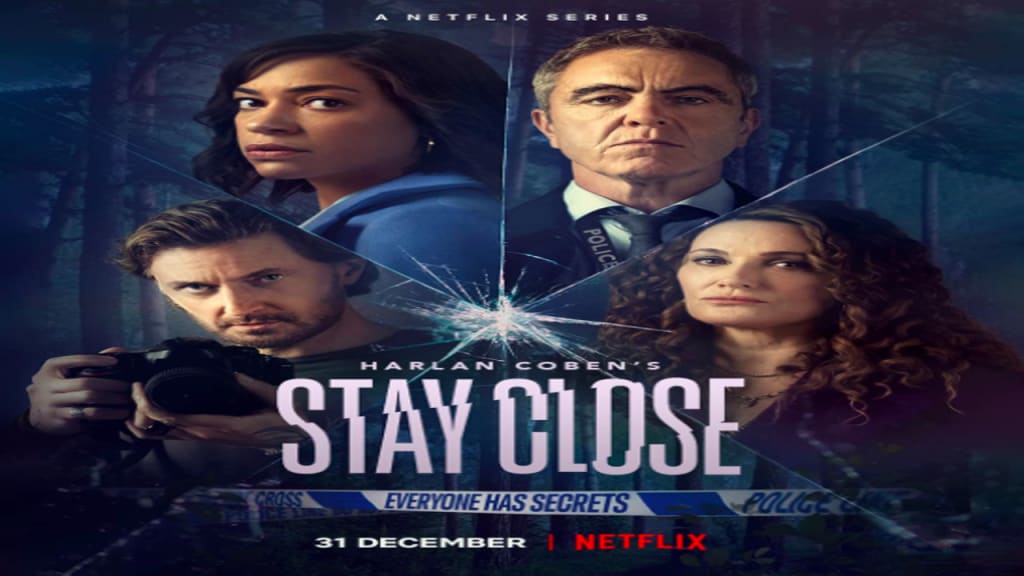
I thought a good way to start off the New Year would be a review of Stay Close, Harbin Coben's latest mini-series, just up on Netflix. I've enjoyed all the series based on his novels, and Stay Close is one of the best.
[Believe or not, no big spoilers ahead.]
Lots of things to like in this classic Coben scenario of a woman about to be married, but, oops, she has a past with a different identity, in this case, just about knocking on her front door.
Among my favorite ingredients:
- James Nesbitt as Detective Broome -- I think of Broome as a British (actually, Northern Irish) Bosch, because, well, Nesbitt looks and acts a lot like Titus Welliver as Bosch, indefatigable, taking it on the chain, heart of gold. Nesbitt was excellent in Bloodlands, and, powerful, again, in Stay Close.
- 'Ken' and 'Barbie' are great villains, with a psycho banter and style right out of Clockwork Orange.
- And speaking of 'Barbie,' the women in Stay Close are every bit as dexterous with weapons as the men. Refreshing to see, including in the protagonist Megan (very well played by Cush Jumbo).
- Another memorable character, Harry Sutton by Eddie Izzard. And good to see Richard Armitage (MI5) again.
Now, as to the plot, I don't want to give too much away, so here's what I'll say. This is a very complex story, with multiple victims and multiple suspects, and the ending surprised me, and since I'm usually pretty good at spotting who did what, I'd say it's likely to surprise you, too.
Which is a good thing. Stay Close is easily bingeable and eminently rewarding,
About the Creator
Paul Levinson
Novels The Silk Code, The Plot To Save Socrates, It's Real Life: An Alternate History of The Beatles; LPs Twice Upon A Rhyme & Welcome Up; nonfiction The Soft Edge & Digital McLuhan, translated into 15 languages. Prof, Fordham Univ.
Keep reading
More stories from Paul Levinson and writers in Criminal and other communities.
Review of 'True Story'
As the year quickly draws to a close, I wanted to tell you that True Story, a seven-episode mini-series my wife and I finished watching last night on Netflix, has to be one of the best crime dramas of year. That's right. Clean out of the ballpark with a fast-moving story that manages to pull the rug out at the end of just about every episode.
By Paul Levinson4 years ago in Criminal
The Last Train Witness
M Mehran The final train left the underground platform at 11:48 p.m. By 11:49, the platform was empty. By 11:52, a man was dead. And by morning, the city would learn that dozens of commuters had been present — yet not a single witness had seen the crime. The Silence Beneath the City The underground transit system ran like veins beneath the metropolis, carrying thousands through tunnels of concrete and fluorescent light. People avoided eye contact, protected their personal space, and guarded their routines. It was an unspoken rule of urban survival: See nothing. Say nothing. Keep moving. On Platform 6, that rule became deadly. The victim, later identified as Markus Engel, lay near the yellow safety line, his briefcase resting inches from his hand. No signs of struggle. No weapon. No obvious motive. Just a body and unanswered questions. Detective Assigned to the Impossible Lena Vogel stood at the platform edge as early trains roared past, wind whipping through her coat. She studied the scene with narrowed focus. “No witnesses?” she asked. Her partner shook his head. “Forty-two passengers used the platform during the window. Every one of them claims they saw nothing.” Lena looked up at the security camera mounted above the stairs. Disabled. Not broken — disabled. “That’s not coincidence,” she murmured. The Man No One Knew Markus Engel was not famous, wealthy, or politically connected. He lived alone, worked as a logistics analyst, and paid his taxes on time. His neighbors described him as polite and forgettable. Which made the contents of his briefcase harder to explain. Inside were documents detailing shipping manifests, customs declarations, and flagged cargo routes. Several entries were circled in red. Lena flipped through the pages. “These aren’t random shipments,” she said. “They’re patterns.” “Of what?” She tapped the paper. “Smuggling routes disguised as legitimate trade.” Forty-Two Shadows Detectives interviewed every commuter identified through transit card scans. A nurse finishing a double shift. A university student listening to music. A restaurant worker heading home. A businessman checking emails. Each described the same scene: Train arriving. Doors opening. People exiting. People boarding. Nothing unusual. Nothing memorable. Nothing seen. Lena replayed their statements in her mind. Not lies — rehearsed absence. Urban invisibility had become a shield. The Camera That Didn’t See Transit technicians confirmed the camera feed had looped exactly three minutes of footage — a deliberate override requiring system access. “This wasn’t a random assault,” Lena said. “Someone planned invisibility.” “Over a logistics analyst?” She held up the documents. “Over what he discovered.” The Reporter Underground Tobias Richter had built his reputation exposing black-market networks operating beneath legitimate commerce. When he heard about Engel’s death, he recognized the shipping codes immediately. “These routes connect three ports and two inland depots,” Tobias explained. “On paper, they move electronics and textiles. In reality, they’re suspected of transporting counterfeit pharmaceuticals and restricted chemical compounds.” “Dangerous?” Lena asked. “Potentially lethal,” he replied. She looked back at the evidence. Markus Engel hadn’t been a victim of random violence. He had been silenced. A Witness Who Didn’t Know He Saw Three days into the investigation, a breakthrough arrived unexpectedly. A ten-year-old boy named Emil had been traveling with his mother that night. While she scrolled through her phone, he had been watching reflections in the dark tunnel window as the train arrived. “I saw a man standing very still,” he told Lena. “Like he was waiting but not getting on.” “Did you see his face?” Emil shook his head. “But he wore gloves. Inside.” Lena’s pulse quickened. Gloves suggested preparation. Control. Intent. “What happened next?” “He stepped forward when the doors opened,” Emil said. “Then people walked in front of him.” “And then?” “He was gone.” The Pattern of Disappearance Transit entry logs revealed a transit card used minutes before the murder — then never again. Fake identity. Disposable access. Professional execution. Tobias traced Engel’s flagged shipments to a shell company operating through layered subsidiaries. The company’s board members existed only on paper. But one name appeared repeatedly in customs overrides: a mid-level compliance officer with authority to clear inspections. Lena stared at the file. “Someone inside the system,” she said. Beneath the Surface A coordinated raid two weeks later uncovered a storage facility filled with mislabeled cargo: counterfeit antibiotics, restricted solvents, and toxic compounds disguised as industrial cleaners. Authorities estimated the illegal trade could have endangered thousands. The compliance officer disappeared the night before his arrest. So did the man who killed Markus Engel. The Weight of Looking Away The transit authority restored the disabled camera footage using backup server fragments. The recovered frames showed only partial images: commuters boarding, blurred movement, a gloved hand briefly visible near Engel’s shoulder. Then nothing. The moment of death hidden behind ordinary motion. Forty-two people present. Forty-two people unaware. Or unwilling to notice. A City Reflects News coverage ignited public debate: How could a murder happen in a crowded space without witnesses? Had technology made people less observant? Had fear replaced responsibility? Sociologists called it diffusion of responsibility. Psychologists described urban desensitization. Commuters insisted they were simply surviving crowded routines. Lena stood again on Platform 6 weeks later, watching passengers move with practiced detachment. She wondered how many stories passed unseen each day. How many warnings went unnoticed. How many lives intersected briefly before vanishing into anonymity. Remembering the Invisible Markus Engel’s name faded quickly from headlines. The smuggling network remained under investigation. Policy reforms were proposed, debated, delayed. But a small plaque appeared near the platform stairs: In memory of Markus Engel Who saw what others missed Commuters walked past it daily. Some paused. Most didn’t. The Last Train Arrives Late one evening, Lena waited as the final train approached. Wind rushed through the tunnel, carrying echoes of steel and distant movement. Passengers stepped off. Others boarded. Reflections shimmered in the dark glass. For a moment, she thought about how easily a person could disappear in plain sight — swallowed by routine, distraction, and silence. Then the doors closed. The train departed. And the platform returned to stillness. But Lena kept watching. Because crime does not always hide in darkness. Sometimes it happens in full view — concealed not by shadows, but by the human instinct to look away. And somewhere beneath the noise of the city, truth still waits for someone willing to see it. SEO Keywords naturally included: urban crime story, underground murder mystery, criminal investigation thriller, smuggling crime network, public safety crime, investigative crime fiction, dark transit mystery, modern crime narrative, city crime thriller.
By Muhammad Mehranabout 6 hours ago in Criminal
Man Who Said Wife Fell on Corn Rake Convicted of Her Murder
He claimed his wife died after she fell backward on a corn rake while working on the family’s farm. Prosecutors said inconsistencies in the pattern proved the injury wasn’t an accident. He’s now serving life without parole in an Iowa prison. As is the case with most crimes, a few supporters contend that Todd Mullis, 43, did not kill Amy, 39.
By Criminal Matters3 days ago in Criminal
📢 Raise Your Voice Thread: 02/19/2026
Our “Raise Your Voice Threads” are hosted most alternating Thursdays at 12PM ET to offer creators more avenues to uncover exceptional stories on Vocal. As we are continuously searching for fresh creators and inspiring stories, this thread provides an opportunity to exchange and discuss the stories that have moved and motivated us on Vocal.
By Raise Your Voice by Vocal2 days ago in Resources



Comments
There are no comments for this story
Be the first to respond and start the conversation.