

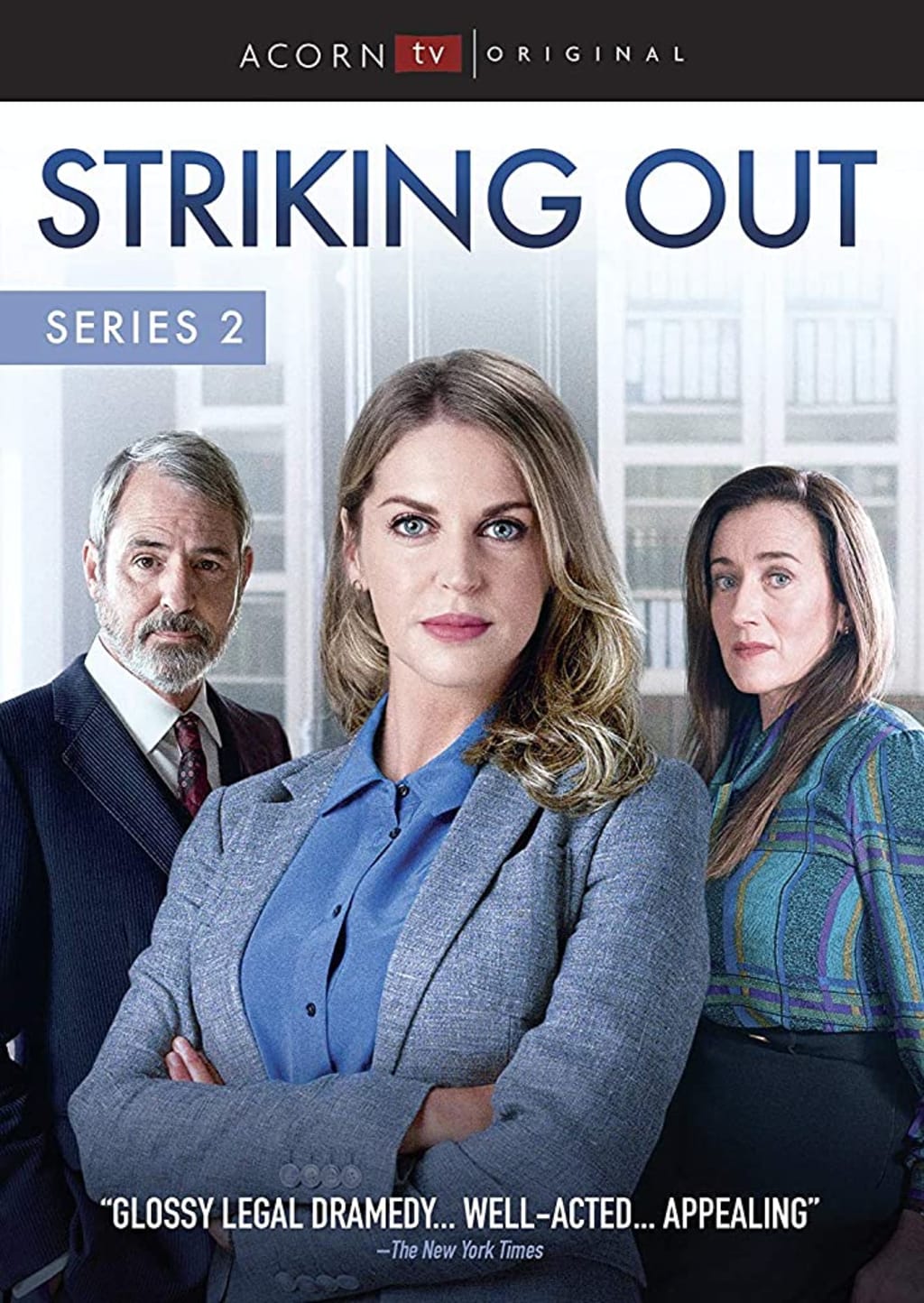
My wife and I binged the two seasons of Striking Out, originally (in 2017-2018) on Irish TV, now on Acorn via Amazon Prime. The show only ran two seasons, and there's apparently no prospect for a third season, which is a shame, because the two seasons were quite good, and the second season ended on an unexpected turn of events.
The set-up of the show is something we've seen before: a happily married or about to be happily married woman comes home to find her man happily going at it in bed with another woman. In the case of Striking Out, Tara and Eric, the about-to-be-married happy couple, both are attorneys, who work in Eric father's firm, and just for good measure, Tara's father is an attorney, too. Lots of possibilities there, and the narrative is especially enjoyable to see because it all takes place in Dublin, a sight for sore eyes in these our current COVID-beset times.
But the stories are good, too, and come in two kinds. One is episodic, as Tara struggles to establish her own practice, and takes this unusual case and that. The other narrative is continuing, and delves into what's going on in Eric's father's firm. It's under investigation, by some kind of independent prosecutor who is both brilliant and drinks too much, and whom Tara comes to sometimes work with, which adds further provocative permutations to the story.
The acting is excellent. Amy Huberman plays an appealing Tara, wounded, powerful, loving, and funny. The supporting cast features Moe Dunford (Vikings), Neil Morrissey (Line of Duty), and Maria Doyle Kennedy and Nick Dunning from The Tudors, so how can you go wrong? The only thing wrong about Striking Out is that there's no third season, so here's a final plea for one in case anyone who can make that happen is reading this.
About the Creator
Paul Levinson
Novels The Silk Code, The Plot To Save Socrates, It's Real Life: An Alternate History of The Beatles; LPs Twice Upon A Rhyme & Welcome Up; nonfiction The Soft Edge & Digital McLuhan, translated into 15 languages. Prof, Fordham Univ.
Keep reading
More stories from Paul Levinson and writers in Criminal and other communities.
Review of 'Balthazar'
My wife and I just finishing bingeing two seasons, sixteen episodes, of Balthazar, the French series on Prime Video Acorn, made in 2018 and 2019, streaming here since April. Despite it being about a Parisian coroner (Balthazar) who cuts open dead bodies and hasn't gotten over the terrible murder of his fiance (or maybe wife) 15 years ago, the series is actually a great pick-me-up in these, our very troubled, times.
By Paul Levinson6 years ago in Criminal
Valentine's Day Murder in Ft. Myers
Valentine’s Day has long been observed as the day of love. Couples around the country go the extra mile to show their significant other how much they mean. It’s also a day when countless murders have occurred. In my opinion, murder on Valentine’s Day is more personal and sends a deeper message than murders committed on other days of the year.
By Criminal Mattersabout 13 hours ago in Criminal
DNA recovered at Nancy Guthrie’s property that doesn’t belong to her or those close to her, sheriff’s office says
Investigators have identified DNA evidence recovered from the property of Nancy Guthrie that does not match Guthrie or anyone known to be closely associated with her, according to a statement released by the county sheriff’s office. The discovery has introduced a new and potentially significant development in an ongoing criminal investigation that has drawn public attention for months. Sheriff’s officials said forensic testing was conducted on biological material collected during a detailed search of Guthrie’s residence and surrounding land. The samples were submitted to a state crime laboratory for analysis. Results confirmed that at least one DNA profile does not correspond to Guthrie or to individuals already identified in the case, including family members, friends, or first responders who were present during the initial investigation. Authorities declined to specify exactly where on the property the DNA was found, citing the integrity of the ongoing inquiry. However, they described the evidence as “relevant and probative,” indicating that it may help investigators determine whether another person was present at the scene during a critical time period. “This DNA does not belong to Ms. Guthrie or anyone within her known circle,” the sheriff’s office said in a written statement. “We are continuing to analyze and compare the profile through national databases in hopes of identifying its source.” The case surrounding Guthrie has remained under active investigation since law enforcement first secured her property following reports of suspicious circumstances earlier this year. While officials have not publicly named any suspects, they have consistently stated that the situation is being treated as a criminal matter rather than an accident or natural death. Forensic experts note that unidentified DNA can be both promising and complicated. While it may point to the presence of an unknown individual, it does not automatically establish guilt or involvement in a crime. DNA can be transferred in many ways, including through casual contact, and investigators must carefully evaluate how and when the material may have been deposited. “This kind of finding opens new avenues, but it also raises questions,” said a former homicide investigator familiar with similar cases. “The challenge is determining whether the DNA is connected to the crime or is simply incidental.” The sheriff’s office confirmed that the DNA profile has been uploaded to national law enforcement databases, including CODIS, in an effort to locate a possible match. If a match is found, authorities would then assess whether the individual had any legitimate reason to be on Guthrie’s property. Family members of Guthrie released a brief statement through an attorney, saying they were encouraged by the development and hopeful that the new evidence would bring clarity. “We want answers,” the statement read. “We trust law enforcement to follow every lead and uncover the truth about what happened.” Community reaction has been mixed, with some residents expressing relief that progress appears to be underway, while others worry the case could remain unresolved for months or even years. The rural nature of the property and the limited number of witnesses have made the investigation particularly challenging. Officials emphasized that the discovery does not change the presumption of innocence for anyone connected to the case. No arrests have been made, and no charges have been filed. Investigators are continuing to review phone records, surveillance footage from nearby areas, and financial transactions that could provide further context. The sheriff’s office also stated that additional forensic testing is underway on other items recovered from the property, including clothing and household objects. Those results have not yet been released. Legal analysts say the presence of unidentified DNA could become central if the case eventually goes to court. Defense and prosecution teams alike would likely scrutinize how the evidence was collected, stored, and interpreted. Any contamination or procedural misstep could weaken its value. “This is a critical moment in the investigation,” said a criminal justice professor. “If the DNA leads to a known individual with no lawful reason to be there, it could reshape the entire narrative of the case.” For now, authorities remain cautious in their public messaging. They urged anyone with information related to Guthrie’s case to come forward, noting that even seemingly small details could prove significant. As the investigation continues, the discovery of DNA from an unknown source stands as one of the strongest forensic leads so far. Whether it will ultimately identify a suspect or simply deepen the mystery remains to be seen. What is clear, officials say, is that the case is far from closed. “This evidence reinforces our commitment to pursue every possible lead,” the sheriff’s office said. “We will not stop until we have a complete and accurate understanding of what occurred.” The coming weeks are expected to bring further updates as forensic comparisons continue and investigators follow new lines of inquiry prompted by the DNA findings.
By Fiaz Ahmed about 10 hours ago in Criminal
I Don't Need My Phone... Wait, Is That Actually True?
My parents gave me my first cell phone when I was twelve years old. It wasn't a fancy iPhone or anything, not even close. Just a simple black flip phone for when I needed to call or text them after school.
By Madison "Maddy" Newtona day ago in Humans




Comments
There are no comments for this story
Be the first to respond and start the conversation.