
The Debt That Can Never Be Paid: Why Justice Demands More Than Punishment
We Lock People Away and Call It Justice, But True Accountability Means Facing the Human Cost—On Both Sides
There is a debt that can never be paid. Not with time served, not with remorse expressed, not with any sentence a court can impose. When one person takes from another—a life, a sense of safety, a future—the scales can never be fully balanced. Something is gone forever. Someone is missing forever. And the person who caused that loss carries a weight that no amount of punishment can lift. This is the terrible truth at the heart of criminal justice: we are trying to measure the immeasurable, to repair the irreparable, to balance scales that will always tip.
We have built a system that pretends otherwise. We assign numbers to harm—years of incarceration, dollars of restitution, levels of offense. We process millions of cases through this arithmetic, calculating what is owed and what has been paid. The numbers give us the illusion of justice, of closure, of accounts settled. But the numbers are lies. They cannot capture the hole in a mother's heart. They cannot measure the nightmares that wake a survivor in the dark. They cannot quantify the life that will never be lived, the children who will never be born, the love that will never be given. The numbers are just numbers. The debt is infinite.
The people who commit crimes carry this truth whether they acknowledge it or not. Some spend their entire sentences—and their entire lives—running from it, building walls of denial, convincing themselves that they are victims too, that the system is unfair, that what they did was not so bad. Others face it directly, and it nearly destroys them. The weight of what cannot be undone is heavier than any chain, any cell, any punishment the state can devise. To truly see the face of the person you have harmed, to understand the fullness of what you have taken, is to enter a kind of prison from which there is no release.
I think about a man I came to know through a restorative justice program. He had killed someone decades ago, in a moment of drunk driving. The other driver, a father of three, had died at the scene. My acquaintance served his time—fifteen years, every day of it. He got out, tried to rebuild his life, tried to move forward. But he could not. Not because the system kept punishing him—he had paid his debt, by the numbers. But because the real debt could never be paid. He told me that not a day went by when he did not think about the man he killed, the children who grew up without a father, the wife who had to tell them their dad was not coming home. He carried them everywhere. They were his permanent companions.
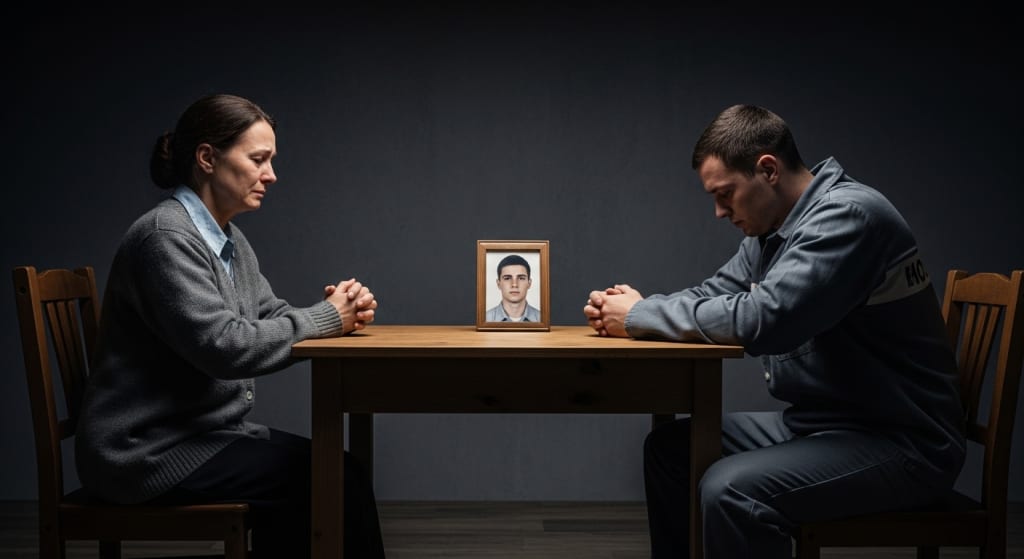
He wanted, more than anything, to meet the family. Not to explain, not to defend, not to ask for forgiveness—he did not believe he deserved it. Just to say, face to face, that he knew. That he carried them. That he was sorry in a way that words could not capture. It took years to arrange. The family was understandably reluctant. But eventually, they agreed. They met in a room like the one in the image—a simple table, two chairs, a photograph between them. He spoke first. He told them he thought about their husband, their father, every day. He told them there was no excuse, no justification, nothing that could undo what he had done. He told them he was sorry, knowing the word was laughably inadequate. And then he waited.
The widow looked at him for a long time. She later said she had imagined this moment a thousand times, rehearsed the things she would say, the anger she would unleash. But when the moment came, something else happened. She saw a man, not a monster. A man who was also broken, also carrying something that would never heal. She did not forgive him—not then, maybe not ever. But she saw him. And in that seeing, something shifted. Not the debt—that remained, infinite and unpayable. But the isolation of carrying it alone, on both sides, eased just slightly.
This is what restorative justice offers that punitive justice cannot: the possibility of recognition. Not forgiveness, necessarily. Not reconciliation, always. But the chance to sit in the same room and acknowledge, together, that something terrible happened and can never be undone. The chance to speak and be heard, to ask and to answer, to see the humanity in the person who caused the harm and the person who bears it. This does not balance the scales. Nothing can. But it makes the weight slightly more bearable, because it is no longer carried alone.
The punitive system we have built does not allow for this. It separates offender from victim, physically and emotionally. It tells the victim that their role is to provide testimony and then step aside while the state pursues justice on their behalf. It tells the offender that their debt can be paid in years and days, that release means resolution. Both are lies. The victim is left with their grief, their questions, their unmet need to be heard. The offender is left with their guilt, their isolation, their unanswered longing to make things right. The system processes them separately and calls it justice. But justice that does not address the human heart is not justice at all.
The alternatives exist. Restorative justice programs around the world have brought victims and offenders together in carefully facilitated meetings, with remarkable results. Not always—some victims cannot bear it, some offenders are not ready, some harm is too great. But when it works, it works at a depth that punishment never reaches. Victims report feeling heard, validated, able to move forward. Offenders report a kind of release, a lifting of the isolation of guilt. Both sides report that something shifted that they did not think could shift. The debt remains. But the carrying of it changes.
These programs are not soft on crime. They are harder on crime than prison ever is. Prison allows an offender to serve time and forget, to focus on survival, to avoid the face of the person they harmed. Restorative justice demands that they look, that they listen, that they sit with the full weight of what they have done. Many say they would rather serve extra years than go through that meeting. That is how hard it is. That is how real.
The photograph on the table between them holds everything. It holds the life that was lived, the life that was lost, the future that will never come. It holds the grief of the woman who loved him, the absence her children will always feel, the hole in the world where he used to be. It holds the weight that the other man will carry for the rest of his life, the knowledge that he did this, that it cannot be undone, that he is forever connected to this family by an act he would give anything to reverse. The photograph holds all of it. And in the silence, in the room, in the presence of that image, something real happens. Not resolution. Not repair. But recognition. And recognition is the beginning of everything.
The debt that can never be paid is real. It is the fundamental truth at the heart of criminal justice, the truth our system is designed to ignore. We pretend that years can balance lives, that time served can equal time taken, that punishment can restore what was lost. But the pretense is crumbling. More and more people are asking: what would justice look like if it took the human heart seriously? What would it mean to hold offenders accountable in ways that actually address the harm? What would it look like to support victims in ways that go beyond testimony and waiting?
The answers are emerging, in small rooms with simple tables, in conversations that no one wants to have and no one can avoid forever. They are emerging in the faces of victims who choose to meet the people who harmed them, in the faces of offenders who choose to look and listen and carry what they cannot undo. They are emerging in the recognition that justice is not a number but a relationship, not a sentence but a process, not a debt to be paid but a wound to be tended.
The room is quiet. The photograph is still. The two people on either side of the table carry what they carry, together now, in the same space, under the same light. Nothing is fixed. Nothing is finished. But something has begun. And beginning is the only way anything ever changes.
About the Creator
HAADI
Dark Side Of Our Society
The Midnight Confession
M Mehran At exactly 12:03 a.m., the confession arrived. No envelope. No fingerprints. No return address. Just a plain white sheet slid under the glass doors of the central police station in the heart of the city. By morning, three detectives, one journalist, and an entire criminal investigation unit would be consumed by its contents. Because the letter did not confess to a crime. It confessed to seven. A City Awake in Darkness The city never truly slept. Neon reflections shimmered in puddles, and distant sirens blended with late-night traffic. In the shadows between high-rise apartments and aging brick buildings, deals were made, secrets were buried, and truth was negotiated. Crime here wasn’t loud. It was quiet. Organized. Invisible. And for years, someone had been watching. Detective Hanna Weiss Hanna Weiss arrived at the station before sunrise, her boots echoing across the tiled floor. She was known for solving cases others abandoned — not because she followed rules, but because she understood people. The night officer handed her the letter with a nervous expression. “No prints. No cameras caught anything,” he said. She unfolded the page. The handwriting was precise. Unemotional. Deliberate. I confess to the following crimes: • Arson – Dock Warehouse 12 • Armed robbery – Nordbank transport van • Kidnapping – case #44721 (victim recovered) • Data theft – municipal records breach • Extortion – three corporate entities • Evidence tampering – ongoing corruption trial • Murder – December 14, Riverside District I am ready to be judged. But first, you must understand why. — A Citizen Hanna read it twice. Then a third time. Confessions were rarely neat. Criminals lied, deflected, justified. They did not itemize. And they did not invite understanding. The Reporter Who Wouldn’t Let Go By 8:00 a.m., news of the confession had leaked. Jonas Keller stared at the photocopy on his desk, his coffee growing cold. He specialized in corruption stories — the kind that earned threats instead of awards. The murder listed in the confession caught his attention. December 14. Riverside District. Official ruling: unsolved. Unofficial whispers: silenced whistleblower. Jonas grabbed his coat. If the confession was real, the city was about to fracture. Crime Scene Reopened Riverside District smelled of damp concrete and river mist. The alley where the body had been found remained unchanged — forgotten by the city, remembered only by rumor. Hanna crouched near the spot marked months earlier. “Victim was Lukas Brandt,” she said to Jonas, who had appeared without invitation. “Financial auditor. Found with blunt force trauma.” Jonas nodded. “He was preparing testimony against infrastructure contracts.” Hanna glanced at him. “You knew?” “I tried to interview him,” Jonas replied. “He canceled the night he died.” They exchanged a look. The confession had turned coincidence into pattern. A Criminal with a Purpose By midday, detectives confirmed details from the letter. The warehouse fire exposed illegal chemical storage. The bank transport robbery stole untraceable cash later linked to bribery funds. The kidnapping victim was a corporate accountant who later testified against embezzlement. Each crime had targeted wrongdoing. Each victim was connected to corruption. This was not random criminal activity. This was surgical. The Message Hidden in Crime Back at the station, Hanna spread case files across the table. “This person isn’t committing crimes for profit,” she said. Jonas leaned forward. “They’re correcting something.” “Or punishing it.” They studied the final line again: You must understand why. Hanna tapped the paper. “This isn’t a confession.” “It’s a summons,” Jonas said. The Second Letter At 11:57 p.m. the following night, the second letter arrived. This time addressed directly to Detective Weiss. Inside was a USB drive. One video file. Hanna hesitated before pressing play. A hooded figure sat in shadow, voice distorted but calm. “I did these things,” the figure said. “Every charge is true. But the law failed before I did.” Images flashed across the screen: Bribed inspectors. Altered safety reports. Destroyed evidence. Threatened witnesses. Then the face of Lukas Brandt appeared — alive, speaking urgently. “If anything happens to me,” he said in the recording, “the contracts must be exposed.” The video ended. Silence filled the room. Jonas exhaled slowly. “He was killed to stop testimony.” Hanna nodded. “And someone decided the system wouldn’t deliver justice.” Criminal or Catalyst? The city divided overnight. Some called the confessor a terrorist. Others called them a hero. Talk shows debated morality versus legality. Social feeds flooded with arguments. Victims of corporate negligence spoke publicly for the first time. And still, no suspect emerged. Until the third message. Midnight, Riverside Bridge Come alone. Bring the truth. Hanna arrived just before midnight, fog rolling over the river like drifting smoke. A figure stepped from the shadows. Not armed. Not threatening. Just tired. “I never wanted to hurt anyone,” the voice said. “Except you did,” Hanna replied. The figure removed the hood. A woman in her early thirties. Pale. Determined. “My father died in Dock Warehouse 12,” she said. “Toxic exposure. Reports were falsified. No one charged.” She swallowed. “Lukas Brandt tried to fix it. He was killed. Evidence vanished. Witnesses disappeared. So I made sure the truth couldn’t.” “By committing crimes,” Hanna said. “By forcing truth into daylight.” Sirens sounded faintly in the distance. The woman extended her wrists. “I’m ready to be judged,” she said. Hanna hesitated. Law demanded arrest. Justice demanded reflection. She placed cuffs gently on the woman’s wrists. The Confession Heard Worldwide By morning, the full story dominated headlines: WHISTLEBLOWER MURDER LINKED TO INFRASTRUCTURE CORRUPTION CONFESSION EXPOSES SYSTEMIC COVER-UP PUBLIC INQUIRY LAUNCHED The woman’s crimes remained real. But so did the corruption she exposed. Families demanded reform. Officials promised transparency. Investigations reopened. And for the first time in years, accountability seemed possible. The Weight of Truth Jonas published his story three days later. Not about a criminal mastermind. But about a system that forced ordinary citizens into extraordinary actions. Hanna visited the detention center that evening. “Was it worth it?” she asked through the glass. The woman considered. “The truth is finally visible,” she said. “You decide.” A City Forced to Look Crime had shaken the city. But truth had awakened it. Streetlights flickered on as night returned, illuminating bridges, rooftops, and alleys where secrets once thrived unchallenged. Justice would take years. Reform would face resistance. Memory would fade. But something had shifted. Because one confession had forced an entire city to confront a question more unsettling than crime itself: What happens when justice fails — and citizens take its place? And long after the headlines faded, the echo of that midnight confession continued to haunt the corridors of power. SEO Keywords naturally included: crime story, criminal confession, corruption crime, justice system failure, urban crime thriller, investigative crime narrative, dark city mystery, true crime style fiction, criminal investigation story.
By Muhammad Mehrana day ago in Criminal



Comments
There are no comments for this story
Be the first to respond and start the conversation.