
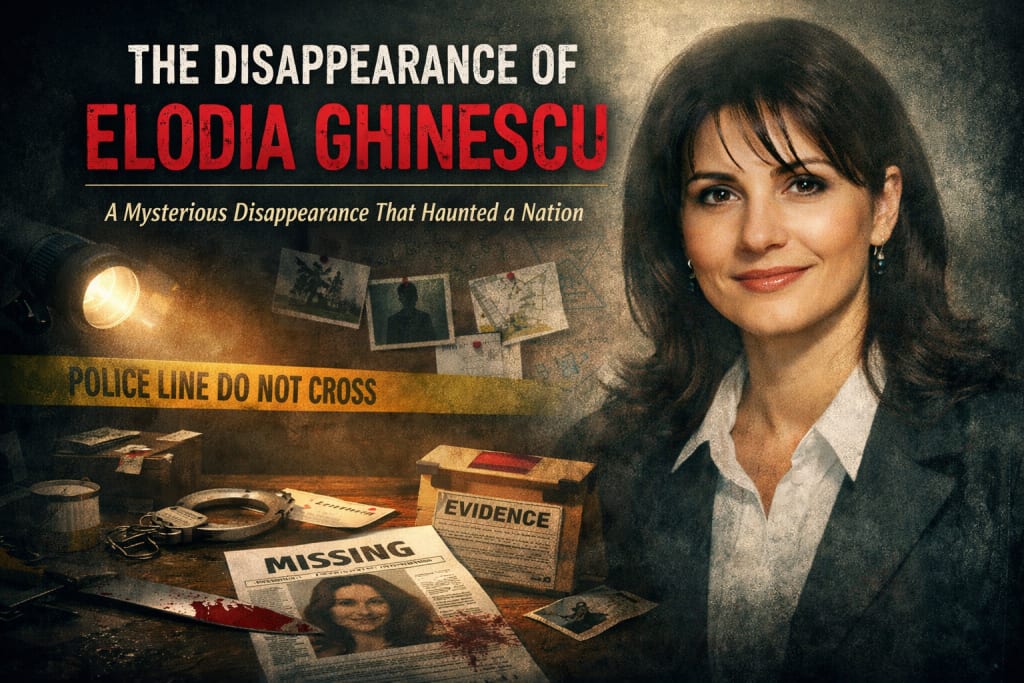
The Disappearance of Elodia Ghinescu: Romania’s Most Infamous Unsolved Murder
A Mysterious Disappearance That Haunted a Nation

Introduction
In the early 2000s, Romania was gripped by a criminal mystery that seemed to combine elements of drama, betrayal, and unresolved truth. This was the disappearance of Elodia Ghinescu, a lawyer from Brașov whose vanishing would become one of the most talked-about and controversial crime cases in the country’s modern history.
The story fascinated the public not just because it involved a missing person, but also because it revealed cracks in trust — between spouses, between citizens and institutions, and between the media and the truth.
In this piece, we’ll dive into what happened, how the case unfolded, why it captivated the nation, and how questions still linger even years after the crime.
Who Was Elodia Ghinescu?
Elodia Marilena Ghinescu was a lawyer based in Brașov, Romania. Known to colleagues as intelligent and driven, she had a professional reputation that contrasted sharply with the dramatic way her life — and presumed death — would later unfold.
In 2004, she married Constantin Cristian Cioacă, a chief police inspector. Their marriage was troubled, with arguments, jealousy, and legal battles punctuating their relationship. These personal issues would later become central to the investigation into her disappearance.
The Disappearance
In August 2007, Elodia disappeared without a trace. What made the case unusual was not just the disappearance itself, but the way information about it trickled out — often incomplete, often muddled, and frequently contradictory.
Her husband, Cioacă, initially claimed that she had left voluntarily, suggesting that she had run off or was having an affair. This explanation did little to satisfy the police or the public, especially as time passed with no sign of her.
At the time, the media closely followed the case. News channels, newspapers, and talk shows debated every detail: from the couple’s personal life to the possible motives behind her disappearance. Romania had never before seen a missing person case turn into such national spectacle.
The Investigation
As the investigation continued, prosecutors and detectives turned their attention more and more toward Elodia’s husband. Suspicion grew that Cioacă might have been involved in her disappearance in a far more sinister way than he ever admitted.
DNA testing played a crucial role months later. Investigators collected samples from the Ghinescu household and sent them for analysis. The results reportedly indicated that Elodia’s genetic material matched traces found in the couple’s apartment — especially in areas that could only be explained by foul play.
Despite the absence of a body, prosecutors believed they had enough evidence to take legal action. It was a rare move, as most murder cases require a body to definitively prove that a crime occurred. Romania has only seen a handful of murder convictions without a body being found — and this would become one of them.
The Trial and Conviction
Eventually, Cristian Cioacă was arrested and charged with the premeditated murder of his wife. After months of testimony, legal debate, and intense media scrutiny, the court found him guilty. He was sentenced to a lengthy prison term — though for many, questions remained long after the verdict.
One of the striking elements of the case was that, despite the conviction, Elodia’s body was never found. This meant that no definitive closure was available — no burial site, no remains, nothing beyond DNA links and circumstantial evidence.
This absence of physical evidence allowed conspiracy theories and speculation to flourish. Was the body truly destroyed? Was it hidden so well that no one could find it? Did someone else help cover up the trail? These questions haunted public discussion for years.
Why This Case Captivated Romania
What made the disappearance of Elodia Ghinescu stand out wasn’t just the crime itself — brutal as it was — but the way it was experienced by the Romanian public. Here’s why it captivated national attention:
1. Personal Drama Played Out in Public
The strained marriage, accusations of infidelity, and the fact that the husband was a police inspector added layers of drama and irony that appealed to media narratives.
2. The Mystery of the Missing Body
Most murder cases are solved with a body — making the conviction in this case particularly unusual. The absence of a body kept curiosity alive for years.
3. Media Frenzy
Romanian news outlets turned the case into a long-running story, with reporters following every development. When the media focuses on a single case for months, the public inevitably becomes invested — almost personally.
4. Public Distrust of Institutions
Because the legal system had to navigate a conviction without a body and based in part on forensic evidence, many ordinary people debated whether justice was truly served. This controversy highlighted broader issues of trust in law enforcement and courts.
Aftermath and Legacy
Years after the conviction, the case of Elodia Ghinescu still lingers in Romanian collective memory. It’s referenced in discussions about missing people, forensic science, and media responsibility.
For some, it’s a tragic story of a lawyer lost in a domestic dispute that escalated to murder. For others, it’s a cautionary tale about how relationships can hide dangerous undercurrents. And for many, it’s simply one of the most dramatic crime stories modern Romania has ever seen.
Conclusion
The disappearance of Elodia Ghinescu remains more than just a crime case. It challenged how Romanians viewed justice, media, and truth itself. A woman vanished, a husband was convicted, and a nation watched — captivated, conflicted, and still asking questions.
Even today, long after headlines have faded, the story continues to spark debate: Was justice served? Could the mystery ever really be solved? And, perhaps most hauntingly, what truly happened to Elodia?
About the Creator
A Breakup That Ended in Murder: The Dark Side of Emotional Dependency
In November 2016 a young relationship in Loxahatchee Florida ended in a tragedy that would leave an entire community searching for answers.At the center of the case were James Barry a 21-year-old college student, and his former girlfriend, Melanie Eam, who was 22 at the time.Their relationship, which began like many others between young adults navigating school and early adulthood, gradually took a troubling turn. According to accounts later presented in court, Melanie became increasingly fixated on James and on maintaining constant access to his life. What may have initially felt like devotion slowly transformed into something far more consuming.
By Kure Garba5 days ago in Criminal
Craft Over Catharsis Challenge Winners
Craft Over Catharsis? What the hell does that even mean? The phrase came out of a curation meeting as a genuine question. We had been noticing that many challenge entries, across prompts, naturally gravitate toward trauma, grief, and personal reckoning. That makes sense. Writing is often cathartic. It's one of the ways we process what we've lived through.
By Vocal Curation Team6 days ago in Resources




Comments (1)
Fascinating, thanks!