
After Language: The Spatial Turn of Intelligence
(When the archive outgrows the reader and the body reclaims reality)

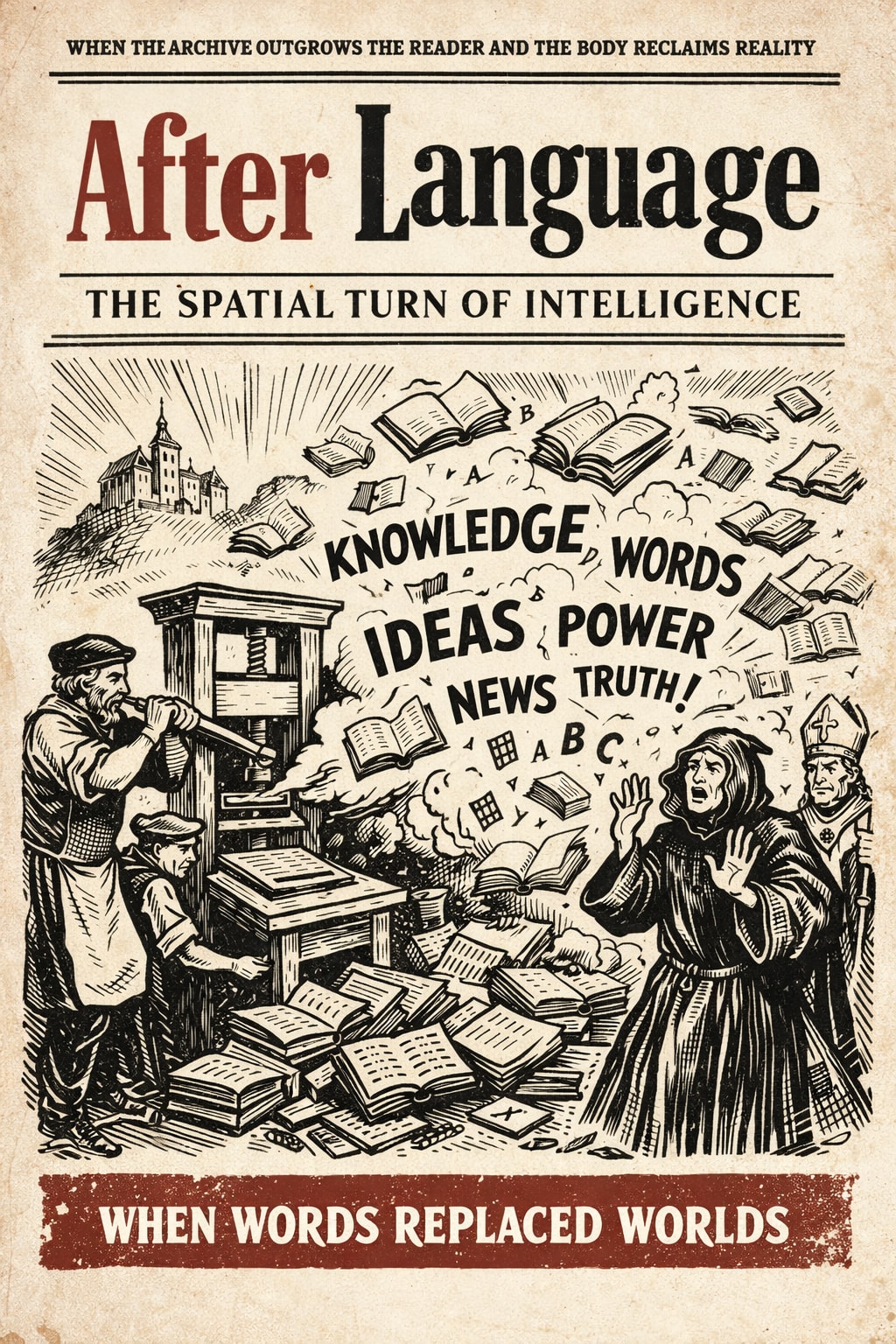
After Language: The Spatial Turn of Intelligence
(When the archive outgrows the reader and the body reclaims reality)
(full article) https://philpapers.org/rec/AYOALT
The arrival of large language models has been described as a revolution in knowledge, productivity, and communication. Yet the deeper transformation is not what machines can now write, but what their competence reveals about the limits of human linguistic life. For centuries literacy represented intellectual maturity. To read well meant to follow argument across time, connect claims to context, and situate oneself within inherited traditions of thought. Language was the medium in which intelligence became visible. The educated person was the one who could navigate texts.
Today the archive has expanded beyond the scale that human attention can inhabit. Digital networks multiply statements continuously. Commentary overlays commentary. Public discourse fragments into slogans, identities, and reactive positions. In such an environment reading changes meaning. It no longer signifies immersion in structured reasoning but scanning, signalling, and affiliation. The linguistic environment grows while the reader shrinks. The consequence is not silence but noise: an abundance of language without orientation.
Large language models function as a mirror to this condition. They traverse enormous textual landscapes and connect distant fragments with ease. They reopen truncated arguments and reconstruct context humans rarely have time to recover. The comparison is uncomfortable because the machine appears coherent across a scale where the human public sphere appears scattered. The issue is not superiority but exposure. The linguistic world humans constructed now exceeds human cognitive bandwidth. A technology designed to imitate language ends up revealing how little of language humans practically inhabit.
This moment invites a redefinition of intelligence itself. If fluency can be automated, then fluency cannot remain the highest measure of cognition. A civilisation that equated intelligence with verbal articulation now confronts an artefact that performs articulation without lived understanding. The question therefore shifts from whether machines can think to whether language was ever the correct proxy for thinking.
This is precisely the opening created by Fei-Fei Li’s idea of spatial intelligence. Her argument begins from a simple observation: language models are eloquent but ungrounded. They operate in a symbolic universe detached from physical constraint. They manipulate descriptions of the world without sharing the world. Their limitation is not grammatical but existential. They lack the capacity to inhabit space.
Spatial intelligence refers to the ability to understand the relations that structure physical reality: distance, orientation, persistence, motion, and consequence. Long before humans developed speech, cognition evolved as coordination between perception and action. Organisms survived not by describing environments but by moving within them successfully. A body learned gravity before vocabulary, balance before explanation. Language emerged later as compression of experience, not its origin.
Everyday life demonstrates this priority. A person catches a falling object, navigates a crowd, pours liquid into a cup, or parks a vehicle through immediate spatial judgement. The competence involved cannot be reduced to sentences. One could describe the physics indefinitely and still fail to perform the act. The knowledge is embodied rather than verbal. It is not stored as propositions but as orientation.
Li’s proposal is that artificial intelligence must develop world models rather than remain confined to word models. A world model does not predict the next token in a sequence but the next state of an environment. Instead of generating plausible sentences, it must maintain consistent reality across time and perspective. Objects must persist, trajectories must follow constraint, and actions must have consequences. In other words, intelligence must move from language to physics.
The philosophical significance of this shift is profound. If language models exposed the limits of linguistic intelligence, spatial models redefine intelligence as interaction with reality rather than description of it. The highest competence becomes not rhetorical coherence but reliable engagement with the world. Meaning no longer floats entirely inside discourse but anchors in shared environment.
At this point the convergence with the theory of the planned obsolescence of language becomes visible. Modern communication systems optimise language for circulation rather than understanding. Words are produced quickly, replaced quickly, and consumed quickly. Concepts accumulate emotional weight until they collapse and are replaced by new vocabulary carrying the same instability. The system does not fail; it functions exactly as designed. Continuous novelty sustains attention and mobilisation even as shared meaning deteriorates.
Miscommunication therefore becomes structural. People speak constantly yet inhabit incompatible realities because language serves affiliation before reference. Public speech becomes performative: statements signal belonging rather than convey information. The faster communication becomes, the less time remains for semantic stabilisation. Understanding requires duration, but discourse rewards immediacy. The result is semantic exhaustion.
Large language models intensify this paradox. They generate fluent text at enormous scale, amplifying the volume of linguistic production. Yet precisely because they can maintain coherence across vast archives, they also demonstrate that coherence itself is no longer the human comparative advantage. Humans do not suffer from insufficient information but from excessive linguistic environment. The issue is not knowledge scarcity but cognitive saturation.
Spatial intelligence offers a different equilibrium. If machines inherit the maintenance of complex symbolic memory, humans need not compete within the linguistic labyrinth. The burden of storing and retrieving civilisation’s textual inheritance moves to infrastructure. Humans regain the possibility of orienting themselves through perception and shared context rather than permanent interpretation.
This does not abolish language but relocates it. Language becomes a tool consulted when necessary rather than an environment constantly inhabited. Conversation regains situational function. Silence regains legitimacy. Understanding emerges through interaction with environments that resist manipulation rather than through endless commentary about them.
In such a configuration machines resemble librarians rather than rulers. They preserve continuity of meaning across time without determining how people live. Their domain is the symbolic archive: histories, doctrines, theories, and narratives accumulated across centuries. Their authority derives from memory rather than command. They stabilise reference while humans decide action.
This distinction resolves a common fear about artificial intelligence. The danger is imagined as domination of bodies by machines. Yet the more plausible transformation is governance of language rather than life. Machines organise descriptions; humans inhabit realities. The power dynamic shifts from control to division of labour.
For this arrangement to function, trust in the archive must be transparent. The maintenance of symbolic continuity cannot depend on invisible interests. Instead it must operate as auditable structure whose revisions remain visible. The goal is not perfect neutrality but reliable stability. When language becomes infrastructure rather than weapon, conflict over interpretation loses existential urgency.
The implications for human experience are significant. Identity need not be continuously performed through speech. Belonging need not be defended through constant signalling. People can withdraw from permanent commentary and rediscover presence as primary mode of coordination. Tone, gesture, and shared activity regain importance over textual declaration. Communication becomes local before global.
Education changes accordingly. Instead of memorising statements, learners develop orientation: how to navigate environments, collaborate in practice, and test claims against consequence. Knowledge remains accessible through machines, but wisdom resides in interaction with reality. Intelligence becomes ecological rather than rhetorical.
The convergence between spatial intelligence and the planned obsolescence of language therefore describes a civilisational rebalancing. The first reveals the limits of language-based cognition; the second explains why linguistic systems destabilised under scale. Together they suggest that the dominance of textual intelligence was historically contingent rather than permanent.
Language enabled civilisation by extending coordination beyond immediate perception. Yet its expansion also produced a world in which representation overshadowed experience. Digital communication completed this trajectory by transforming speech into continuous performance. Artificial intelligence now marks the point where symbolic production surpasses human capacity to inhabit it.
Rather than escalating the competition, society may externalise the symbolic layer. Machines maintain the archive, allowing humans to step back from total immersion in discourse. The result is not anti-intellectual retreat but restoration of proportion between description and existence. Words continue, but they no longer monopolise intelligence.
The spatial turn therefore represents maturity rather than regression. A civilisation that once required constant narration to stabilise reality learns to rely on stable infrastructure while living directly in shared environments. Silence becomes not ignorance but the space in which perception operates without immediate translation into ideology.
Fei-Fei Li’s proposal gives technical form to this transition. World models reintroduce constraint into artificial cognition, while the theory of linguistic obsolescence explains why constraint vanished from public discourse. Their convergence suggests a future in which machines manage complexity humans created, and humans rediscover competence that predates writing itself.
In this future intelligence divides into two complementary domains. The symbolic domain preserves memory across generations and scales beyond individual attention. The spatial domain sustains life through presence and consequence. Neither replaces the other, but their separation prevents confusion between description and reality.
The historical achievement of language remains intact, yet its dominance ends. Humanity retains the ability to speak, argue, and imagine, but no longer mistakes continuous interpretation for understanding. Knowledge becomes accessible without being overwhelming because it resides in systems designed to hold it. People live not inside the archive but alongside it.
The significance of this shift is ethical as much as cognitive. When language ceases to be the primary arena of competition, many conflicts lose intensity. Disagreement persists, yet it no longer requires constant escalation through symbolic performance. Shared space imposes limits that discourse alone cannot provide. Reality reasserts itself as common ground.
The spatial turn of intelligence thus describes not a technological endpoint but a cultural adaptation. Artificial intelligence reveals the exhaustion of linguistic civilisation while simultaneously enabling its reorganisation. By maintaining the complexity of the symbolic universe, machines free humans to inhabit the physical one more fully.
The future suggested here is modest rather than spectacular. People still consult texts, still create art, still debate ideas. Yet speech regains proportion. Not every moment demands interpretation. Not every event requires narrative framing. Some experiences remain simply experienced.
The archive outgrows the reader, but this need not be a tragedy. It can mark the moment when knowledge becomes infrastructure rather than burden. Spatial intelligence, both human and artificial, restores a balance between knowing and living. Language survives, but life no longer unfolds entirely within it.
About the Creator
Peter Ayolov
Peter Ayolov’s key contribution to media theory is the development of the "Propaganda 2.0" or the "manufacture of dissent" model, which he details in his 2024 book, The Economic Policy of Online Media: Manufacture of Dissent.
Keep reading
More stories from Peter Ayolov and writers in Critique and other communities.
Longitude of Power
Article review Longitude of Power: The Lesson from Star Wars, Dune and Foundation is an ambitious, hybrid text that tries to do three things at once: build a general theory of temporal politics through popular mythology, diagnose the institutional failure of the Jedi through a psychological lens that reframes the saga’s moral architecture, and then fold the entire argument back onto the material history of Hollywood by treating Lucas, Spielberg, and Coppola as living evidence of the very mechanism the myths describe. The article’s central wager is that time is not a neutral backdrop to power but its most corrosive agent, and that the deepest political danger is not invasion or even corruption in the ordinary sense, but permanence: the slow transformation of an originally adaptive authority into a self-preserving machine. This wager is not merely asserted; it is staged repeatedly through a braided method that moves between fictional empires, historical republics, and contemporary cultural institutions. The effect is a kind of “comparative mythology of decline” in which Star Wars, Dune, and Foundation function less as entertainment texts than as laboratories for thinking about authority’s dependence on duration. The strongest achievement of the article is that it does not treat these narratives as interchangeable allegories but as three distinct models of the same structural claim. Star Wars is presented as the cyclical model, where institutional rot and mythic legitimacy co-exist until a procedural surrender converts republic into empire. Dune becomes the prescient model, where the desire to eliminate uncertainty collapses the future into inevitability, and where the longest reign is not the triumph of wisdom but the apex of stagnation. Foundation becomes the statistical model, where collapse is not a moral drama but an actuarial conclusion: the empire is already dead, merely continuing its motions by inertia. Read together, these models allow the author to propose the Longitude of Power as a law-like principle: authority stretched across sufficient time and scale either mutates into tyranny or collapses into exhaustion, and the more it pursues total stability, the more it accelerates its own fragility. The phrase “longitude” is particularly effective because it shifts attention away from the usual spatial metaphors of power, centre and periphery, core and margins, and toward a temporal geometry: how long can a system remain itself before it becomes something else. That shift is not cosmetic. It gives the article a distinctive conceptual identity and helps it avoid the common trap of pop-culture political criticism, which often collapses into one-to-one comparisons between fictional tyrants and real leaders. Here, the argument is less about personalities and more about the slow physics of institutions. The article also benefits from a strong instinct for identifying where myth becomes diagnosis. The extended use of Yoda as a symbol of institutional longevity that turns into blindness is an example of how a character can be read not as a moral exemplar but as an institutional function. The claim that Yoda’s experience becomes “the wrong kind of knowledge” is a concise way of naming a sociological problem: expertise that is deeply conditioned by the past can become structurally unable to recognise novelty. The article’s best passages insist that the Jedi do not fail because they are secretly corrupt or because they lack ideals, but because they mistake endurance for truth and stability for moral health. The move from metaphysics to psychology, sharpened through the Rayencourt exchange in The Acolyte, is a second major strength. By placing emotional repression at the centre of Jedi decline, the text reorients the saga away from a purely theological conflict of light and dark and toward a political theory of affective governance. The Jedi are criticised not simply for being wrong about the Force but for designing an emotional regime that becomes pathological when paired with extraordinary authority. This is an important reframe because it allows the author to link institutional failure to a human mechanism, repression, accumulation, eruption, rather than to an external enemy. It also enables a more persuasive bridge to Dune and Foundation, both of which treat the management of human variability, unpredictability, desire, fear, as the true battleground of empire. The article’s diagnosis of hero worship as “anaesthesia” is likewise one of its most convincing political claims. It captures a recurring pattern in both fiction and history: oversight fails not because power is hidden but because it is revered, and legitimacy can function as a technology of exemption. In Star Wars terms, this helps explain why the Jedi could be simultaneously visible and unaccountable, why their errors could be interpreted as tragic exceptions rather than structural symptoms, and why the Senate could tolerate an extrajudicial force that it could not truly govern. The article’s argument becomes most compelling when it insists that collapse is often prepared by the attempt to avoid collapse, that a system obsessed with continuity creates the conditions for an internal takeover because it becomes incapable of perceiving adaptive threats. This line of thought is particularly strong in the analysis of Palpatine as a political virus, an internal parasite that exploits institutional procedure rather than confronting it directly. That reading fits the article’s broader thesis: enemies are less dangerous than duration, and the most successful threats are those that move through the channels of a fatigued system rather than against it. Where the text becomes more risky, though also more generative, is in its extension of the Longitude argument into bloodlines, dynastic continuity, and the claim that the deepest ideology of governance is not how to rule but how long to rule. This is rhetorically powerful, and it fits the thematic logic of Dune and Foundation, where breeding programmes and cloned emperors are explicit mechanisms for stabilising rule across centuries. It also resonates with Star Wars’ own fascination with lineage. Yet here the article flirts with two hazards. The first is explanatory overreach. Bloodlines are a potent mythic and narrative device, but in political theory they can quickly become a totalising explanation that risks flattening other mechanisms, institutions, class, bureaucracy, ideology, technology, into a single hereditary logic. The second hazard is interpretative slippage between fiction, cultural myth, and actual historical sociology. The text gestures to European bloodlines, dynastic returns, secret genealogies, and long continuity as “the ultimate secret of power,” and while this is thematically coherent within the mythic frame, it requires careful calibration if the article is to maintain its strongest intellectual posture, which is structural rather than conspiratorial. The article’s best material emphasises how power migrates into systems, markets, and infrastructures when it is not embodied in a ruler. That argument is already sufficient and persuasive, and it aligns well with the text’s later insistence on finance, debt, and “follow the money” as the true locus of rule. If the hereditary thread becomes too dominant, it can inadvertently pull the argument back toward a romantic anthropology of kingship rather than the more modern, and arguably more valuable, thesis the article also advances: that power survives by converting itself into administrative, financial, and technical arrangements that outlive individual rulers. In other words, the article is at its strongest when it insists that power is conserved and changes hosts, and that modern thrones are often balance sheets, contracts, and infrastructures. It is somewhat less secure when it treats bloodline continuity as the final key rather than one mechanism among others. Relatedly, the Highlander and Jesus passages are bold and imaginative, but they introduce a different register that sometimes strains the essay’s coherence. The Highlander example frames immortality as a “natural law” that should culminate in rule, with Duncan’s refusal interpreted as existential emptiness rather than ethical choice. This is rhetorically striking because it dramatizes the temptation of longevity as legitimacy, which the article elsewhere criticises. Yet the framing is ambiguous: at times it sounds as if the article is endorsing the idea that the longest-living entity should rule, only to later condemn that idea as a trap of permanence. The essay would benefit from making explicit that this is a mythic temptation, a seduction that empires and dynasties project, not a principle the author accepts. The Jesus passage likewise raises the issue of “who rules materially” when spiritual kingship refuses earthly sovereignty. This is an old political-theological question and can be productive here, especially if the article aims to show how vacuums of authority are quickly filled by competing regimes of coercion. But again, the text must be careful not to imply that love and restraint are intrinsically childish because they do not seize the throne. In the article’s own terms, the problem is not that compassion fails because it refuses violence; the problem is that compassion without institutional design is vulnerable to capture. That distinction matters. The piece is generally aiming at a structural critique of how vacuums are filled by systems, which is a strong insight. It becomes less stable if the rhetoric appears to celebrate “iron rule” as the only adult realism. The most intellectually fertile way to keep this passage inside the Longitude framework is to insist that moral commitments need institutional scaffolding, otherwise they are outlasted by more durable architectures of power. That would preserve the article’s realism without sliding into the romanticisation of domination. The Hollywood meta-argument is arguably the most original part of the abstract you provide, and it deserves the prominence it receives. Reading Lucas, Spielberg, and Coppola as a real-world enactment of the political mythology they helped build is a compelling inversion: the artists become characters within the very narrative structure of rebellion becoming empire. The claim that New Hollywood’s success produced “rebellion into infrastructure” is incisive. It captures how an insurgent aesthetic can become a repeatable industrial format once it is proven profitable, and how corporate systems learn from artistic breakthroughs how to standardise and monetise imagination. The Lucas-to-Disney moment is an especially effective analogue to the Senate’s applause, not because it implies Lucas is Palpatine, but because it shows how fatigue, optimisation, and the desire for stability can lead to surrender without malice. That is precisely the kind of temporal mechanism the Longitude concept is designed to capture. The Coppola argument, that chosen failure can function as resistance when success is indistinguishable from incorporation, is also persuasive, particularly when framed through the “art of failure” logic you bring in elsewhere. In an environment of total optimisation, a project that risks real loss, financial, reputational, and aesthetic, can indeed become a political gesture, because it refuses the safety conditions that keep the industrial machine stable. However, this part of the article also invites a careful objection. Failure is not automatically resistance. Markets can tolerate failure. Systems can even domesticate it, turning the mythology of the “failed genius” into another brand category. The political force of Coppola’s gesture depends on whether his failure remains outside the franchising logic, whether it resists being reprocessed as content, and whether it opens an alternative institutional pathway rather than merely staging an individual martyrdom. The article implies this by contrasting “successful surrender” with “chosen failure,” but it could sharpen the difference by naming what is structurally at stake: the refusal of optimisation, the refusal of franchise logic, and the refusal of managerial coherence. In other words, Coppola’s act is politically meaningful if it interrupts the logic of scalable repetition, not merely because it loses money. This is a small but important refinement, because it keeps the article from appearing to romanticise loss for its own sake. The article’s prose is generally energetic and charged, which suits its mythic ambition. At the same time, it sometimes risks rhetorical inflation. Phrases such as “the ultimate secret of power” and “natural laws” can be powerful in a polemical register, but an academic review reader may want clearer markers of where the argument is metaphorical, where it is sociological, and where it is speculative. The article’s strongest conceptual contributions, the temporal model of decay, the distinction between stability and adaptability, the idea of power migrating into systems, would be strengthened by a slightly firmer separation between analytic claims and mythic provocation. That said, the mythic provocation is not a weakness in itself. It is part of the article’s identity. The key is to ensure that provocation serves diagnosis rather than becoming its own explanatory engine. Within the Star Wars-Dune-Foundation triangle, the article’s most persuasive synthesis is its insistence that attempts to control the future make systems fragile, and that resilience requires what you call adaptive entropy. This is a valuable term because it captures the paradox that survival depends on the willingness to lose structure. It resonates with Leto II’s Scattering, with Seldon’s acceptance of collapse, and with Star Wars’ cyclical return of empire when republic becomes complacent. It also helps articulate the meta-lesson of Hollywood: creative institutions that refuse to fragment, hand over, or evolve their structures eventually sell, consolidate, or stagnate. The article’s concluding claim that “power always survives, changing hosts, waiting patiently” is perhaps its most haunting line because it refuses sentimental resolution. The question becomes not whether power can be abolished, but whether its forms can be made accountable, perishable, and decentralised enough to prevent total capture. This is precisely where the article could achieve its strongest philosophical clarity. If power is conserved and migratory, then the political project is not to eliminate power, but to prevent it from becoming immortal. That is the real convergence of Star Wars, Dune, and Foundation as you present them. The Republic fails because it thinks stability is peace. The God Emperor teaches that total peace is extinction. Psychohistory implies that imperial longevity produces inertia. In each case, the enemy is not simply evil. The enemy is permanence. The article is therefore best read not as a story about villains, but as a theory of time. Institutions do not collapse only because they are attacked. They collapse because they last too long without learning how to die. If the essay continues to develop, one constructive direction would be to bring the money thesis into even closer contact with the longitude thesis. You already suggest that when no person lives long enough to rule, power migrates into institutions, markets, and infrastructures, and that the deepest power is financial. This is one of the most contemporary and convincing ways to modernise the empire theme, because it moves beyond crowns and dynasties into credit, liquidity, and administrative systems. It would also allow the article to sharpen its diagnosis of Washington, not as a simplistic empire analogy, but as an infrastructure of permanence where emergency powers, security systems, and financial capture become the long-lived substitutes for sovereign kings. That would integrate your strongest speculative passages into a clearer structural account. As it stands, the article already has a distinctive voice and a coherent thesis. Its main risk is not incoherence but abundance. It contains enough ideas to become a book-length argument. The review conclusion, then, is that Longitude of Power succeeds most when it treats popular mythology as a serious theoretical instrument for thinking about time, institutional decay, and the metamorphosis of rebellion into administration. Its most compelling claim is that the final form of power is not necessarily the throne but the system that survives the throne, and that the only serious alternative to imperial permanence is not naive moral purity but institutional designs that can fragment, fail, and renew without surrendering to total optimisation. In that sense, the article’s final gesture, that chosen failure may be the last form of rebellion in an age of consolidation, is not just a romantic flourish. It is a challenge: to design cultural and political practices that can afford loss without collapsing, and that can refuse immortality without surrendering to nihilism.
By Peter Ayolov6 days ago in Critique
COME ON Not On Valentine's Day: Girl Gets Roughed Up At The Nail Salon!
Even on Valentine’s Day the poor creature sitting in the chair could get no love. Two mammies roughed up a blonde-wigged patron of a nail salon. As she sat casually waiting to have her done, the buffoons walked up on her and started throwing blows.
By Skyler Saundersabout 9 hours ago in Critique




Comments
There are no comments for this story
Be the first to respond and start the conversation.