
Practice vs Performance
Why Not Everything You Write Is Meant to Be Published

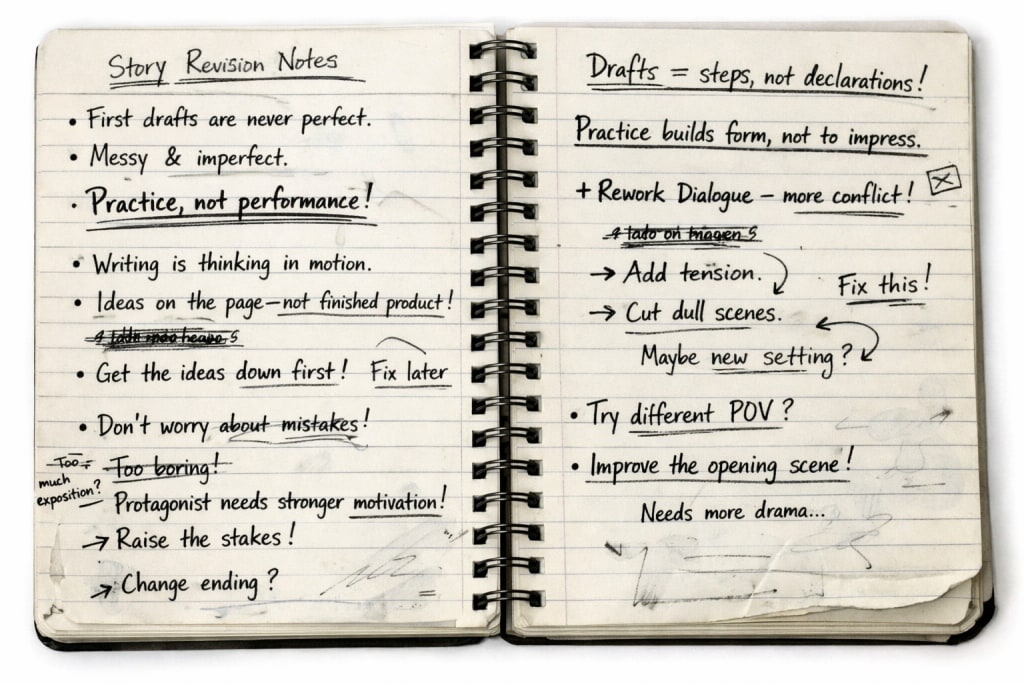
One of the quiet pressures shaping modern communication is the assumption that anything written should be immediately shareable. Drafts blur into declarations, and exploration is mistaken for conclusion. Under this pressure, writing becomes performative by default. The moment words are placed on a page, they are treated as finished statements rather than steps in a process. This expectation distorts both how writing is produced and how it is received, collapsing practice into performance and leaving little room for genuine development.
Practice exists to build form, not to impress an audience. In any discipline, practice is repetitive, imperfect, and often private. It is where mistakes are made deliberately, where weak points are exposed, and where refinement happens without consequence. Performance, by contrast, is evaluative. It is where form is tested under observation. Confusing these two stages creates anxiety and stagnation. When every act of writing is treated as performance, writers become cautious, defensive, or silent, not because they lack ideas, but because the cost of imperfection feels too high.
This confusion is intensified by platforms that reward immediacy and visibility. When feedback loops are fast and public, the distinction between rehearsal and presentation erodes. Writers are incentivized to skip practice entirely and present only what feels safe or finished. Ironically, this often leads to flatter work, because ideas that require exploration are abandoned before they have time to mature. The absence of visible practice does not signal mastery. It often signals constraint.
Understanding writing as practice restores freedom to the process. Drafts can exist without justification. Tangents can be followed without apology. Ideas can be tested, revised, or discarded without being mistaken for commitments. Practice allows thinking to remain flexible. It creates space for synthesis, where connections form gradually rather than being forced into premature coherence.
This distinction also clarifies why volume alone should not be taken as evidence of oversharing. A large amount of writing can exist primarily as practice, even if some of it eventually becomes public. The value of practice is not measured by audience size, but by how effectively it supports later performance. A single polished piece often rests on many unseen drafts that trained the mind to recognize what mattered.
Treating all writing as performance also distorts how readers interpret what they encounter. Exploratory writing is read as declarative. Questions are taken as positions. Provisional thoughts are treated as fixed beliefs. This creates unnecessary conflict and discourages honest inquiry. When readers expect performance, they respond with judgment rather than engagement, even when the writer intended to explore rather than assert.
Separating practice from performance does not mean abandoning standards or responsibility. It means applying them at the appropriate stage. Practice is where ideas are allowed to be wrong. Performance is where ideas are expected to hold. When those expectations are reversed, learning slows and expression becomes rigid. The willingness to practice privately is often what makes strong public communication possible.
This framework also reframes the role of tools that support drafting and exploration. When writing is understood as practice, assistance does not threaten authenticity. It supports repetition, reflection, and refinement. The danger arises only when practice is mistaken for completion, or when reflection is mistaken for action. Tools are not the problem. Mislabeling the stage is.
Recognizing that not everything written is meant to be published restores proportion to the act of writing. It allows writers to invest deeply in the process without feeling compelled to expose every iteration. It also allows readers to approach public work with a clearer understanding of what they are encountering. Performance becomes meaningful precisely because practice was allowed to exist.
Writing that emerges from a healthy distinction between practice and performance tends to be more honest, more coherent, and more durable. It reflects work that was done before the audience arrived. When that distinction is respected, writing regains its role as a tool for thinking, not just a medium for display.
About the Creator
Peter Thwing - Host of the FST Podcast
Peter unites intellect, wisdom, curiosity, and empathy —
Writing at the crossroads of faith, philosophy, and freedom —
Confronting confusion with clarity —
Guiding readers toward courage, conviction, and renewal —
With love, grace, and truth.
Keep reading
More stories from Peter Thwing - Host of the FST Podcast and writers in Critique and other communities.
AI as a Reflective Surface
Much of the confusion surrounding artificial intelligence comes from treating it as an agent rather than a surface. When people speak about AI “doing the thinking,” “creating the ideas,” or “speaking for someone,” they are often projecting agency onto a system that does not possess intention, belief, or understanding. This projection obscures what is actually happening in many real-world uses. In those cases, AI is not acting as a source of meaning, but as a surface that reflects, redirects, and reshapes what is already present.
By Peter Thwing - Host of the FST Podcast10 days ago in Critique
Katie Holmes Honors Dawson’s Creek Costar James Van Der Beek After His Death at 48. He Is Beloved.
Image credits This article includes images obtained from a third party source (people.com). James Van Der Beek and Katie Holmes appear in these images. Image credits belong to Jim Spellman for WireImage and the Everett Collection.
By James Andersonabout 5 hours ago in Critique




Comments
There are no comments for this story
Be the first to respond and start the conversation.