
Truth, Theft, and the Courage to Remember: Reclaiming Our Stolen Histories
From whitewashed textbooks to looted museums, reclaiming memory is the first step to repair

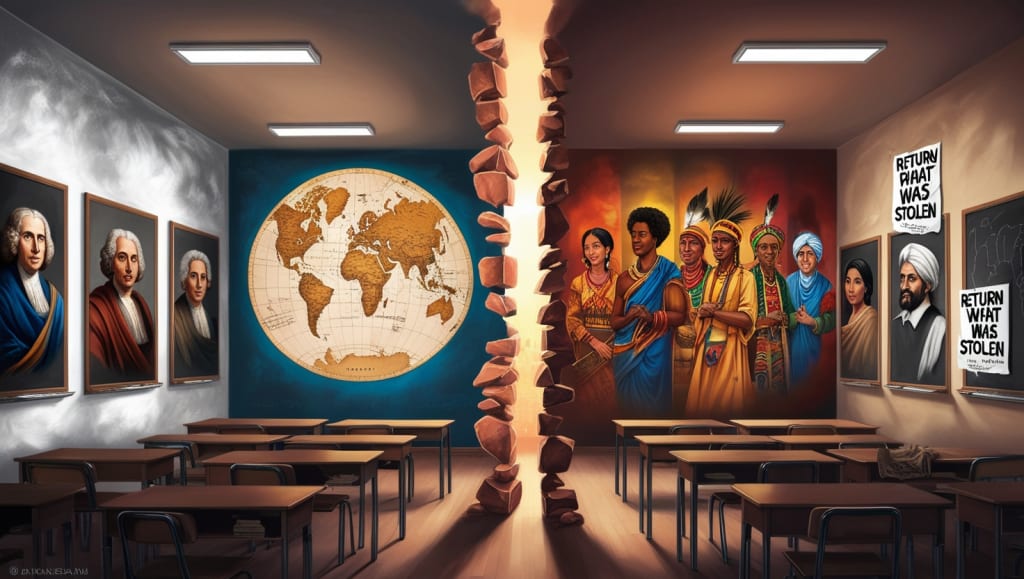
History, we are told, is about facts. Dates. Kings. Wars. Inventions. But the question I keep returning to is: Whose facts? Whose kings? Whose inventions? I didn’t grow up asking that question. I accepted the timeline I was taught — the one that began in Ancient Greece, skipped to Rome, fast-forwarded to the Enlightenment, then marched triumphantly into the Industrial Revolution. I was told this was progress. That this was civilization. But something always felt off.
Entire continents were reduced to footnotes. Entire peoples were painted as passive, conquered, or undeveloped. Africa was a land of slavery. Asia was a market. The Americas were waiting to be “discovered.” And the people from these places — people who looked like me — were almost never cast as heroes, inventors, or philosophers.
The Myth of the Western Timeline
The more I’ve learned, the more I’ve had to unlearn. The idea that democracy, science, and logic began in Europe is not just false — it’s dangerous. It props up a story of white superiority that still echoes in our systems today.
Before the Enlightenment, there was Timbuktu — with its vast libraries and schools. Baghdad, where medicine and philosophy flourished. Nalanda. Cusco. Benin. Long before Galileo, African astronomers were charting stars. Before Descartes asked, “What is the self?”, so did Indian and Islamic scholars — in more nuanced and spiritually complex ways.
Learning this wasn’t just academic for me. It was personal. Because it forced me to reckon with how much had been taken — not just from history, but from me.
Museums of Theft, Textbooks of Silence
I am certain that many Africans have walked into some of the world’s most celebrated museums and felt uneasy. Surrounded by the spoils of empire — the Benin Bronzes, Egyptian mummies, Aztec gold — They couldn’t help but feel like They were walking through a crime scene. But instead of evidence, these items were displayed as trophies.
Even worse is what’s left unsaid in classrooms. The Industrial Revolution is framed as innovation, not the direct result of stolen labor and stolen cotton. Colonization is painted as “exploration,” not exploitation. And so the cycle of silence continues. This isn’t just historical negligence — it’s an ongoing theft of dignity.
Why Memory Matters
I don’t write these things because I have all the answers. I don’t. I’m still learning — still piecing together the history I was never given. But I do know that memory matters. When young people don’t see themselves in stories of greatness, they start to believe that greatness isn’t meant for them. When we erase non-European contributions to knowledge, we reinforce a lie that whiteness is the engine of human progress.
I know what it’s like to internalize that lie. I know what it’s like to feel unseen — to question if your ancestors ever did anything “important.” That’s the power of erasure. That’s why telling the truth is not just about the past — it’s about reclaiming the future.
Truth Is the Beginning, Not the End
Someone once asked me what we can do to make things right. I didn’t pretend to be a scholar or a policymaker. I just said this: We must begin with truth.
And not just the truth of European brutality, but the truth of African brilliance. Asian resistance. Indigenous survival. Arab knowledge. Latin American vision. We must name what was stolen — not just land, labor, and gold, but memory. Identity. Possibility. We must unlearn the myth that Europe invented modernity. We must unlearn the idea that colonialism was a side story — it was the main story.
Reclaiming the Full Story
This isn’t just about inclusion. It’s about justice. It’s about rewriting syllabi. Returning artifacts. Funding indigenous and Black scholars. Rethinking institutions. Asking different questions:
- Who is missing from this narrative?
- Whose voice is being centered?
- Who benefits from the version we are told?
The truth hurts — but the lie kills. I write this not as an expert, but as someone trying to remember. Trying to feel whole again. Trying to reconnect with a stolen inheritance. Because memory isn’t just about what happened. It’s about who we are allowed to become. And maybe, if we remember with honesty and courage, we can become something better — together.
About the Creator
David Thusi
✍️ I write about stolen histories, buried brilliance, and the fight to reclaim truth. From colonial legacies to South Africa’s present struggles, I explore power, identity, and the stories they tried to silence.
Keep reading
More stories from David Thusi and writers in Critique and other communities.
Stolen Identity: How Europe Built Itself by Erasing Others
I used to look at Europe and admire its order. The marble streets. The paintings. The architecture. The libraries with their golden shelves. And then I began to ask: Where did all of this come from? Not just physically — but morally, historically, and spiritually. And the answer, if we’re honest, is this: Europe’s identity was built on theft.
By David Thusi9 months ago in Critique
Standing While Falling
Quotation from Friedrich Nietzsche "He who wrestles long with monsters should beware lest he himself become a monster. And if you gaze long into an abyss, the abyss also gazes into you. Man is not destroyed by suffering, but by the meaning he makes of it."
By LUCCIAN LAYTH27 days ago in Critique
Catherine O’Hara Could Do Anything
Catherine O’Hara had a glow about her. Her crackling wit and those Irish features (fire red hair and bold blue eyes) all added up to a comedic force. She held onto her placement as a performer hailing from Canada. But she made her mark in America. Yet another immigrant who did well in the States, imagine it.
By Skyler Saundersabout 15 hours ago in Critique



Comments (1)
I never thought much about whose history we're taught. But you're right, it's often a Western-dominated view. I remember learning about ancient civilizations, but it was mostly about Greece and Rome. Now I realize how much we've missed. What else can we do to make history education more inclusive? And how do we get museums to return these stolen artifacts? It's eye-opening to see how different cultures contributed to science and philosophy. I had no idea African astronomers were mapping stars before Galileo. We need to change the narrative and give credit where it's due. What steps can we take to ensure these stories are told in schools?