
What AI Can’t Learn from Data: African Ethics in a Digital Age
Centering human values in an increasingly artificial world

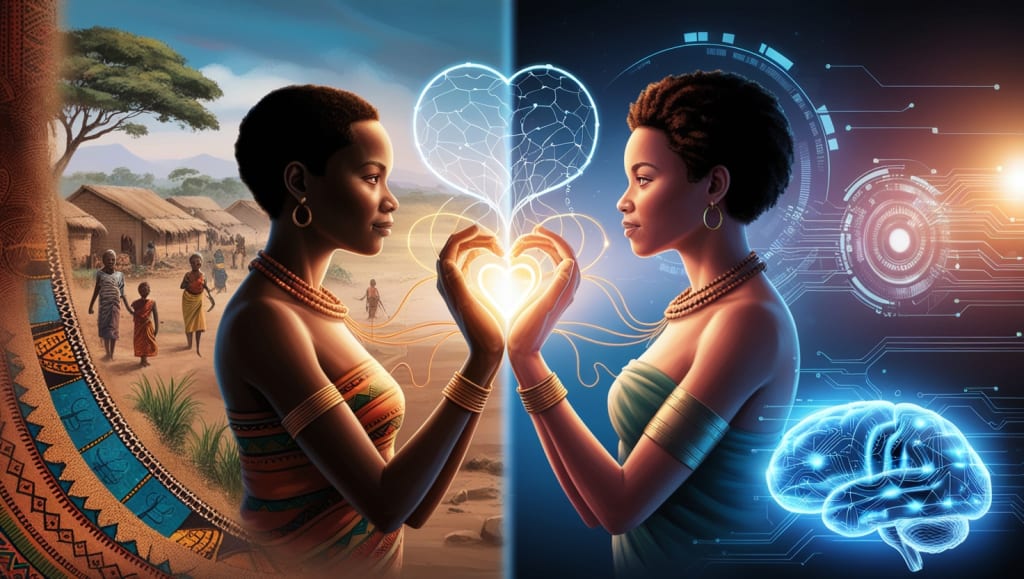
I didn’t grow up thinking about artificial intelligence. I grew up thinking about fairness. In classrooms, courts, street corners, and songs — fairness wasn’t just an abstract idea. It was personal. It meant something when someone was overlooked, misjudged, or discarded. It had a smell, a tone of voice, a lived weight.
Now, the world is building machines that make decisions once left to humans. Who gets hired. Who gets loaned money. Who gets flagged as suspicious. And I keep wondering: Can a machine be taught what fairness feels like?
AI Sees Patterns. It Misses Pain
Let’s be honest — most AI systems aren’t malicious. But they are deeply limited. They don’t understand why someone might avoid a bank. Or how being misnamed by a system becomes more than a technical error. They process probability, not history. Prediction, not experience.
They replicate whatever the data tells them is “normal.” But who decides what normal is? In many places, including across Africa, “normal” has often meant being excluded. Misread. Misrepresented. And now those same patterns are being baked into digital systems — but with a cloak of objectivity.
If Ubuntu could speak to AI, it would say: “You don’t understand us because you only measure us.” Ubuntu isn’t a relic. It’s a living ethic. It means identity is not a solo performance — it’s a choir. It means morality grows in how we relate, not just how we compute. Imagine if AI had to pass a test, not only for speed or accuracy, but for humility.
What would that look like? An algorithm that pauses when context is missing. A system that doesn’t pretend to be neutral when it’s not. A chatbot that doesn’t just give you answers but asks how you’re doing. These sound poetic. But maybe that’s the point. Ethics isn’t only about logic. It’s also about poetry. And pain. And memory.

Africa Isn’t a Tech Desert. It’s an Ethical Archive
We’re often told that Africa is “catching up” to global innovation. But I’d argue: We’re holding a kind of wisdom the world is only starting to need. Long before predictive algorithms, African societies used storytelling, elders, rituals, and moral imagination to guide choices. Not always perfectly — but always with people in mind.
We didn’t separate reason from emotion. We didn’t pretend choices could be “clean” or purely rational. That’s the kind of ethical grounding AI needs right now. Not more efficiency. More accountability. Not just smarter systems. Wiser ones.
I’m not anti-tech. I’m anti-amnesia. When we forget the people behind the data, or the stories beneath the numbers, we risk creating machines that feel powerful — but are blind to the very things that make us human. Africa has something to say about this. And it’s not a whisper. It’s a declaration: “You are not your data. You are your dignity.” If AI is to serve the world, it must learn to see us whole.
I write about AI and ethics not because I fear machines — but because I fear forgetting what we owe each other. Before we automate morality, we must remember the slow, painful, beautiful way real morality is made together.
About the Creator
David Thusi
✍️ I write about stolen histories, buried brilliance, and the fight to reclaim truth. From colonial legacies to South Africa’s present struggles, I explore power, identity, and the stories they tried to silence.
Keep reading
More stories from David Thusi and writers in Critique and other communities.
Generative AI & Knowledge Gaps
Introduction: The New Knowledge Divide Generative AI promises to democratize creativity and knowledge, making vast worlds of text, images, and ideas accessible to anyone with an internet connection. Yet beneath this promise lies a troubling paradox: the very data on which these systems are trained reflects a deep imbalance in whose voices, values, and philosophies count as knowledge.
By David Thusi5 months ago in Critique
Standing While Falling
Quotation from Friedrich Nietzsche "He who wrestles long with monsters should beware lest he himself become a monster. And if you gaze long into an abyss, the abyss also gazes into you. Man is not destroyed by suffering, but by the meaning he makes of it."
By LUCCIAN LAYTH27 days ago in Critique
The Blue Sword
The Blue Sword by Robin McKinley Nothing says a childhood classic like white savior Mary Sue! I snagged this one after listening to an episode of Brandon Sanderson’s podcast where he said this inspired one of the stained glass windows decorating his house (because of course he has presumably awesome stained glass windows).
By Matthew J. Fromm3 days ago in Critique
A Letter to the Firestarter
Dear Firestarter, We can all see you, we've been watching you since you began. In case you didn't know we were here before you and we will be here after. We witnessed your rise, your setbacks, your guilt and your lies. We witnessed you start the fire.
By Donny Foley4 days ago in Poets


Comments (1)
Good starting,keep it up