
Ice Water
The cycle of winter freeze and thaw as it pertains to rocks.

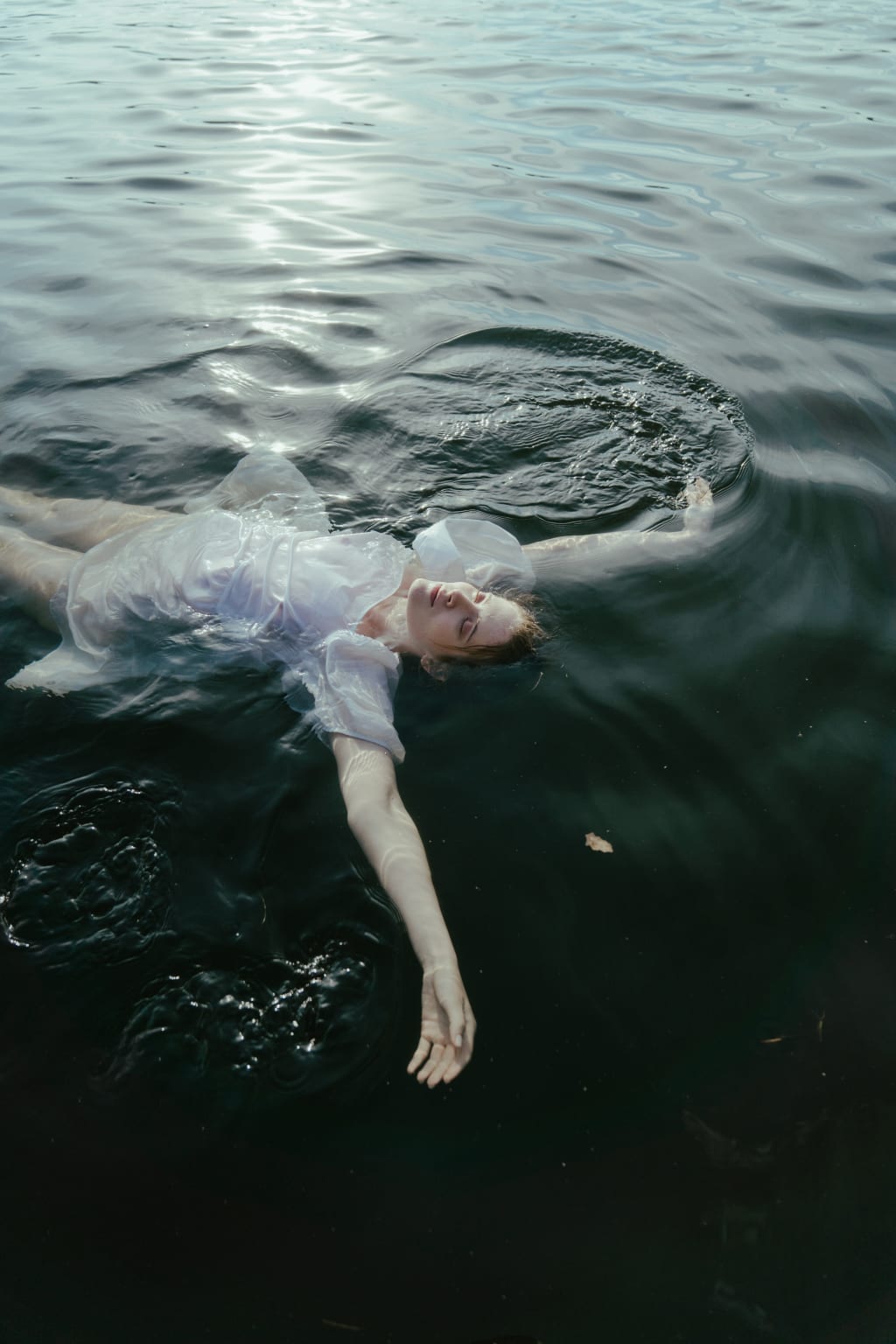
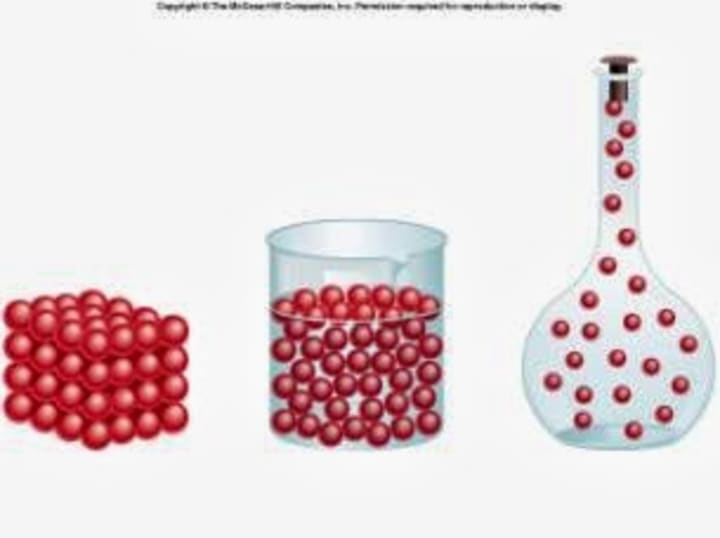
Water disobeys the Particle Theory of Matter; rather than contracting when cold, water expands. For complicated reasons, the molecules spread out instead of huddling together despite the fact they are indeed in a crystalline lattice and vibrating in a solid state. Yes, that means that frozen water is a mineral. Anyway, the PToM, as it pertains to water was one of my favourite topics to explain when I taught children because it sets the perfect example of how much life, like people, frequently refuses to follow the common rules of engagement.
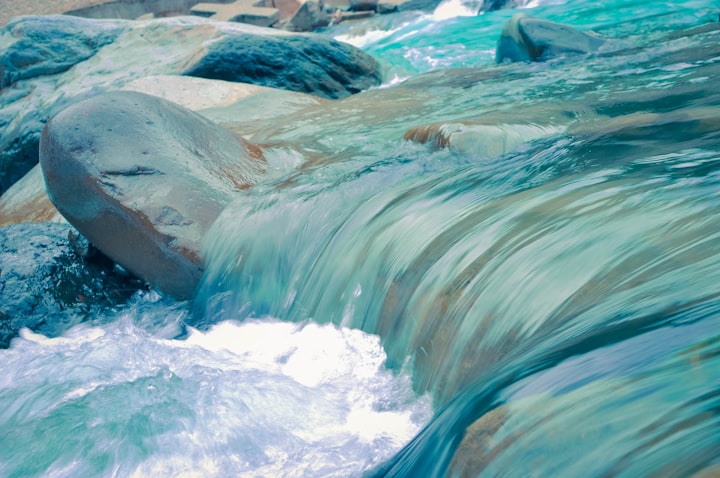
Water shapes our world in many ways, from carving canyons to rising as droplets in your exhaled breath on a winter's day. Did you know that, by volume, water vapour is the largest greenhouse gas in the atmosphere? There is no debating dihydrogen monoxide is a beautiful substance, but like people, it can be complex and dangerous, too.
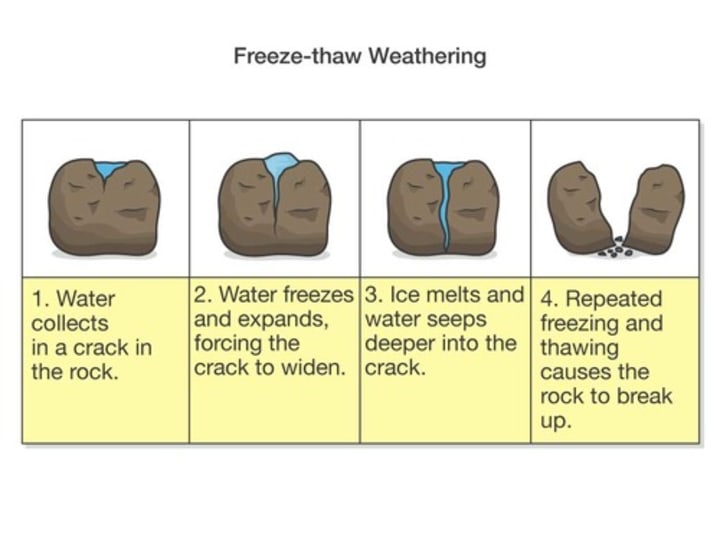
One of nature's most destructive weathering methods is the "freeze-thaw cycle". In a nutshell, this is why those potholes are always worse in the spring.
Allow me to dramatize it. I'm a fiction writer whose first love is rocks, so bear with me.
The unknowing rock gives up some of its empty spaces, and like a bad lover, the water takes over. Sure, it made the holes whole, but only at the expense of forcing them wider apart. Then the thaw happens; you know, those moderately warm days where the sun comes out and the ground warms just enough to turn everything into slush. This is the time when the water liquifies and shrinks away, like the pull back of the emotions you thought had been there, but now begin to doubt. As the winter continues, the water can't seem to ever make up its mind, repeating its horrendously selfish cycle of filling, making whole, thawing and retreating, until by the time spring comes, those cracks in the pavement are now ugly, gaping wounds!
So, why the heck have I bothered to sit down and write about a portion of geomorphology most of you are aware of, but never stopped to examine?
Because I'm not a poet. I sat down to write a poem, to make myself feel better after a really hard day, and this is what came out. I may like fictions; I may even be somewhat good at them—that's at my readers' discretion—but I know for certain I'm good at regurgitating science facts on command.
Coping mechanisms come in all forms . . .
There are good poems out there. One of my longtime favourites, which is also a family favourite (my grandfather's) is the The Wreck of the Hesperus by Henry Wadsworth Longfellow. If I was capable of writing a poem like that today, it's what would have come out. Instead you got a poorly told geography lesson.
Here's the poem I didn't write, but wish I could have:
It was the schooner Hesperus,
That sailed the wintry sea;
And the skipper had taken his little daughtèr,
To bear him company.
Blue were her eyes as the fairy-flax,
Her cheeks like the dawn of day,
And her bosom white as the hawthorn buds,
That ope in the month of May.
The skipper he stood beside the helm,
His pipe was in his mouth,
And he watched how the veering flaw did blow
The smoke now West, now South.
Then up and spake an old Sailòr,
Had sailed to the Spanish Main,
"I pray thee, put into yonder port,
For I fear a hurricane.
"Last night, the moon had a golden ring,
And to-night no moon we see!"
The skipper, he blew a whiff from his pipe,
And a scornful laugh laughed he.
Colder and louder blew the wind,
A gale from the Northeast,
The snow fell hissing in the brine,
And the billows frothed like yeast.
Down came the storm, and smote amain
The vessel in its strength;
She shuddered and paused, like a frighted steed,
Then leaped her cable's length.
"Come hither! come hither! my little daughtèr,
And do not tremble so;
For I can weather the roughest gale
That ever wind did blow."
He wrapped her warm in his seaman's coat
Against the stinging blast;
He cut a rope from a broken spar,
And bound her to the mast.
"O father! I hear the church-bells ring,
Oh say, what may it be?"
"'T is a fog-bell on a rock-bound coast!" —
And he steered for the open sea.
"O father! I hear the sound of guns,
Oh say, what may it be?"
"Some ship in distress, that cannot live
In such an angry sea!"
"O father! I see a gleaming light,
Oh say, what may it be?"
But the father answered never a word,
A frozen corpse was he.
Lashed to the helm, all stiff and stark,
With his face turned to the skies,
The lantern gleamed through the gleaming snow
On his fixed and glassy eyes.
Then the maiden clasped her hands and prayed
That savèd she might be;
And she thought of Christ, who stilled the wave
On the Lake of Galilee.
And fast through the midnight dark and drear,
Through the whistling sleet and snow,
Like a sheeted ghost, the vessel swept
Tow'rds the reef of Norman's Woe.
And ever the fitful gusts between
A sound came from the land;
It was the sound of the trampling surf
On the rocks and the hard sea-sand.
The breakers were right beneath her bows,
She drifted a dreary wreck,
And a whooping billow swept the crew
Like icicles from her deck.
She struck where the white and fleecy waves
Looked soft as carded wool,
But the cruel rocks, they gored her side
Like the horns of an angry bull.
Her rattling shrouds, all sheathed in ice,
With the masts went by the board;
Like a vessel of glass, she stove and sank,
Ho! ho! the breakers roared!
At daybreak, on the bleak sea-beach,
A fisherman stood aghast,
To see the form of a maiden fair,
Lashed close to a drifting mast.
The salt sea was frozen on her breast,
The salt tears in her eyes;
And he saw her hair, like the brown sea-weed,
On the billows fall and rise.
Such was the wreck of the Hesperus,
In the midnight and the snow!
Christ save us all from a death like this,
On the reef of Norman's Woe!
About the Creator
Call Me Les
Aspiring etymologist and hopeless addict of children's fiction.
If I can't liberally overuse adverbs and alliteration, I'm out!
Website: lesleyleatherdale.ca
#elbowsup
~&~
She/Her
Reader insights
Outstanding
Excellent work. Looking forward to reading more!
Top insights
Easy to read and follow
Well-structured & engaging content
Expert insights and opinions
Arguments were carefully researched and presented
Eye opening
Niche topic & fresh perspectives
On-point and relevant
Writing reflected the title & theme
Keep reading
More stories from Call Me Les and writers in Earth and other communities.
Changing the World Happens a Person at a Time
This interview is the beginning of a series of interviews collected as part of the ongoing column by Call Me Les in the new Vocal Creators Chronicle. The column titled "Chat with Les", presents candid interviews with artists, scientists, humanitarians and authors. Both Les and The Chronicle are deeply honoured Dr. Roshdy is our opening interview.
By Call Me Les4 years ago in Humans
Why Fruit Shell Biomass Is Perfect for Charcoal Making: A Property Analysis
When it comes to sustainable charcoal production, not all biomass materials are created equal. Among the various options—from wood chips to agricultural residues—fruit shell biomass (such as walnut shells, coconut shells, peanut shells, and almond shells) stands out as an ideal candidate. Its unique physical and chemical properties not only make the charcoal making process more efficient but also result in high-quality charcoal with versatile applications. In this post, we’ll break down the key properties that make fruit shell biomass a top choice for charcoal production, and touch on how these properties interact with charcoal making equipment to optimize outcomes.
By Bestonpyrolysis2 days ago in Earth
Our Song
Evening has given way to night. Gently, I settle next to you on the comfortable, old love seat and reach for your hand. You snatch it away, again. It cuts me to the quick, but I hide the pain, understanding that the reaction is but part of your demented state. Since the accident, your presence here in our cozy home has been clouded by a haze I can't see. Nevertheless, I feel the frigidity of your expressions and it serves as an excruciating reminder of the immeasurable distance between us.
By Dana Crandella day ago in Fiction



Comments
There are no comments for this story
Be the first to respond and start the conversation.