
Porch Lights and Pickup Trucks
A Portrait of American Village Life Through Seasons, Simplicity, and Sunday Suppers

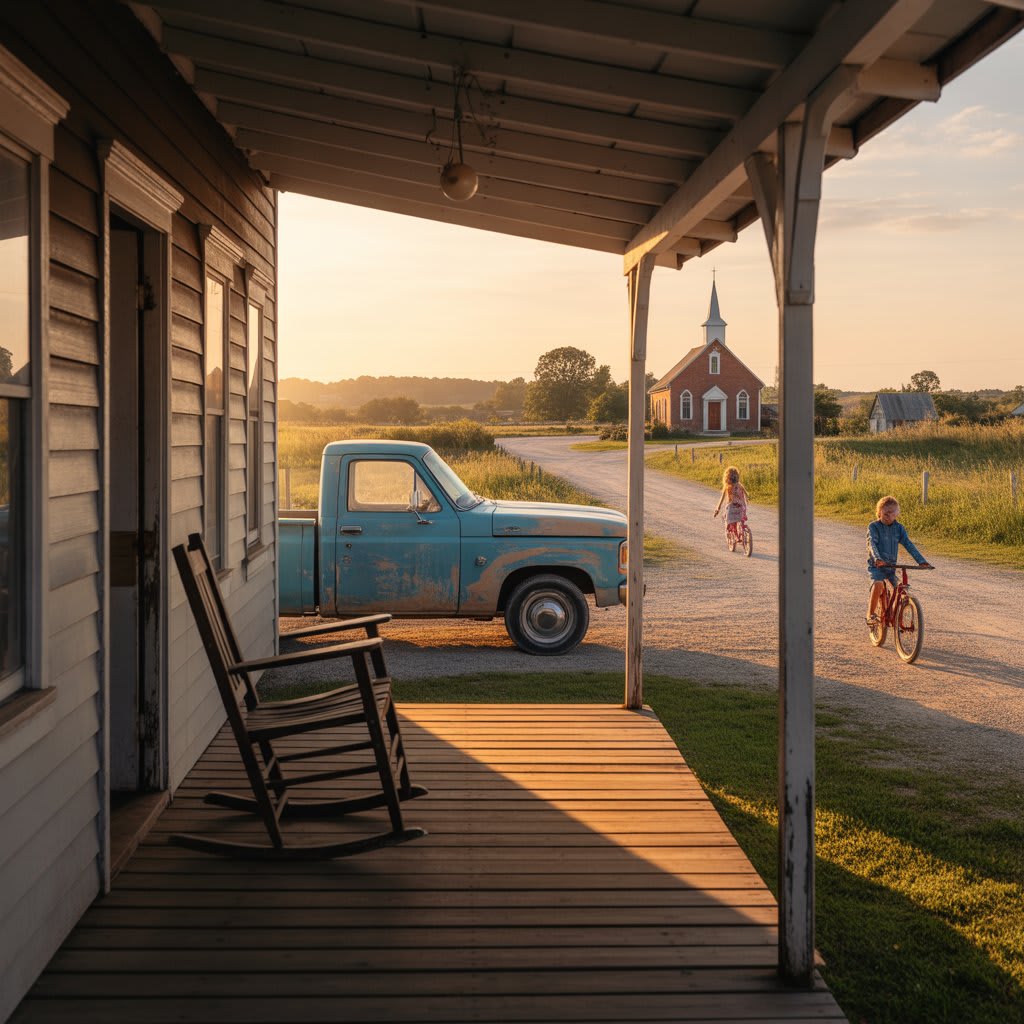
In the quiet bend of Mason County, tucked between slow rivers and cornfields that stretched for miles, sat the village of Wesley Hill. It wasn’t marked on most maps. The roads had no stoplights, and the diner served the same five meals since 1974. Yet it was the kind of place where you waved to strangers, left your doors unlocked, and borrowed sugar without asking.
Wesley Hill was home to fewer than 600 people—farmers, teachers, mechanics, and retired soldiers. Life here didn’t change much, and that was just the way folks liked it.
This story isn’t about a grand event. It’s about the beauty of ordinary days, as seen through one American family—the Sanders.
Chapter One: The Morning Stillness
At 5:30 every morning, even before the roosters crowed, Ray Sanders, 58, was already in his barn. The thick scent of hay, diesel, and old leather greeted him like an old friend. His family had tilled this land for four generations. Corn in summer, wheat in fall, cover crops in winter. The rhythms of the earth set the pace of his life.
Ray didn’t complain about the early hours or the calloused hands. Farming was what he knew. What he loved. The soil remembered you, he often said. “If you respect it, it feeds you. If you don’t, it teaches you.”
His wife, Martha, rose shortly after. She brewed strong coffee in a ceramic pot and made bacon in an iron skillet passed down from her grandmother. Their house was modest—white paint, wraparound porch, a swinging bench that creaked in the wind.
She turned on the radio to the local AM station. Same DJ for 20 years. Same country ballads. It was comforting.
At 7:00 sharp, Ray came in smelling like the outdoors. They ate together, hands clasped in prayer before every meal. The screen door banged behind him as he left to check on his fields.
Chapter Two: School, Bikes, and Back Roads
Their youngest daughter, Maggie, was 12 and in sixth grade. She rode her bike two miles to Wesley Elementary, a red-brick building with only eight classrooms and one shared gym. Her teacher, Ms. Powell, had taught every Sanders child since 1989.
School wasn’t fancy—no smartboards or high-speed internet—but the kids knew how to spell, do math in their heads, and write thank-you letters. At recess, they played tag under oak trees instead of scrolling phones.
After school, Maggie rode to her friend Daisy’s house, where they practiced baton twirling for the upcoming Harvest Parade. Every October, Wesley Hill held a parade down Main Street with floats, marching bands, tractors, and hayrides. It was the event of the year, second only to the County Fair in July.
Chapter Three: Community and Coffee Cups
Every Saturday, Ray met the same group of men at Kenny’s Diner—a one-room place with green vinyl booths and chipped mugs. The walls were lined with faded photos of football teams and WWII veterans.
They talked about crop prices, the weather, the local high school team, and occasionally politics, though never too loudly. Arguments were rare. People here believed more in handshakes than headlines.
Across town, Martha joined the Ladies’ Quilting Circle at the church basement. It was more social than stitching, but every year they donated over a hundred handmade quilts to veterans, new mothers, and the elderly.
At the heart of Wesley Hill was togetherness. No one went hungry, not for long. If someone’s barn burned down, the town rebuilt it. If someone lost a spouse, three casseroles showed up by sunset.
Chapter Four: Storms and Sundays
That summer, a fierce storm rolled through the county. Winds ripped through fields, downed power lines, and left Wesley Hill in the dark for two days. Without air conditioning or television, families pulled out candles and board games.
Ray’s old generator kept their freezer running. He drove into town to check on elderly neighbors. Martha cooked on a wood stove behind the house, and Maggie read books by flashlight.
It reminded them of older times—not better or worse, just quieter.
By the third day, power returned. Life resumed.
And on Sunday, the pews of Wesley Hill Baptist Church were packed.
Ray wore his cleanest flannel. Maggie put on a dress. Pastor Coleman gave a sermon on storms—natural and personal—and how the Lord brings calm after chaos.
People sang louder that morning.
Chapter Five: Fairs, First Loves, and Fireflies
By midsummer, the County Fair arrived. For kids like Maggie, it was the highlight of the year. She entered a pie contest (cherry), helped her older cousin show sheep, and spent five dollars trying to win a stuffed bear.
At night, fireflies blinked across the fields. Teenagers held hands by the Ferris wheel. Young couples danced to local bands. The air smelled of funnel cakes and sweet corn.
Ray and Martha watched from a bench, hands entwined, remembering when they were the young couple once.
“That’s real love,” Martha whispered, watching Maggie giggle with a boy from her class.
“No,” Ray grinned. “Real love is letting me eat the last bite of your pie.”
Epilogue: Seasons of the Same
By fall, the harvest began. Tractors hummed day and night. The trees turned amber and red. The Harvest Parade rolled down Main Street, and Maggie marched with pride.
Then winter came. Snow blanketed the land, turning fences and fields into a quiet poem.
In Wesley Hill, life didn’t race. It moved like a rocking chair on a porch—steady, creaking, warm.
People grew old, children grew up, and stories passed from mouth to mouth over pie, coffee, and firelight.
And through it all—the land, the porch lights, and the pickup trucks remained.
Simple. Familiar. Home.
About the Creator
AFTAB KHAN
SUBSCRIBE ME AND READ STORY
Storyteller at heart, writing to inspire, inform, and spark conversation. Exploring ideas one word at a time.
Writing truths, weaving dreams — one story at a time.
From imagination to reality
Keep reading
More stories from AFTAB KHAN and writers in Earth and other communities.
The Powder Keg Ignites: A Story of Ambition, Alliances, and the Road to World War I
Prologue: A Peaceful Continent Beneath a Boiling Surface (1890–1905) At the turn of the 20th century, Europe glittered like a crown under the sun. Its empires were vast, its monarchs grand, and its cities vibrant. There was a sense of triumph in the air—science, industry, and art flourished. Yet, behind the grandeur, whispers of tension echoed across courts and capitals. Beneath the illusion of peace lay old grievances, new ambitions, and a web of treaties waiting to be tested.
By AFTAB KHAN7 months ago in Earth
Two Miles Beneath the Ocean: A Hidden World Thriving Near a Volcano
Two miles beneath the surface of the ocean, in complete darkness and under crushing pressure, lies a world so vast and alive that it challenges everything we thought we knew about life on Earth. Hidden close to an active underwater volcano, this extraordinary ecosystem spans an area roughly equal to 233 soccer fields and is home to an estimated 20,000 living creatures.
By Ayesha Lashari2 days ago in Earth



Comments
There are no comments for this story
Be the first to respond and start the conversation.