
Scientists discover first-ever Bose-Einstein state in magnons reshaping physics
Magnons reshaping physics

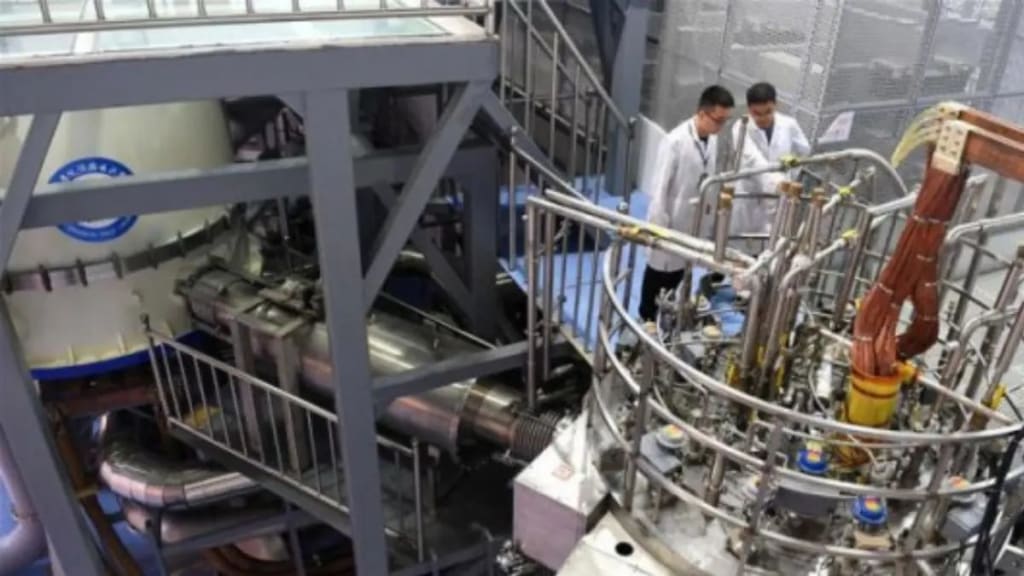
Scientists discover first-ever Bose-Einstein state in magnons reshaping physics
The recent discovery of the first-ever Bose-Einstein condensate (BEC) state in magnons marks a significant breakthrough in condensed matter physics. This discovery reshapes our understanding of quantum mechanics, magnetism, and potential applications in future technologies such as quantum computing and spintronics. Bose-Einstein condensates, first predicted by Albert Einstein and Satyendra Nath Bose in the 1920s, are a unique state of matter where particles known as bosons cool to temperatures near absolute zero and behave as a single quantum entity. Until now, BECs have been observed in atoms and other quasiparticles, but the confirmation of this phenomenon in magnons opens new possibilities in fundamental and applied physics. Magnons are the collective excitations of electron spins in a magnet, acting as quasiparticles that carry angular momentum and energy. These excitations emerge due to the quantum mechanical interactions between electrons in a solid material. Magnons play a crucial role in magnetic properties and have been the subject of extensive research in spintronics, a field that explores the use of electron spin for information processing. The formation of a Bose-Einstein condensate in magnons implies that, under certain conditions, these quasiparticles can synchronize their quantum states, forming a macroscopic wave function similar to what occurs in superfluidity and superconductivity.
The breakthrough discovery of a magnonic BEC was made possible by precise experimental techniques that allowed scientists to manipulate and cool magnons to ultra-low temperatures. Researchers used advanced spectroscopic tools and ultrafast laser techniques to observe the collective behavior of magnons in a controlled environment. By carefully tuning the magnetic and thermal conditions, they demonstrated that magnons can reach a quantum coherent state, exhibiting properties analogous to atomic Bose-Einstein condensates. This realization is particularly exciting as it bridges the gap between quantum mechanics and magnetism, offering a deeper understanding of quantum phase transitions and collective quantum phenomena. One of the most intriguing aspects of the magnonic BEC is its potential applications in quantum information science. Traditional computing systems rely on electrical charges to store and process information, but these systems face significant limitations in terms of heat dissipation and energy efficiency. Magnon-based computing, leveraging the properties of Bose-Einstein condensation, could revolutionize data processing by enabling ultrafast, energy-efficient information transfer. Since magnons do not carry electrical charge, their movement generates minimal heat, making them an ideal candidate for next-generation computing technologies.
Another significant implication of this discovery is its impact on spintronics. Spintronics is an emerging field that explores how electron spin, rather than charge, can be used to develop faster, more efficient electronic devices. The ability to create a magnonic BEC could lead to the development of novel spintronic devices where quantum coherence plays a role in information storage and retrieval. Scientists speculate that these advancements could eventually lead to room-temperature quantum computing, a goal that has remained elusive in current quantum technology. The discovery also provides insights into the nature of phase transitions in quantum systems. In classical physics, phase transitions such as the melting of ice or the boiling of water are well understood, but quantum phase transitions occur at the microscopic level, driven by quantum fluctuations rather than thermal energy. The observation of a Bose-Einstein condensate in magnons offers a new model to study these transitions, potentially leading to groundbreaking discoveries in condensed matter physics. Understanding quantum phase transitions is essential for developing new materials with exotic properties, such as high-temperature superconductors and topological insulators. From a theoretical perspective, the existence of a magnonic BEC challenges and refines existing models of magnetism and collective quantum behavior. Traditional theories of magnetism, such as the Heisenberg model and spin wave theory, describe how electron spins interact to form magnetic structures. The observation of a magnonic BEC suggests that under specific conditions, these interactions can lead to a macroscopic quantum state, which may require modifications to existing theoretical frameworks. Physicists are now working to integrate these findings into a more comprehensive understanding of quantum materials.
In experimental physics, the ability to create and control a magnonic BEC could lead to new ways of engineering materials with tailored quantum properties. Scientists envision the development of "quantum magnonic circuits" where coherent magnons are used to manipulate quantum information in ways previously thought impossible. These circuits could function as fundamental building blocks for quantum networks, allowing information to be transmitted with unprecedented efficiency and security. The concept of quantum magnonics is still in its infancy, but this discovery lays the groundwork for future research in this direction. Despite the excitement surrounding this discovery, several challenges remain. One of the primary hurdles is maintaining the coherence of the magnonic BEC over extended periods and at practical temperatures. Most Bose-Einstein condensates require extremely low temperatures, often achieved using sophisticated cooling techniques such as laser cooling or evaporative cooling. Finding a way to stabilize a magnonic BEC at higher, more accessible temperatures would be a game-changer for practical applications. Scientists are actively exploring new materials and experimental setups to overcome these limitations. Another challenge is integrating magnonic BECs into existing technological infrastructures. Modern electronic and computing systems are based on well-established semiconductor technology, and incorporating quantum magnonic devices would require a significant shift in hardware design. Researchers are investigating hybrid approaches that combine traditional electronics with magnonic components, potentially allowing for a gradual transition toward spin-based computing.
The discovery of a Bose-Einstein condensate in magnons also raises fundamental questions about the nature of quasiparticles and their role in quantum physics. Quasiparticles are emergent phenomena that arise from the collective behavior of underlying particles, and they provide a powerful framework for understanding complex materials. The confirmation of a magnonic BEC suggests that other quasiparticles, such as phonons (quantized vibrations in a solid) or excitons (bound electron-hole pairs), might also exhibit similar quantum condensation effects under the right conditions. This possibility opens up new research directions in condensed matter physics, where scientists will explore whether other exotic quasiparticles can form Bose-Einstein condensates. The broader implications of this discovery extend beyond physics into technological innovation and future engineering. The ability to control and manipulate magnons with precision could lead to advancements in fields such as wireless communication, where spin-based transmission of information could reduce energy consumption and increase efficiency. Additionally, magnonic BECs could play a role in developing new types of sensors with extreme sensitivity, capable of detecting minute changes in magnetic fields or other environmental conditions. Ultimately, the realization of a Bose-Einstein condensate in magnons represents a paradigm shift in our understanding of condensed matter physics. It demonstrates that quantum mechanical principles, long thought to be confined to microscopic particles, can manifest in collective excitations within solid materials. This finding paves the way for a new era of research into quantum materials, spin-based technologies, and novel computing architectures that leverage the principles of quantum coherence and collective behavior.
As scientists continue to explore the fascinating properties of magnonic BECs, the potential applications and theoretical insights they provide will likely shape the future of both fundamental physics and practical technology. The journey from theoretical prediction to experimental realization has been a testament to human ingenuity, and this breakthrough underscores the importance of continued exploration in the quantum realm. The discovery of the first-ever Bose-Einstein state in magnons is not just a milestone in condensed matter physics; it is a glimpse into the quantum future that lies ahead.
About the Creator
Adnan Rasheed
Author & Creator | Writing News , Science Fiction, and Worldwide Update| Digital Product Designer | Sharing life-changing strategies for success.
Keep reading
More stories from Adnan Rasheed and writers in Earth and other communities.
How Humans Will Get Oxygen on Mars
How Humans Will Get Oxygen on Mars. Mars often called the Red Planet has long been a subject of fascination for scientists space agencies and visionaries. With ambitious plans from organizations like NASA SpaceX and other space agencies human colonization of Mars is no longer just science fiction it is becoming an achievable goal. However one of the greatest challenges for sustaining human life on Mars is the availability of oxygen. Unlike Earth Mars has a very thin atmosphere composed mainly of carbon dioxide about 95% with only trace amounts of oxygen. This makes survival on the planet impossible without external sources of breathable air. To establish a human presence on Mars scientists and engineers are exploring various methods to generate oxygen ensuring that future astronauts and colonists have a reliable supply for breathing fuel production and other essential activities. One of the most promising solutions for oxygen production on Mars is the Mars Oxygen In Situ Resource Utilization Experiment (MOXIE). This experimental technology developed by NASA has already demonstrated success aboard the Perseverance rover. MOXIE works by extracting carbon dioxide from the Martian atmosphere and using a process called solid oxide electrolysis to separate oxygen atoms. This method requires electricity which can be generated from solar panels or nuclear power sources. The extracted oxygen can then be stored for human consumption or used as rocket fuel for return missions. MOXIE’s small scale experiments have proven that oxygen production on Mars is feasible and future missions will aim to scale up this technology to support human settlements.
By Adnan Rasheed11 months ago in Earth
a new year for the trees
The snow allows me to go where I usually can’t in good conscience. Someone has already made a path here, so I follow the deep footfalls cast by snow. Still, I don’t touch sand and keep mindful of slick surfaces as I wind the path past the iced over marsh and back up the dunes to the copse of maritime pine stark against the bright white and pale, sleeping grass. A muted green yet green nonetheless among the hibernating things.
By Chaia Levi6 days ago in Earth
Self Help: Grifters' Gospel
On Self-Help, Snake Oil, and the Illusion of Change Psychology professionals and students can be imagined on two opposite sides of a line called self-help books: likely a larger group opposes pop-science and step-by-step manuals filled with talk of success, journaling, and not giving a f**k; others love them, but they aren’t many.
By Avocado Nunzella BSc (Psych) -- M.A.P 7 days ago in BookClub


Comments
There are no comments for this story
Be the first to respond and start the conversation.