
The Earth’s Secret Dance
How Continents Drift and the Future of Our Planet

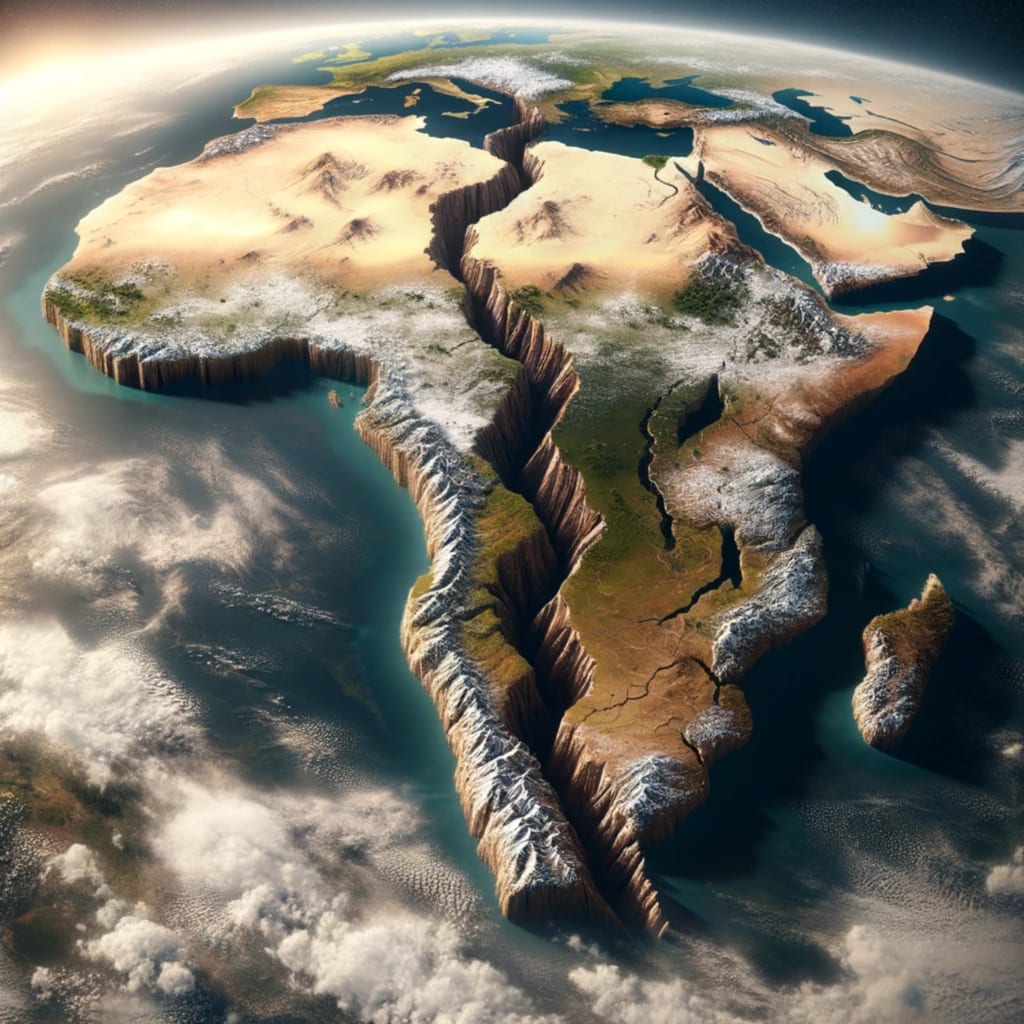
At first glance, our continents might seem like massive rafts adrift on an ocean of molten lava, waiting to collide like bumper cars. But the truth is far more intricate—and fascinating. Let’s dive into Earth’s layers, tectonic tango, and the tantalizing future of our ever-shifting world.
A Cake with Layers: The Anatomy of Earth
Think of Earth like a decadent layered cake, but with rocks instead of frosting. The crust, mantle, and core make up the three primary layers of our planet. Here’s the breakdown:
1. Crust: The thin, crunchy top layer, much like the surface of a cake. It’s where life, oceans, and tectonic plates reside. Made up of igneous, sedimentary, and metamorphic rocks, it’s just 1% of Earth’s total volume.
2. Mantle: Below the crust lies this dense, rocky layer, which flows like ultra-slow-moving honey. It powers the movement of tectonic plates.
3. Core: The hottest part, divided into a molten outer layer and a solid inner core. Temperatures here are hotter than the surface of the Sun, yet the immense pressure keeps the inner core solid.
The Dance of the Plates
Earth’s crust isn’t a single, solid shell. It’s broken into tectonic plates that drift atop the upper mantle’s semi-solid "taffy-like" flow. These plates are both fragile and flexible—like a cookie that can crumble but also stretch.
This movement happens because of convection currents in the mantle. Heat rises and falls, much like soup bubbling on a stove. Over millions of years, this slow-motion dance has reshaped the face of our planet, creating mountains, trenches, volcanoes, and continents.
The Puzzle of Pangaea
Long ago, the continents weren’t scattered across the globe. They were part of a massive supercontinent called Pangaea—Greek for “all Earth.” Imagine standing in the middle of a vast expanse of land, surrounded by one colossal ocean. Over 175 million years ago, Pangaea began to break apart, forming the continents we know today.
It was Alfred Wegener, a meteorologist, who first proposed the idea of continental drift in the early 20th century. He noticed that the coastlines of Africa and South America fit together like puzzle pieces. Further evidence showed that their rocks and fossils also matched, proving they were once united.
The Future of Continents: A New Supercontinent
Earth’s tectonic plates are still moving—albeit at the speed of fingernail growth. Over millions of years, these movements could bring about a new supercontinent. But what might it look like? Scientists have proposed several scenarios:
1. Novopangaea: The Atlantic Ocean shrinks as the Americas collide with Africa and Europe, forming a landmass that stretches from pole to pole.
2. Amasia: The Americas drift westward, joining Australia and pivoting around Siberia.
3. Aurica: All continents converge near the equator, creating a ring-like supercontinent with sunny beaches and warm weather.
4. Pangaea Proxima: Similar to Novopangaea, but centered more on the Arctic region—chilly, but spectacularly unique.
The Ring of Fire and Earth’s Ongoing Drama
The Pacific "Ring of Fire," a path dotted with volcanoes and earthquake zones, is a key player in shaping Earth’s future. Subduction zones—where one plate dives beneath another—act like barriers, dictating the direction of plate movement. This fiery ring influences the collision and merging of continents.
Watching Earth’s Evolution
While it’s fun to imagine a front-row seat to continents colliding and reshaping, these changes occur over tens of millions of years. The next supercontinent won’t form for another 50 million years, so we’ll need to rely on scientific projections (and a lot of imagination).
For now, we live on a planet in motion—a dynamic sphere where even the ground beneath our feet isn’t as steady as it seems.
Earth’s story is a testament to change, resilience, and the unstoppable force of nature. As we continue to study its layers and movements, we uncover not just the past, but glimpses of a future that will reshape everything we know.
About the Creator
Keep reading
More stories from Georgia M. and writers in Earth and other communities.
A Mind-Bending Exploration of Black Hole Cosmology
Imagine looking up at the night sky, marveling at the vast expanse of stars, galaxies, and cosmic wonders, only to learn that everything you see, including the universe itself, might be nestled inside a colossal black hole. This seemingly science-fiction idea, known as Black Hole Cosmology, is a captivating theory proposed by scientists seeking to unravel the mysteries of existence. Could our universe be one of many in a multiverse of black holes? Let’s dive into this mind-boggling concept.
By Georgia M.about a year ago in Earth
Spotlight on the Risks of An Exploding Sea Urchin Population
The marine ecosystem is a complicated place full of millions of species and hundreds of thousands of critically interdependent relationships. While the decline of some species populations might have only marginal effects on the health of the world’s oceans, others could set off a chain of events that could ultimately be catastrophic.
By Virginia Chipurnoi7 days ago in Earth


Comments
There are no comments for this story
Be the first to respond and start the conversation.