
The Net Worth of Volcanoes: Measuring the Value of Earth’s Fiery Giants
Volcanoes are often associated with destruction—lava flows, ash clouds, and dramatic eruptions that reshape landscapes and threaten lives. However, beyond their destructive power, volcanoes hold immense economic, scientific, and ecological value. When people speak about the “net worth” of a volcano, it does not mean money stored inside it, but rather the total value of resources, energy, land fertility, minerals, tourism, and long-term benefits that volcanoes provide to human civilization. When viewed through this broader lens, volcanoes may be among the most valuable natural systems on Earth.

Volcanic Land and Agricultural Wealth
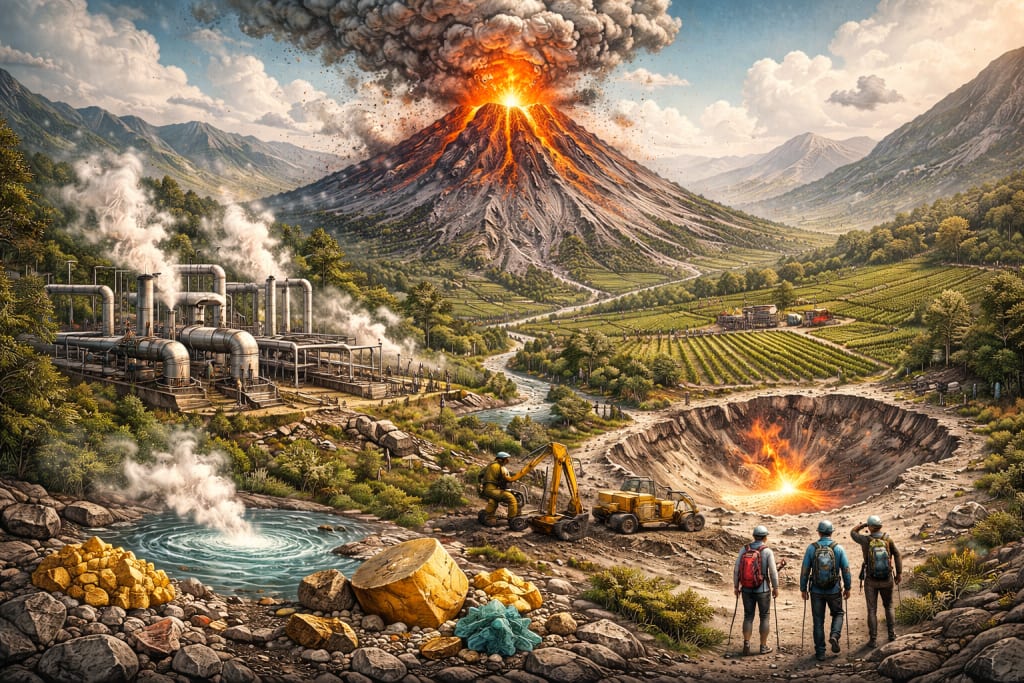
One of the greatest economic benefits of volcanoes lies in fertile soil. Volcanic ash is rich in minerals such as potassium, phosphorus, magnesium, and calcium. Over time, weathered lava and ash create some of the most productive agricultural lands in the world.
Regions near Mount Etna (Italy), Mount Fuji (Japan), Java (Indonesia), and parts of Central America support dense populations because of volcanic soil. Crops such as rice, coffee, tea, bananas, grapes, and sugarcane thrive in these areas.
The agricultural value generated by volcanic regions globally is estimated to be hundreds of billions of dollars annually, making fertile volcanic land one of the most valuable long-term assets derived from volcanoes.
Mineral and Metal Resources
Volcanoes play a major role in forming valuable mineral deposits. Many metals essential to modern industry originate from volcanic or hydrothermal activity. These include:
Gold
Silver
Copper
Zinc
Nickel
Platinum
Rare earth elements
Volcanic regions are also sources of obsidian, pumice, basalt, and sulfur, which are used in construction, medicine, cosmetics, and industry.
Some of the world’s richest mining zones—such as the Andes, the Pacific Ring of Fire, and parts of Africa—exist because of ancient volcanic activity. The estimated global value of volcanic-related mineral reserves runs into trillions of dollars, making volcanoes indirect contributors to global wealth and industrial development.
Geothermal Energy: A Renewable Power Source
Another major component of a volcano’s net worth is geothermal energy. Heat stored beneath volcanic regions can be harnessed to produce electricity and provide heating with minimal carbon emissions.
Countries such as:
Iceland
Indonesia
Philippines
New Zealand
Kenya
generate a significant portion of their electricity from geothermal power. A single large geothermal field associated with volcanic activity can be worth billions of dollars over its operational lifespan due to low fuel costs and long-term energy stability.
Globally, geothermal energy from volcanic zones contributes tens of billions of dollars annually to national economies and plays a growing role in clean energy transitions.
Tourism and Cultural Value
Volcanoes attract millions of tourists each year. Famous volcanoes like Mount Vesuvius, Mount Fuji, Mount Kilimanjaro, Kilauea, and Mount Etna generate enormous tourism revenue through:
Guided treks and viewing platforms
National parks and museums
Cultural festivals and spiritual tourism
Local businesses and hospitality
Volcanic tourism contributes billions of dollars annually to global tourism. For example, Hawaii’s volcanic landscapes alone generate several billion dollars per year in tourism-related income.
In addition to economic value, volcanoes hold deep cultural and spiritual significance, adding intangible value that cannot be measured purely in money.
Scientific and Educational Value
Volcanoes are natural laboratories that help scientists understand:
Earth’s interior
Plate tectonics
Climate interactions
Natural disaster prediction
The knowledge gained from volcanic research helps protect lives, improve infrastructure planning, and advance earth sciences. While difficult to quantify, the long-term scientific value of volcanoes is immense and contributes indirectly to global safety and economic stability.
Ecosystem and Biodiversity Benefits
Although eruptions can temporarily destroy ecosystems, volcanoes also create new land and support unique biodiversity. Volcanic islands such as Hawaii and Iceland are prime examples of life emerging from lava.
Over time, volcanic regions develop rich ecosystems that support wildlife, forests, and marine life. These ecosystems provide services such as carbon storage, water regulation, and biodiversity preservation—services valued at billions of dollars globally.
The Cost Side: Destruction and Risk
While volcanoes generate wealth, they also carry enormous risks. Eruptions can cause:
Loss of life
Destruction of cities and infrastructure
Disruption of air travel
Agricultural damage
Major eruptions can cause economic losses ranging from millions to tens of billions of dollars. For example, the 2010 Iceland eruption disrupted global aviation, costing the airline industry billions.
Therefore, a volcano’s net worth must be viewed as a balance between long-term benefits and potential catastrophic costs.
Estimating the Net Worth of Volcanoes
When all factors are considered—fertile land, minerals, geothermal energy, tourism, scientific knowledge, and ecosystems—the global net worth of volcanoes collectively can be estimated in the tens of trillions of dollars over long time scales.
An individual major volcano, depending on location and utilization, could be valued anywhere from several billion to hundreds of billions of dollars in combined economic and environmental benefits over centuries.
Conclusion
Volcanoes are far more than symbols of destruction. They are engines of creation, shaping continents, enriching soil, powering cities, and sustaining life. Their true net worth lies not just in money, but in their ability to support agriculture, industry, energy, science, and culture over generations.
When measured across time, volcanoes may rank among the most valuable natural assets on Earth—dangerous, powerful, and incredibly rewarding when understood and respected.
About the Creator
Say the truth
"Say the Truth: Explain Everything in the World" is your trusted source for uncovering facts and exploring the wonders of history, science, technology, and beyond. We simplify complex ideas and reveal truths to inspire curiosity .
Keep reading
More stories from Say the truth and writers in Earth and other communities.
The Net Worth of Thorium in India
# ** ## **How India’s Thorium Reserves Could Shape Its Energy and Economic Future** --- ## **What Is Thorium?** Thorium is a naturally occurring radioactive metal found in the Earth’s crust. It is named after Thor, the Norse god of thunder. Thorium itself is not directly fissile like uranium-235, but it can be converted into uranium-233, which is an excellent nuclear fuel.
By Say the truth about a month ago in Earth
White House Backtracks Initial Claims About Alex Pretti After Intense Backlash
The Controversy Unfolds In recent days, the White House came under scrutiny after making initial claims about Alex Pretti, a figure involved in a politically sensitive incident. The statements, which were widely circulated by mainstream media and social platforms, faced immediate backlash from journalists, politicians, and the public. Critics accused the administration of misrepresenting facts and prematurely assigning narratives, prompting the White House to issue clarifications and revise its official statements. Who Is Alex Pretti? Alex Pretti, a public figure linked to [context-specific involvement, e.g., a political event, policy dispute, or social activism], became the center of national attention due to conflicting reports. Initial White House claims painted Pretti’s actions or statements in a certain light, which opponents argued did not align with evidence or eyewitness accounts. This discrepancy fueled a wider debate about the accuracy of information released by government officials and the consequences of premature public statements. White House Response and Backtrack Facing mounting criticism, White House officials clarified their earlier statements, acknowledging that the initial claims were misleading or incomplete. Spokespersons emphasized that the correction was necessary to ensure the public received accurate information. The revised statement addressed key points: Correcting factual errors from the initial release Acknowledging miscommunication or lack of verification Reassuring the public of commitment to transparency and accountability While the backtrack was intended to restore credibility, many commentators noted that the damage to public trust may be long-lasting, given the widespread media coverage of the original claims. Public and Media Reaction The response from journalists, political analysts, and social media users was immediate: Journalists highlighted the dangers of unverified government statements, emphasizing the need for fact-checking. Political commentators debated whether the administration acted out of political expediency rather than transparency. Social media users expressed skepticism and frustration, with hashtags criticizing the initial claims trending nationally. The incident underscores how rapid dissemination of information in the digital age can amplify errors and make retractions less effective than the original claims. Implications for Government Credibility The Alex Pretti controversy raises questions about government credibility and information management. Experts argue that mistakes like this can have broader consequences for public trust, particularly in an era of heightened political polarization. Key concerns include: Public skepticism toward official statements on sensitive issues Increased reliance on alternative media and citizen reporting to verify facts Pressure on government communications teams to balance speed with accuracy Observers note that while corrections are important, they rarely undo the initial impressions created by early statements. Political Fallout Politicians across the spectrum have weighed in on the situation. Opposition figures have criticized the administration for misleading the public, calling for stronger oversight and accountability measures. Supporters, meanwhile, have emphasized the importance of quickly correcting errors to maintain credibility. The incident is likely to influence how future communications are managed, with officials adopting more cautious approaches to statements involving controversial figures or events. Lessons for Crisis Communication Communication experts highlight several lessons from the Alex Pretti situation: Verify before issuing statements: In politically sensitive situations, fact-checking is essential. Anticipate backlash: Even minor errors can escalate rapidly in the media ecosystem. Act quickly to correct misinformation: Delayed corrections can exacerbate public distrust. Maintain transparency: Open acknowledgment of mistakes helps restore credibility. These principles are critical for government agencies, corporate communications, and public officials, demonstrating how one misstep can dominate headlines and public discourse. Broader Context The controversy also reflects larger trends in political communication, including: The influence of social media in shaping narratives The speed of news cycles, which can pressure officials to release statements before full verification Public demand for accountability and transparency in government Experts argue that the Alex Pretti incident is a reminder of the importance of responsible communication, especially in high-stakes political environments. Conclusion The White House’s backtrack on statements about Alex Pretti illustrates the delicate balance between rapid communication and accuracy in modern politics. While the clarification demonstrates a willingness to correct errors, the incident has already sparked discussions about government transparency, media scrutiny, and public trust. As the public continues to digest these developments, officials may need to reevaluate how sensitive information is communicated, ensuring that future statements are both timely and verified, minimizing the risk of controversy.
By Aarif Lashari7 days ago in Earth
Bradley Cooper’s Latest Movie Is This Thing On? Draws Inspiration from John Bishop’s Journey into Comedy
Hollywood actor and director Bradley Cooper is no stranger to versatile roles, but his latest project, Is This Thing On?, is turning heads for its unique inspiration: the career and journey of Liverpool-born comedian John Bishop. The film, a blend of humor, heart, and ambition, showcases how a global star like Cooper finds creative fuel in the life story of a working-class comedian from the UK.
By Aarif Lashari2 days ago in Earth


Comments
There are no comments for this story
Be the first to respond and start the conversation.