


# The Intriguing Assortment of Moons: An Investigation of Heavenly Variety
Moons, otherwise called regular satellites, are interesting heavenly articles that circle planets and, surprisingly, a few minor bodies all through the planetary group. While Earth has just a single moon, the nearby planet group contains north of 200 moons of all shapes, sizes, and structures, making them one of the most different and fascinating parts of our grandiose area. These moons fluctuate enormously regarding their qualities, with some being bigger than planets, others facilitating frigid seas, and a couple of displaying volcanic action. This article will dive into the wide assortment of moons tracked down across the planetary group, investigating their special elements and the job they play in how we might interpret planetary science.
## 1. Earth's Moon: Our Recognizable Friend
Earth's moon is the most recognizable and all around concentrated on satellite in the nearby planet group, having been the subject of human investigation since the Apollo missions of the last part of the 1960s and mid 1970s. With a width of around 3,474 kilometers, it is the fifth-biggest moon in the planetary group and impacts life on The planet. Its gravitational force drives sea tides and settles Earth's hub slant, which adds to the steadiness of our environment.
The moon's surface is an embroidery of old effect cavities, volcanic fields called maria, and good country districts that date back billions of years. It comes up short on climate, water, or climate, which makes it a distinct, constant scene. Notwithstanding, late disclosures of water ice in forever shadowed cavities at its shafts propose that the moon could in any case have mysteries to uncover.
## 2. The Galilean Moons: Jupiter's Four Goliaths
Jupiter, the biggest planet in the planetary group, has the most gigantic assortment of moons. Its four biggest moons — Io, Europa, Ganymede, and Callisto — are by and large known as the Galilean moons, named after Galileo Galilei, who found them in 1610. Every one of these moons is interesting and offers a brief look into the perplexing idea of heavenly bodies.
### Io: The Volcanic Force to be reckoned with
Io is the most volcanically dynamic body in the planetary group, with many volcanoes heaving sulfur and liquid magma. The extreme flowing powers produced by Jupiter's gravity and its associations with adjacent moons heat Io's inside, driving its consistent volcanic emissions. This outrageous action brings about an energetic surface that is continually being reshaped, canvassed in yellow sulfur stores and dynamic magma streams.
### Europa: The Frosty Sea World
Europa is one of the most encouraging possibility for the quest for extraterrestrial life. Underneath its frigid surface lies a worldwide expanse of fluid water, kept warm by the very flowing powers that drive Io's volcanic action. This sea, which could be as much as 100 kilometers down, can possibly hold onto microbial life. Europa's surface is mismatched by breaks and edges, which propose that the frosty hull is intermittently breaking and transforming, permitting the sea underneath to connect with the surface.
### Ganymede: The Biggest Moon
Ganymede is the biggest moon in the planetary group, in any event, marvellous the planet Mercury in size. It is remarkable in that it has an attractive field, a component ordinarily found in planets as opposed to moons. Ganymede's surface is a combination of dull, old territory and more brilliant, more youthful districts where structural movement has happened. Like Europa, Ganymede is remembered to have a subsurface sea, which adds to its charm as a possible host forever.
### Callisto: The Antiquated Cratered World
Callisto is the most vigorously cratered object in the planetary group, with a surface that has remained to a great extent unaltered for billions of years. It misses the mark on volcanic movement or structural powers seen on its adjoining moons, which makes it a topographically "dead" world. Notwithstanding, Callisto's perfect surface offers an extraordinary window into the early planetary group, saving a record of old effects and cycles that formed the external planets.
## 3. Saturn's Moons: From Titan's Air to Enceladus' Fountains
Saturn, the second-biggest planet, is home to north of 80 moons, each adding to the planet's persona. Two of the most captivating moons in Saturn's framework are Titan and Enceladus, the two of which have been the focal point of extreme logical review.
### Titan: A Moon with an Environment
Titan is the main moon in the nearby planet group with a thick environment, made principally out of nitrogen with hints of methane. This air leads to weather conditions, including precipitation and streams, however these are made of fluid methane and ethane as opposed to water. Titan's surface is set apart by tremendous ridges, lakes, and oceans of hydrocarbons, making a scene that is both outsider and shockingly Earth-like. Underneath this surface might lie one more subsurface expanse of water, which, joined with its natural rich air, makes Titan a vital objective in the quest forever.
### Enceladus: The Spring Moon
Enceladus is a little, frigid moon that has caught the consideration of researchers with its tremendous fountains, which launch tufts of water fume, ice particles, and natural mixtures into space from breaks close to its south pole. These crest start from a subsurface sea, warmed by flowing powers like those influencing Europa. The revelation of natural particles in Enceladus' springs has elevated interest in the moon's capability to help life, making it an excellent contender for future investigation.
## 4. Uranus and Neptune's Strange Moons
Uranus and Neptune, the peripheral planets in the planetary group, likewise have their portion of captivating moons, however they stay less very much investigated because of their huge separation from Earth.
### Miranda: Uranus' Interwoven Moon
Miranda, one of Uranus' moons, stands apart for its strange, interwoven surface. It highlights gigantic bluffs, ravines, and confused territory that recommend serious geographical movement previously. Its surface has all the earmarks of being a composition of various locales, as though it were fallen to pieces and reassembled, making it quite possibly of the most outwardly special moon in the planetary group.
### Triton: Neptune's Caught Moon
Triton, Neptune's biggest moon, is believed to be a caught Kuiper Belt object, giving it an exceptional beginning contrasted with different moons in the planetary group. Triton's surface is shrouded in nitrogen ice and elements springs that eject nitrogen gas, driven via occasional warming from the far off Sun. Triton's retrograde circle — inverse to Neptune's turn — further alludes to its surprising history. Like Europa and Enceladus, Triton may likewise hold onto a subsurface sea, making it one more objective of interest in the quest for life past Earth.
## 5. The Moons of Mars: Phobos and Deimos
Mars, the Red Planet, has two little moons, Phobos and Deimos, which are believed to be caught space rocks from the close by space rock belt. Phobos, the bigger of the two, is gradually spiraling toward Mars and will ultimately either collide with the planet or fall to pieces to shape a ring. These moons are little and sporadically formed, more likened to space rocks than the bigger moons of the external planets.
## End
The moons of our nearby planet group are a different and dazzling assortment of universes, each with its own story to tell. From the volcanic emissions on Io to the frigid expanses of Europa and the thick climate of Titan, these normal satellites give important bits of knowledge into the arrangement and advancement of planetary frameworks. As our investigation of the nearby planet group proceeds, these moons will without a doubt stay key focuses in our mission to figure out the universe and the potential for life past Earth.
About the Creator
Keep reading
More stories from writers in Earth and other communities.
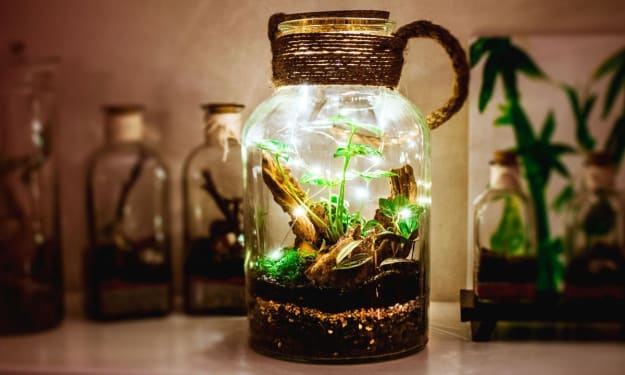
The Terrarium Toolkit: AI Helps You Build and Maintain a Miniature World
You assemble layers of earth, carefully position tiny plants, and add decorative stones, culminating in the moment you place the glass lid or front panel. You've created more than a decoration; you've built a miniature, self-contained world. Yet, weeks later, that world can become clouded—literally. Condensation obscures the view, mold appears on the soil, or a once-vibrant plant turns to mush. The delicate balance you sought has tipped.
By Emma Wallace3 days ago in Earth



Comments (1)
Nice article