
Accurate Winter School Closure Forecasting
Learn how winter school closure forecasting works, how accuracy is measured, and how to interpret predictions with confidence.

How Winter Weather Forecasting Predicts School Closures with Precision
A winter storm watch can turn an ordinary evening into a tense waiting game. Parents refresh district websites. Students hope for a miracle. Administrators weigh safety against instructional time. In those moments uncertainty feels heavier than the snow itself.
Search interest in snow day tracker and school closing predictions spikes every time a major system moves across the map. Families are not chasing novelty. They want clarity. They want to know if buses will roll at dawn or if icy roads will shut down an entire district. They want time to arrange childcare and adjust work schedules without panic.
Accurate forecasting of school closures sits at the intersection of meteorology, transportation logistics, public policy, and community risk tolerance. It is not a guessing game. It is a layered assessment built on data, local geography, and experience earned through seasons of storms.
How Winter Forecast Models Influence Closure Decisions
Weather models form the backbone of any closure assessment. Global models such as the GFS and ECMWF simulate atmospheric dynamics on a planetary scale. High resolution regional models refine that data to project snowfall totals, precipitation type, wind gusts, and surface temperatures down to neighborhood levels.
A forecast that shows three inches of dry snow at 28 degrees carries a different operational impact than freezing rain at 31 degrees. Ice creates hazards that linger long after precipitation ends. Meteorologists interpret not only projected totals but also timing. Snow that begins at noon after buses return poses fewer transportation risks than snowfall that peaks during the morning commute.
District officials study hourly breakdowns. They analyze when road crews can treat surfaces and how fast temperatures will drop overnight. They monitor confidence intervals within forecast models. When multiple models converge on the same outcome confidence rises. When they diverge administrators must decide how much uncertainty is acceptable.
Local microclimates complicate matters. Urban heat islands can reduce accumulation in city centers while rural roads remain slick. Elevated terrain may receive heavier bands of snow. Experience with these patterns shapes judgment far beyond what a simple snowfall map reveals.
Transportation Logistics and Road Safety Assessment
Transportation is often the decisive factor. A district may operate hundreds of buses across thousands of road miles. Many routes include narrow rural roads, steep hills, shaded curves, and gravel segments that freeze quickly.
Road treatment timelines matter. If snow begins overnight and plows can clear primary roads by dawn, closures become less likely. If precipitation falls during early morning hours crews may struggle to stay ahead. Ice is the most disruptive scenario. Salt loses effectiveness below certain temperatures. Black ice can form invisibly on bridges and overpasses.
School districts consult local public works departments. They evaluate plowing capacity, salt inventories, and projected clearing schedules. Administrators also consider bus yard conditions. If drivers cannot safely exit depots the day is effectively lost.
Beyond roads lies pedestrian safety. Many students walk to bus stops before sunrise. Wind chill, blowing snow, and limited visibility add risk. District leaders balance meteorological forecasts with the real world question of whether a seven year old can safely stand at a corner in frigid conditions.
Timing, Temperature, and the Freeze Thaw Cycle
Temperature trends often matter more than raw snowfall totals. A marginal storm hovering near the freezing mark can create chaotic conditions. Rain that transitions to sleet then snow leaves a layered surface that plows struggle to scrape clean.
The freeze thaw cycle amplifies risk. Snow that melts under afternoon sun may refreeze overnight into hard packed ice. A district that remains open during the storm might face more dangerous conditions the following morning.
Wind also plays a role. Strong gusts can drift snow across cleared roads. Rural districts face open field exposures where drifts rebuild quickly. Urban districts may encounter blowing snow that reduces visibility at intersections.
Forecasters study dew point, surface temperature, and ground warmth before projecting accumulation. Early season storms often struggle to stick on warm pavement. Mid winter events accumulate rapidly on frozen ground. Context matters.
Regional Differences in Closure Thresholds
Closure decisions vary by region. A district in northern Minnesota may operate under snowfall amounts that would shut down schools in Atlanta. Communities adapt to typical winter patterns. Snow removal infrastructure reflects local climate norms.
Cultural expectations influence decisions. Some districts prioritize maintaining instructional days at all costs. Others emphasize precaution and parent convenience. Legal requirements for instructional hours also shape the calculus.
These patterns demonstrate that forecasting accuracy must be interpreted within local context. A raw snowfall number alone cannot determine closure probability.
Digital Forecast Platforms and Probability Scoring
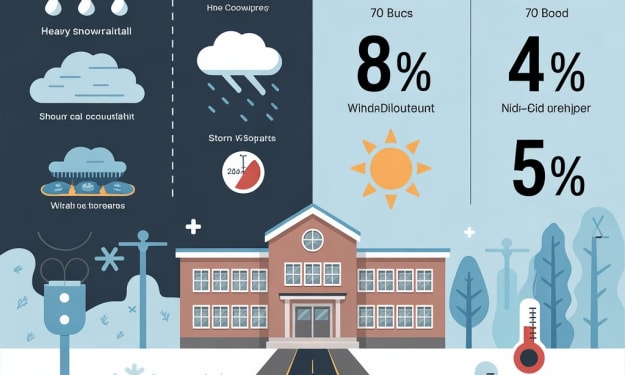
Modern forecasting platforms translate meteorological data into probability scores. These systems ingest model outputs, historical closure data, and regional thresholds. They generate percentage likelihood estimates that signal risk levels to families.
Such platforms track hourly changes. If overnight model runs increase projected ice accumulation the probability rating shifts upward. If temperatures trend warmer closure likelihood declines.
Accuracy depends on model resolution and real time updates. Forecast confidence increases within 24 hours of a storm. Beyond 72 hours uncertainty remains significant. Responsible forecasting platforms communicate confidence levels alongside predictions rather than presenting a binary open or closed outcome.
Parents often encounter snow day tracker dashboards that display color coded maps. These tools simplify complex data into intuitive visuals. The most reliable systems explain the underlying assumptions and avoid overstating certainty.
Data Inputs That Improve Predictive Accuracy
High quality predictions rely on multiple data streams. Satellite imagery tracks cloud structure and moisture feed. Doppler radar monitors precipitation intensity and movement. Surface observation stations report real time temperature, dew point, and wind conditions.
Ground reports enhance calibration. Road temperature sensors reveal whether pavement remains above freezing. Traffic camera feeds show accumulation in real time. Social media posts from bus drivers and maintenance crews provide on the ground context that models cannot capture.
Historical data also strengthens forecasting. Analysts review past storms with similar atmospheric setups. They examine how districts responded and how conditions evolved. Patterns emerge. Some districts close early at the hint of freezing rain. Others wait until ice accumulation crosses a defined threshold.
This layered approach transforms raw weather data into informed probability assessment rather than speculative guesswork.
Administrative Decision Making Behind the Scenes
Behind every closure announcement stands a chain of consultation. Superintendents communicate with transportation directors, facilities managers, local meteorologists, and public safety officials. Discussions begin hours before public announcements.
Instructional impact remains part of the equation. Many districts build snow days into academic calendars. Exceeding those allocations can push the school year into summer or trigger remote learning days. These factors do not override safety but they shape timing.
Equity considerations also arise. Some families rely on school meals and supervised environments during work hours. Administrators weigh weather risks against social impacts. It is a complex balance.
Once a decision is made communication becomes critical. Delays in notification create frustration and confusion. Modern districts use automated messaging systems, social media alerts, and website banners to ensure rapid dissemination.
Interpreting Forecast Confidence as a Parent
Parents often seek certainty. Forecasting offers probabilities. Understanding that distinction reduces frustration. A 70 percent closure probability signals high risk yet not a guarantee. Meteorology deals in dynamic systems where slight shifts in storm track alter outcomes.
Monitoring temperature trends overnight provides clues. If actual readings fall below forecast lows icing risk increases. Observing radar loops reveals whether heavy bands intensify. Local news meteorologists often discuss uncertainty ranges that national apps overlook.
Preparing contingency plans early eases stress. Childcare arrangements, remote work adjustments, and flexible schedules reduce last minute scrambling. Weather forecasting empowers preparation even when outcomes remain fluid.
Searches for school closing predictions reflect a desire for control in uncertain conditions. The most reliable strategy blends forecast data with practical readiness.
Technology, Machine Learning, and Future Trends
Advances in machine learning refine closure forecasting models. Algorithms analyze decades of storm data and district responses. They detect subtle correlations between precipitation type, time of onset, and administrative behavior.
Integration with hyperlocal sensors continues to expand. Internet connected thermometers on school buses could one day feed pavement temperature data directly into predictive systems. Real time fleet tracking might assess route viability minute by minute.
Climate variability adds complexity. Some regions experience more frequent freeze thaw cycles. Others see heavier precipitation events. Forecast models adapt by incorporating updated climatological baselines.
Public trust hinges on transparency. Platforms that explain how predictions are calculated earn credibility. Opaque probability scores without context invite skepticism.
Human Judgment Remains Central
Despite technological progress human judgment remains indispensable. Meteorologists interpret patterns that algorithms may misread. Superintendents understand community tolerance for risk. Bus drivers know which hills freeze first.
Closure forecasting blends science and lived experience. Data informs. Experience contextualizes. Community values guide the final call.
Families who understand this interplay approach winter storms with realistic expectations. They recognize that predictions evolve. They appreciate the responsibility borne by those making the decision before dawn while most of the community still sleeps.
FAQs
How accurate are winter school closure forecasts within 24 hours of a storm?
Accuracy increases significantly within the final 24 hours before impact. Forecast models converge as new data feeds into the system. While uncertainty never disappears, probability assessments during this window tend to reflect real world outcomes with strong reliability.
Why do some districts close for light snow while others remain open during heavy snowfall?
Regional adaptation explains much of the difference. Infrastructure, plowing capacity, road design, and community expectations vary. A light snowfall in a region unaccustomed to winter weather can create more disruption than a heavier event in a snow belt community.
Do temperature forecasts matter more than snowfall totals?
In many cases temperature trends and precipitation type carry greater operational impact. Freezing rain or sleet often leads to closures at lower accumulation levels because ice creates persistent hazards that are difficult to treat quickly.
How early do administrators typically decide on closures?
Discussions often begin the afternoon or evening before a projected storm. Final decisions commonly occur between 4 a.m. and 5 a.m. when updated forecasts and real time observations clarify road conditions.
Can predictive platforms guarantee a closure outcome?
No forecasting system can offer a guarantee. Weather remains dynamic and administrative decisions incorporate human judgment. Probability scores signal risk levels rather than definitive outcomes.
What factors besides weather influence closure decisions?
Transportation logistics, bus driver availability, power outage risk, building heating reliability, and equity considerations all play roles. Weather initiates the conversation but operational realities shape the final announcement.
A Measured Approach to Winter Uncertainty
Winter weather will always introduce a degree of unpredictability. Forecasting tools continue to improve through better models and richer data inputs. Administrative coordination grows more efficient each year.
Confidence comes from understanding how decisions are made rather than expecting flawless foresight. When families interpret probabilities wisely and prepare with flexibility, winter storms lose some of their disruptive power. Precision in forecasting does not eliminate uncertainty. It transforms it into informed readiness grounded in science, logistics, and community experience.
About the Creator
AWAIS TARIQ
Curious about astrology? Explore Astrology Network for insights and tools to reveal the secrets of your zodiac sign.
https://www.astrology-network.com
Keep reading
More stories from AWAIS TARIQ and writers in Education and other communities.
Building Gig Economy Apps and Mobile App Development Los Angeles Regulations
Regulation rarely arrives before innovation. More often, policymakers react after technology reshapes daily life, attempting to balance opportunity with public interest. Nowhere is this tension more visible than in the gig economy, where mobile apps have rewritten how work is organized, compensated, and monitored.
By Nick William3 days ago in Education
The Seed Renaissance: Inside France USD 1.91 Billion Agritech Surge
The era of “one-size-fits-all” crop solutions is officially over. Walking through the agricultural research centers of Île-de-France or browsing webinars on French agritech platforms in 2026, it becomes clear that the modern French farmer is now one of the most discerning in the world. I call them “Seed Strategists” growers who can evaluate genetic traits, sustainability metrics, and yield predictions with the precision of a biotech analyst, valuing data-backed results over tradition alone.
By Neeraj kumarabout 13 hours ago in Education


Comments