
Breaking the Cycle of Constant Overplanning
Why Planning Feels Productive — But Keeps You Stuck
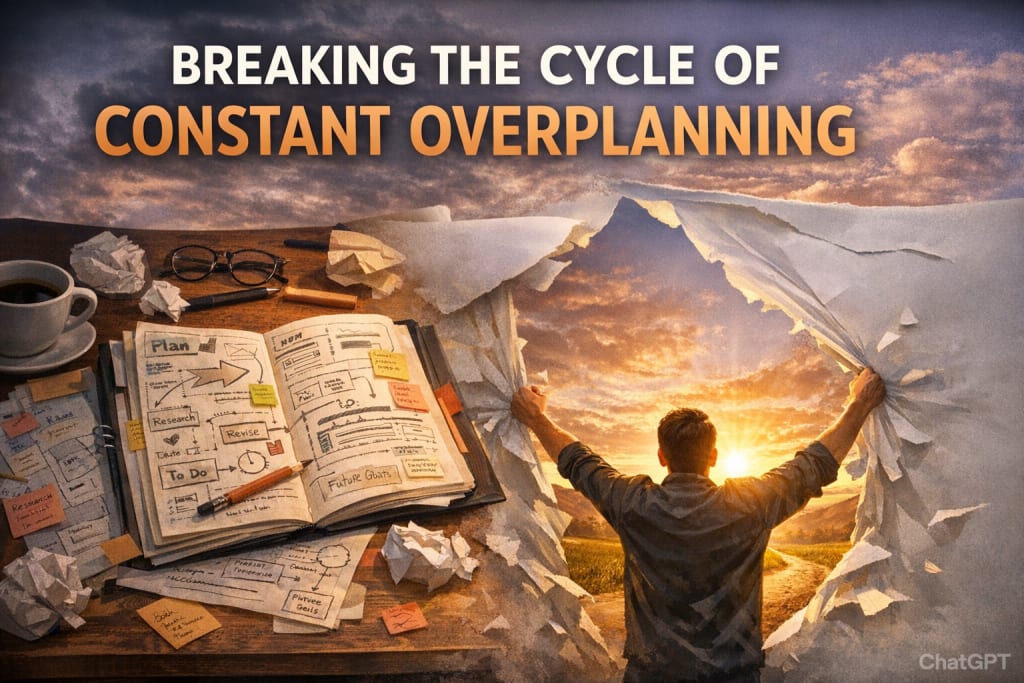
There is a quiet trap that ambitious people fall into.
It looks responsible.
It feels intelligent.
It even feels productive.
But it keeps you stuck.
It’s called constant overplanning.
You tell yourself you’re preparing. You say you’re organizing. You convince yourself you’re “building the foundation.”
So you create new schedules.
You redesign your content calendar.
You watch productivity videos.
You restructure your goals.
You write long to-do lists.
And at the end of the day?
Nothing meaningful was executed.
The dangerous part is this: planning gives you a psychological reward without requiring real risk.
When you plan, your brain feels progress.
But planning is safe.
Execution is not.
Planning doesn’t expose you to failure.
Publishing does.
Launching does.
Committing publicly does.
And that’s where the real resistance begins.
Overplanning is often disguised fear.
Not fear of hard work.
Fear of visibility.
Fear of judgment.
Fear of discovering you’re not as ready as you hoped.
So instead of starting, you refine the system.
You tell yourself:
“I just need to organize this better.”
“Let me improve the strategy first.”
“I’ll begin properly next week.”
Next week becomes next month.
The cycle continues.
Here’s the uncomfortable truth:
You don’t need a better plan.
You need to tolerate imperfect execution.
Overplanning feels powerful because it keeps control in your hands. It delays the moment where reality tests your ideas.
But growth does not come from perfect plans.
It comes from imperfect action repeated consistently.
Think about this carefully.
How many times have you redesigned your workflow?
How many times have you said:
“This time I’ll do it properly.”
And how many times did you abandon it because it wasn’t sustainable?
That’s not a discipline problem.
That’s an avoidance pattern.
When we overplan, we are trying to eliminate uncertainty.
But uncertainty is part of growth.
You cannot build confidence by thinking about building confidence.
You build confidence by acting — and surviving the outcome.
The people who move forward are not the ones with the most detailed planners.
They are the ones who act before they feel fully prepared.
There’s another layer to this.
Overplanning gives you identity comfort.
It allows you to say:
“I’m working on something.”
Without actually confronting the discomfort of doing the thing.
It protects your self-image.
Because as long as the project isn’t fully launched, it hasn’t failed.
It remains potential.
Potential is safe.
Execution is vulnerable.
But here’s the shift you need to make:
Your goal is not to eliminate planning.
Planning is necessary.
Your goal is to limit planning.
Create a simple structure.
Then move.
Instead of:
Planning for three hours.
Plan for twenty minutes.
Instead of:
Redesigning your entire week.
Define today’s one non-negotiable action.
Instead of:
Building the perfect content system.
Publish one piece.
The momentum you’re looking for will not come from clarity.
It will come from repetition.
Most people think clarity leads to action.
Often, action leads to clarity.
You learn faster by doing than by thinking.
Overplanning feels like movement.
But it is often controlled hesitation.
And hesitation compounds.
Weeks turn into months.
Ideas expire.
Confidence shrinks.
Meanwhile, the people who started imperfectly are now improving publicly.
You don’t need a dramatic breakthrough.
You need controlled consistency.
If you recognize yourself in this pattern, don’t shame yourself.
Awareness is progress.
Now shift.
The next time you feel the urge to reorganize everything, pause.
Ask yourself:
Am I preparing…
Or am I postponing?
Then choose the smaller step.
Start before you feel fully ready.
Stop refining.
Start releasing.
Stop reorganizing.
Start producing.
You don’t break the cycle of overplanning by creating a better plan.
You break it by acting while the plan still feels incomplete.
And that’s where real growth begins.
About the Creator
Keep reading
More stories from Bahati Mulishi and writers in Education and other communities.
Why a Webcam Privacy Cover Is a Small Tool That Solves a Big Remote Work Problem
Why a Webcam Privacy Cover Is a Small Tool That Solves a Big Remote Work Problem Remote work has transformed how we communicate, collaborate, and stay productive. Video meetings, virtual interviews, and online presentations are now part of everyday professional life. But while most people invest in laptops, keyboards, and monitors, one small but important detail is often ignored: webcam privacy.
By Bahati Mulishi10 days ago in Education
Best Month to Travel to Barcelona Based on Climate and Events
Choosing the ideal time to explore this vibrant Mediterranean city depends on weather preferences, cultural interests, and the type of experience travelers hope to enjoy. Barcelona offers sunny beaches, historic neighborhoods, and famous festivals year-round, but certain months make for especially memorable visits.
By Juan Monteverde8 days ago in Education
The Tango Connection
I suppose I've become a writer so I wouldn't bore everyone to death telling them my stories. Reading them is reading. Not the same. There's rhythm. And timing and, most importantly, drama and suspense. Unless you have tremendous magnetism and an undeniable stage presence, there's no way you can engage an audience the way you can by writing your story. That's my opinion.
By Rene Volpi 3 days ago in Beat




Comments
There are no comments for this story
Be the first to respond and start the conversation.