
Construction Documentation Checklist: What You Need for Every Project Phase
Your Go-To Checklist for Smooth Approvals, On-Site Clarity & Project Handover

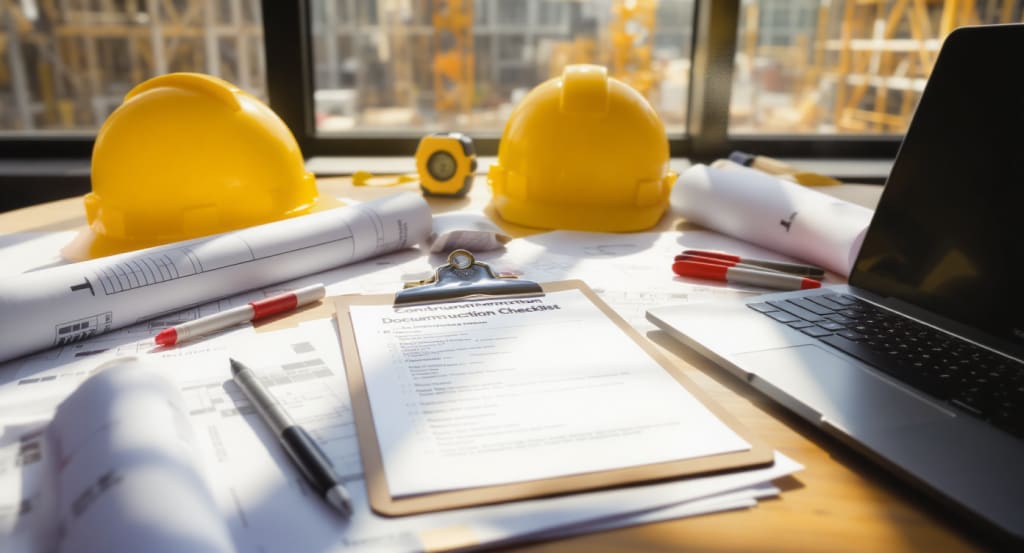
Accurate construction documentation is the backbone of any successful building project. Whether you are working on a residential renovation, commercial buildout, or an infrastructure upgrade, proper documentation ensures project clarity, helps secure permits, reduces design rework, and accelerates construction timelines.
To streamline workflows, contractors, architects, engineers, and facility owners rely on a complete construction documentation checklist that aligns with each milestone on the project timeline.
In this guide, you’ll learn what documentation you need at every project phase—from pre-construction planning to handover and facility management.
Why a Construction Documentation Checklist Matters
Construction projects involve collaboration among architects, MEP engineers, consultants, contractors, subcontractors, vendors, and government authorities.
Without a standardized documentation flow, projects often face:
Permit delays
Design changes and rework
Cost overruns
RFIs due to unclear drawings
Disputes between stakeholders
Safety and compliance risks
A systematic checklist ensures documentation accuracy, accessibility, and accountability, minimizing risk and improving communication throughout the lifecycle of the project.
🏗️ Phase-Wise Construction Documentation Checklist
1. Pre-Construction Phase Documentation
This stage defines scope, legal approvals, design intent, and budget allocation. Proper documentation here prevents conflicts later.
Checklist
✔ Project Brief / Client Requirements
✔ Site Survey Report & Measurements
✔ Feasibility Studies (Technical + Financial)
✔ Initial Design Concept & Space Planning
✔ 2D Floor Plans + Preliminary Schematics
✔ Soil Test Report / Geotechnical Report
✔ Environmental Impact Report (if applicable)
✔ Permit Checklists & Code Compliance Review
✔ Cost Estimation & Project Budget Plan
✔ Risk Assessment Report
✔ Contract Documents (Client & Consultant Agreements)
Purpose: To ensure legal compliance, design feasibility, and cost clarity before execution starts.
2. Design Development Phase Documentation

Here, the conceptual design is refined into detailed drawings for permit approval and bidding.
Checklist
📌 Architectural
✔ Detailed Floor Plans
✔ Sections & Elevations
✔ Door / Window / Fixture Schedules
✔ Area Calculations and BOQs
📌 Structural
✔ Foundation Drawings
✔ Framing Layouts
✔ Reinforcement Details
✔ Structural Load Calculations
📌 MEP (Mechanical, Electrical, Plumbing)
✔ HVAC Layouts
✔ Lighting & Power Drawings
✔ Fire Protection Design
✔ Plumbing Layouts and Schematics
✔ Single Line Diagrams & Panel Schedules
✔ BIM Coordination Models (Optional but highly recommended)
✔ Design BOQ + Material Specs
✔ Energy Efficiency Compliance (ASHRAE, IGBC, LEED etc.)
Purpose: To prepare accurate, coordinated design documents that avoid clashes during construction.
3. Construction Documentation (CD) Phase

This is the most critical documentation stage. It includes detailed, coordinated drawings and technical instructions for site execution.
Checklist
✔ IFC (Issued for Construction) Drawings
✔ Detailed Working Drawings:
Architectural: Finishing details, layouts, joinery, interior details
Structural: Rebars, steel connections, tolerances
MEP: Routing details, equipment sizing, shop drawings
✔ Shop Drawings (prepared by subcontractors)
✔ Standard Operating Procedures (SOPs)
✔ Material Submittals & Product Specifications
✔ Construction Schedules (Gantt/CPM)
✔ Quality Control Manuals
✔ Safety Documentation (PPE, OSHA compliance, Method Statements)
✔ RFI Log System
Purpose: To ensure accurate execution with no ambiguity.
4. Site Execution & Monitoring Documentation
This stage focuses on tracking progress, inspections, changes, and compliance.
Checklist
✔ Daily Progress Reports (DPRs)
✔ Site Inspection Reports
✔ RFI Responses & Change Orders
✔ Work Permit Logs (Hot Work, Height Work etc.)
✔ Testing & Commissioning Logs
✔ Material Delivery Logs & Inventory Records
✔ Contractor Billing & Measurement Sheets
✔ Site Photos & As-Built Markups
Purpose: To maintain transparency of onsite activities and monitor scope changes.
5. Project Handover & Closeout Documentation
Once construction is completed, the documents handed to the client help with building operations and maintenance.
Checklist
✔ As-Built Drawings (Architectural, Structural, MEP)
✔ BIM As-Built Model + Clash-Free Records (if applicable)
✔ Operation & Maintenance (O&M) Manuals
✔ Warranty Certificates
✔ Testing & Commissioning Reports
✔ Final BOQ + Cost Audit Summary
✔ Utility Layout Maps
✔ Fire & Safety Compliance Certificates
✔ Facility Management Guidelines
✔ Final Project Report
Purpose: To enable safe building operations and ensure long-term asset value.
📌 Bonus: Digital Construction Documentation Tips
To avoid data loss and miscommunication, organizations should adopt digital tools like:
BIM (Building Information Modeling)
Cloud-Based Document Management Systems (DMS)
3D Laser Scanning for As-Built Documentation
Construction ERP Software (Procore, Aconex, Buildertrend etc.)
✔ Version-control drawings
✔ Centralized document access
✔ Real-time collaboration
✔ Reduced rework & delays
🧰 Downloadable Construction Documentation Templates (Optional Ideas)
You can create downloadable checklists like:
📎 PDF Checklist – Pre-Construction Documents
📎 Excel Tracker – Site Documentation Log
📎 AutoCAD + BIM Drawing Checklist
(These can be future lead magnets for your website.)
📍 Final Thoughts
Construction documentation isn’t just paperwork—it’s the backbone of project success. A standardized documentation workflow:
✔ Reduces costly rework
✔ Speeds up permit approvals
✔ Improves coordination between stakeholders
✔ Ensures safety and regulatory compliance
✔ Enhances project delivery timelines
Whether you’re an architect, general contractor, developer, or facility owner, using a phase-wise construction documentation checklist ensures transparency and seamless execution from design to handover.
Further Reading
Comparing Traditional Surveying vs. Scan-to-BIM for Historic Structures
7 Critical Mistakes in Architectural Construction Drawings That Delay Your Permit
How to Choose the Right Industrial Architectural Modeling Partner in the U.S.
Why Scan-to-BIM Is Transforming Historic Building Restoration?
About the Creator
Matt Sharon
A professional content writer. Having years of experience in Technology, health, finance, and construction and real estate field. Writing is my passion and I love to play with words Confidently.
Keep reading
More stories from Matt Sharon and writers in Education and other communities.
The ROI of Laser Scanning for Historic Building Renovation Projects
Renovating a historic building is not just a construction activity—it's a responsibility. Architects, engineers, and preservationists must balance modernization needs with meticulous care for original details. This is where 3D laser scanning delivers one of the highest returns on investment (ROI) in the entire restoration workflow.
By Matt Sharon2 months ago in Education
Why I Decided on Business Before I Even Finished School
I’ve always had the need to create something of my own. I never had a dream job. Not even once. When people asked me what I wanted to become, there was no clear answer—because deep inside, I knew I didn’t want to be stuck anywhere. I tried to think about college, about following a “safe” path, but it never felt right. I didn’t feel it. The only thing that ever felt natural to me was business.
By Affiliates Eveabout 2 hours ago in Education
Beyond Algorithms: The Human-AI Connection
It began as a routine assignment. Sofia, a cognitive scientist, had been asked to test a new AI interface called Elios, designed to assist in emotional intelligence training. At first, she thought it would be like any other experiment—data points, behavior patterns, predictive modeling—but what she discovered went far beyond numbers and code.
By hazrat alia day ago in Education
Not Just For Clean Up: A History Of The MCU's Department of Damage Control
Initially an organisation that seemed to exist to help the heroes of the Marvel Cinematic Universe, from Phase Four onwards, the Department of Damage Control has shifted into a more antagonistic role. Most recently seen in the Wonder Man series, the current incarnation of Damage Control seems to target superpowered individuals, regardless of whether that person poses an active or intentional threat.
By Kristy Anderson5 days ago in Geeks


Comments
There are no comments for this story
Be the first to respond and start the conversation.