
Designing Cross-platform Learning Systems
FreeKidsContent.com

Introduction: While designing cross-platform learning systems, we focused on three pillars: teaching, practice, and improvement. Together, these pillars form the structural foundation and design philosophy of our digital learning model.
A model that combines guided sequential lesson curriculums and cyclical activities akin to the waterfall design model. With feedback loops between progress and lessons/activities liken to the agile or responsive model. Allowing students to build foundations first, then improve through continuous practice and feedback.
Refer to the diagram below. Where lessons deliver teaching materials, activities enable practice, and progress displays improvement over time. With direct links from Progress back to the Lessons and Activity phase allowing for continuous improvement.
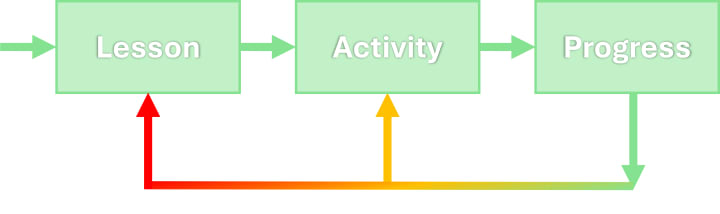
In the following article, we will define each individual phase and establish its contribution to the resulting learning systems.
Lesson: The Oxford Advanced Learner’s Dictionary defines a lesson as a period in which teaching and learning take place. With the Merriam-Webster Dictionary placing its origins from Middle English and Anglo-French leçon, ultimately from the Latin lectio, meaning “a reading”. Commonly equivalent to 课 (kè), meaning a lesson or class, and referring to a school course, as defined in the Xinhua Dictionary.
This phase is designed to introduce and/or reinforce a topic, with the number of lessons and their breakdowns determined by the level of clarity required for full understanding of the material. Features including, but not limited to, embedded activities, read-aloud text-to-speech, and on-the-fly navigation to specific sections of a lesson are incorporated into the design language to encourage curriculum curation.
By facilitating the selection, organization, and evaluation of high-quality, relevant educational materials this pillar strives to meet specific learning/teaching goals of students, teachers, and their corresponding institutions.
Activity: The Oxford Advanced Learner’s Dictionary defines an activity as a task or exercise that learners do as part of the learning process. With the Merriam-Webster Dictionary placing its origins from Middle English through French and Latin, from activus, meaning “active”. Commonly equivalent to 活动 (huódòng), composed of 活 (“active”) and 动 (“movement”), meaning an activity or organized event, as defined in the Xinhua Dictionary.
This phase includes various active learning modules such as homework, quizzes, and tests. Each generated programmatically to increase variety and customizable to gauge difficulty. All modules contain assessment question types that include but are not limited to short answer, multiple choice, and true or false. Limitless practice is this phase’s design language.
By repeatedly completing the available activities we hope that individuals can improve proficiency and mastery of a specific lesson or group of lessons.
Progress: The Oxford Advanced Learner’s Dictionary defines progress as the improvement or development of a learner’s knowledge, skills, or understanding over time. With the Merriam-Webster Dictionary placing its origins from the Latin progressus, meaning “advance”. Commonly equivalent to 进步 (jìnbù), composed of 进 (“to advance”) and 步 (“step”), meaning progress or improvement, as defined in the Xinhua Dictionary.
This phase tracks a user’s lesson history and activity performance. Using a mix of numbers and graphs, we can capture progression at specific moments in time (day, week, and month). Additionally, by analyzing this data, we can highlight areas for improvement and maintain motivation by displaying historic accomplishments.
Conclusion: The combination of the Lesson, Activity, and Progress phases enables users to learn, practice, and pinpoint specific areas for growth. Utilizing a dual feedback loop to bridge learning gaps, misunderstandings, or misinterpretation of a specific topic.
We intend to implement this model in systems covering early education topics like math, science, and English. Once our data is finalized, our findings will be published openly to help improve public education resources.
Thank you very much for taking the time to read this article. I’d appreciate any feedback, ideas, or thoughts on the piece. Thanks again, Tom Jr.
About the Creator
Tom Wanyama
FreeKidsContent.com
Keep reading
More stories from writers in Education and other communities.
The Healing Giant China $573 Billion Pharmaceutical Revolution (2025-2033)
In 2026, the global healthcare map is being redrawn, and its epicenter is undeniably moving East. China is no longer just the world’s manufacturing hub; it is now its second-biggest pharmaceutical laboratory. Driven by a rapidly aging population, a massive surge in chronic disease prevalence, and a government-led "Innovation-First" mandate, the China pharmaceutical industry is entering its most transformative decade. According to latest research, the sector reached USD 306.5 Billion in 2024 and is projected to skyrocket to USD 573.0 Billion by 2033. Exhibiting a robust CAGR of 7.20% during 2025-2033, the nation is successfully transitioning from "Made in China" to "Innovated in China."
By Neeraj kumara day ago in Education
Casie Hynes and the Push to Redefine Mathematics Education
Mathematics has always played a central role in education, yet it remains one of the most polarizing subjects students encounter. Some learners feel empowered by numbers and patterns, while others experience frustration and self-doubt early in their academic journey. Despite decades of discussion about reform, many math classrooms still rely on methods that emphasize memorization and speed over understanding and curiosity. In a world shaped by data, technology, and constant change, this approach no longer meets the needs of today’s students.
By Casie Hynesabout 8 hours ago in Education
Choose Your Own Adventure: St Helena Station
*****Preface***** I have been obsessed with Choose Your Own Adventure stories since I was a kid. I credit them with my love of reading and writing. I've been struggling to get my own kids to embrace words the same way I have but they love video games and our occasional Dungeon's and Dragon's game... which gave me an idea. I'll write an interactive story. So far its working; my middle son loves it and can't wait for the next section to come out.
By Sandor Szabo2 days ago in Fiction
📢 Raise Your Voice Thread: 02/05/2026
Our “Raise Your Voice Threads” are hosted most alternating Thursdays at 12PM ET to offer creators more avenues to uncover exceptional stories on Vocal. As we are continuously searching for fresh creators and inspiring stories, this thread provides an opportunity to exchange and discuss the stories that have moved and motivated us on Vocal.
By Raise Your Voice by Vocala day ago in Resources




Comments
There are no comments for this story
Be the first to respond and start the conversation.