
How to Learn Anything Faster: Scientifically Proven Study Techniques
Unlock Your Brain's Full Potential: Master Speed Learning Techniques for Success

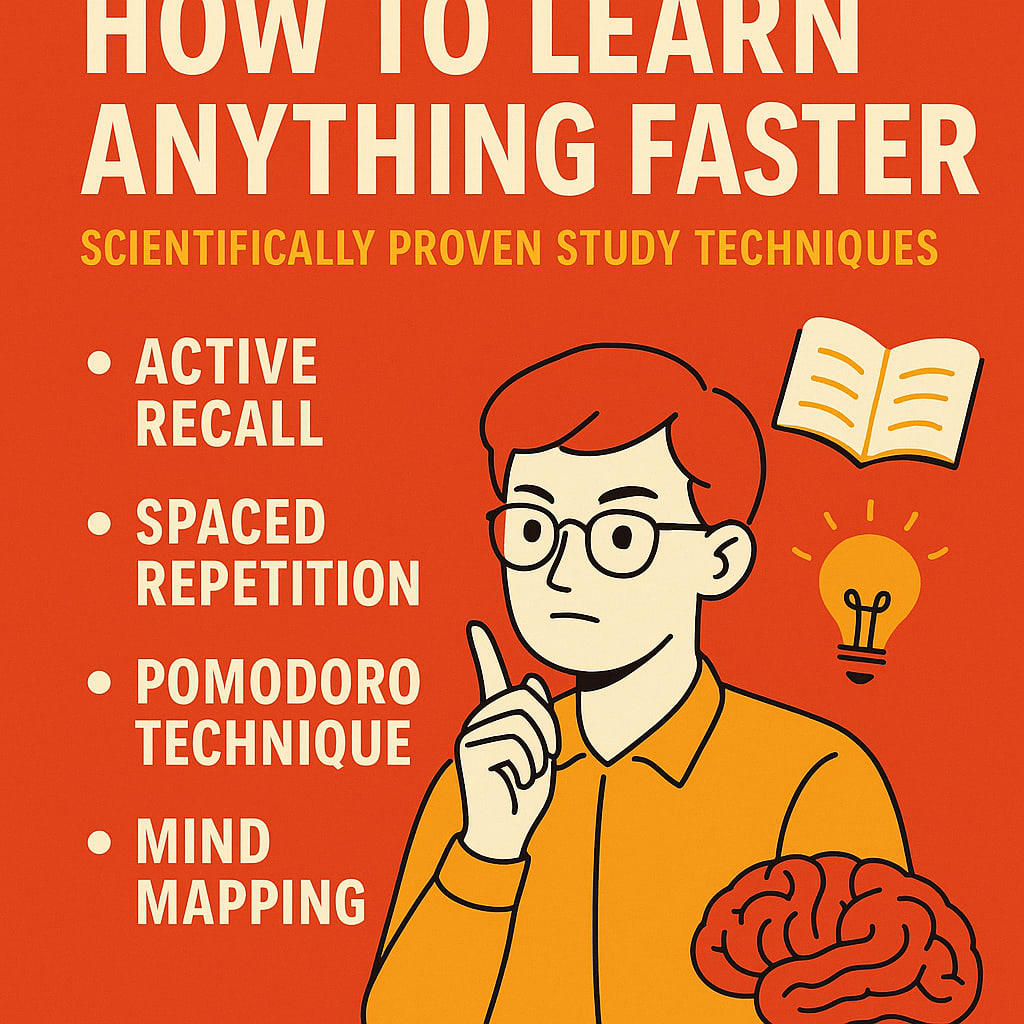
In a world that never stops evolving, the ability to learn quickly is more than just a luxury—it’s a necessity. Whether you're a student trying to ace exams, a professional aiming to acquire new skills, or someone looking to stay ahead of the curve, mastering the art of fast learning can be your secret weapon. Imagine if you could cut your learning time in half and retain information more effectively. Sounds like a dream? It doesn’t have to be!
In this article, we’ll explore scientifically proven methods that can drastically improve your learning speed. These aren’t just tips you’ll read about once and forget; these techniques have been backed by research and can revolutionize the way you approach learning forever.
1. The Power of Active Recall: Challenge Your Memory
Have you ever found yourself rereading the same page of a textbook over and over again, only to realize that you can’t remember much of it? That’s because passive reading doesn’t work as well as you might think. To truly learn, you need to challenge your brain to recall information actively.
What is Active Recall? Active recall is a technique that involves testing yourself on the material you’re learning. Instead of passively reviewing notes, you actively try to retrieve information from memory. Studies have shown that this form of retrieval practice strengthens memory retention and improves long-term recall.
How to Use Active Recall Effectively?
Flashcards: Create flashcards with questions on one side and answers on the other. Regularly test yourself on these cards.
Teach Someone Else: Explaining what you’ve learned to someone else forces you to recall the information and helps reinforce your understanding.
Self-Testing: Before studying a topic, try to recall everything you know about it. Then, after studying, test yourself again to see how much you’ve retained.
By incorporating active recall into your study routine, you’ll notice a significant boost in your ability to remember information.
2. Spaced Repetition: The Key to Long-Term Retention
The concept of spaced repetition is simple but incredibly effective. It’s based on the idea that information is best retained when it is reviewed at increasing intervals over time. This method taps into the psychological phenomenon known as the "forgetting curve," which shows that we forget information quickly unless we review it regularly.
Why Spaced Repetition Works When you space out your review sessions, your brain has to work harder to recall the information, which strengthens neural connections. Over time, this leads to better retention and understanding.
How to Implement Spaced Repetition
Use Spaced Repetition Software (SRS): Tools like Anki and Quizlet allow you to create flashcards and set them to review at optimal intervals.
Manual Spacing: If you prefer a more traditional approach, you can create a schedule to review your notes on the first day, then again after 2 days, 4 days, 7 days, 14 days, and so on.
By spacing out your reviews, you’ll keep information fresh in your mind without feeling overwhelmed by constant cramming.
3. The Pomodoro Technique: Breaks That Boost Productivity
One of the most effective ways to learn faster is by improving your focus. But let’s face it, staying concentrated for hours at a time can be difficult. That’s where the Pomodoro Technique comes in—a time management method that encourages focused work intervals followed by short breaks.
How the Pomodoro Technique Works The technique is simple: work in focused 25-minute intervals (called “Pomodoros”) followed by a 5-minute break. After four Pomodoros, take a longer break of 15–30 minutes. This cycle prevents burnout and maintains a high level of productivity.
Why It Works Research has shown that our brains can only maintain high levels of focus for a limited amount of time. Taking short, frequent breaks helps your mind stay sharp and avoid fatigue, allowing you to retain more information during your study sessions.
4. Mind Mapping: Visualize and Organize Information
We often think of learning as a linear process—read, memorize, repeat. But the brain doesn’t work that way. It thrives on connections and associations. That’s where mind mapping comes into play. Mind maps are visual diagrams that help organize and represent knowledge.
How Mind Mapping Works When you create a mind map, you start with a central concept and branch out into related ideas. This process helps you see the bigger picture and makes it easier to connect new information with what you already know.
How to Create a Mind Map
Start with a central idea in the middle of a blank page.
Branch out into subtopics, and then further break those down into smaller details.
Use colors, images, and keywords to make the map visually engaging.
Mind maps not only help with memorization but also make it easier to recall information by creating associations between different concepts.
5. The Feynman Technique: Teach What You’ve Learned
The best way to truly learn something is by teaching it. This is the core idea behind the Feynman Technique, named after the Nobel-winning physicist Richard Feynman. He believed that to understand a concept deeply, you should be able to explain it in simple terms.
How the Feynman Technique Works
Step 1: Choose a concept you want to learn.
Step 2: Pretend you are teaching it to a child or someone who knows nothing about the subject.
Step 3: Identify any gaps in your knowledge as you try to explain the topic. Go back to your study materials and fill in those gaps.
Step 4: Simplify and refine your explanation until you can clearly articulate the concept in simple language.
By teaching others or even yourself, you reinforce your understanding and uncover areas that need further study.
6. Visualization Techniques: Harness the Power of Your Imagination
Did you know that your brain processes images faster than words? By using visualization techniques, you can improve your ability to recall information, especially when it comes to complex or abstract concepts.
How Visualization Works Visualization is the process of mentally imagining a scenario or concept in detail. By creating vivid mental images, your brain forms stronger neural connections, making it easier to recall information later.
How to Use Visualization for Learning
Visualize Concepts: If you're learning about a historical event, imagine the scene in your mind as vividly as possible. For math or science, visualize the process of solving a problem step-by-step.
Create Mental Movies: Turn what you're learning into a story. The more engaging and detailed the story, the easier it will be to remember.
Visualization works by activating the same brain regions involved in actual experiences, making it a powerful tool for improving memory and understanding.
7. Eliminate Distractions: The Importance of Focused Learning
No matter how good your study techniques are, they won’t work if you're constantly distracted. In today’s world of notifications and multitasking, focusing on a single task for an extended period can be challenging. But distractions drain your cognitive resources and make it harder to retain information.
How to Eliminate Distractions
Turn Off Notifications: Silence your phone and avoid checking social media while studying.
Create a Distraction-Free Study Environment: Choose a quiet, clutter-free space to study.
Set Clear Goals: Having a specific goal for each study session helps keep you focused and on track.
Conclusion: Your Roadmap to Faster Learning
Learning doesn’t have to be a slow, tedious process. By implementing scientifically proven techniques like active recall, spaced repetition, the Pomodoro technique, mind mapping, the Feynman technique, and visualization, you can boost your learning speed and retention dramatically.
Remember, learning faster isn’t just about working harder—it’s about working smarter. By applying these strategies, you’ll unlock your brain’s full potential, paving the way for greater success in your academic, personal, and professional life.
So, what are you waiting for? Start practicing these techniques today, and watch how quickly you can learn anything you set your mind to. Your future self will thank you!
About the Creator
Keep reading
More stories from Sohail Abbas and writers in Education and other communities.
"The Einstein Quote That Changed the World"
Albert Einstein's profound insights and revolutionary theories changed the very fabric of how we perceive the universe. Among his numerous quotes, one in particular stands out: “Imagination is more important than knowledge.” This statement not only reflects Einstein's visionary thinking but also challenges our conventional understanding of what it means to truly innovate. In this article, we’ll dive deep into this powerful statement, exploring its significance, the context in which it was said, and how it continues to inspire generations today.
By Sohail Abbas9 months ago in Education
Why Are Neutron Stars So Dense?
The Life and Death of Massive Stars The story of neutron star density begins with massive stars. Stars shine by fusing lighter elements into heavier ones in their cores. This nuclear fusion releases energy that pushes outward, balancing the inward pull of gravity. As long as this balance exists, the star remains stable.
By shahkar jalala day ago in Education
Cabin Fever Because of Snow, Sleet, and Freezing Rain That Turned to Icy Roads
What Is Cabin Fever? The short answer is that cabin fever is restlessness from being in a confined area. Cabin fever is the distressing irritability or restlessness experienced when a person or group is stuck at an isolated location or in confined quarters for an extended time. Research shows that prolonged cold, gray skies, and being stuck indoors can trigger mood shifts similar to “winter blues.”
By Margaret Minnicks5 days ago in Humans


Comments
There are no comments for this story
Be the first to respond and start the conversation.