
Is AI Transcription Accurate Enough for Professional Use?
Understanding the Role of AI and Human Accuracy in Modern Transcription
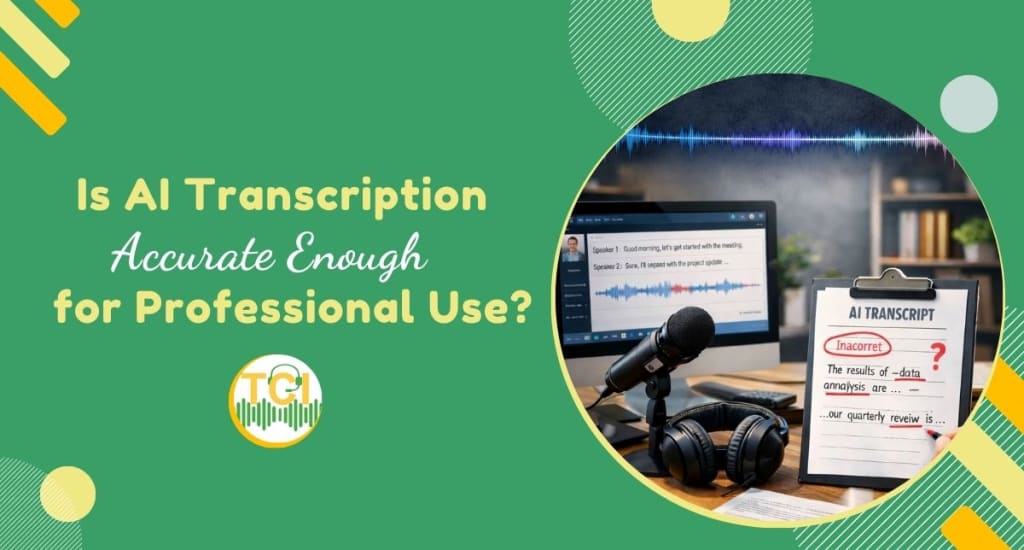
The rise of artificial intelligence has transformed the way professionals handle audio and video content. Meetings, interviews, podcasts, court hearings, lectures, and media productions can now be converted into text within minutes using AI-powered transcription tools. What once took hours—or even days—can now be done almost instantly.
But this speed raises an important question: Is AI transcription accurate enough for professional use?
The short answer is: it depends on the context. While AI transcription has made impressive progress, human transcription still remains the gold standard for professional, legal, academic, and high-stakes content. This article explores where AI transcription excels, where it falls short, and why human transcription continues to play a critical role.
Understanding AI Transcription Accuracy
AI transcription works by using machine learning models trained on vast amounts of audio and text data. These systems analyze speech patterns, predict words, and convert sound into written language. On clean audio with a single speaker, neutral accents, and minimal background noise, AI transcription accuracy can reach 85–95%.
For casual or internal use, this level of accuracy may be acceptable. However, in professional environments, even small errors can have serious consequences. A missing word, incorrect name, or misunderstood phrase can change the meaning of a sentence entirely—especially in legal, medical, academic, or journalistic contexts.
Where AI Transcription Performs Well
AI transcription is undeniably useful in certain situations. It works best when:
- Audio quality is high and noise-free
- Speakers talk clearly and at a moderate pace
- There is minimal overlap between speakers
- Content is informal or for internal reference
For example, AI transcription can be effective for:
- Rough meeting notes
- Draft podcast transcripts
- Lecture summaries
- Personal voice memos
- Content ideation and research
In these scenarios, speed and affordability often matter more than perfect accuracy.
The Limitations of AI Transcription
Despite advancements, AI transcription still struggles with several critical aspects of real-world communication.
1. Context and Meaning
AI does not truly understand context. It processes patterns, not intent. Sarcasm, humor, emotional tone, and implied meaning are frequently misinterpreted or lost altogether. A human transcriber can understand when a speaker is joking, correcting themselves, or emphasizing a point. AI cannot reliably do this.
2. Accents, Dialects, and Code-Switching
Professional content often includes speakers with diverse accents, regional dialects, or mixed languages. AI systems may mishear or replace unfamiliar words, leading to inaccurate transcripts. Human transcribers can recognize these variations and accurately reflect the speaker’s voice and meaning.
3. Industry-Specific Terminology
Legal, medical, technical, and academic fields rely heavily on specialized vocabulary. AI transcription tools frequently misinterpret jargon, abbreviations, or uncommon terms. A trained human transcriber with subject-matter familiarity and proper legal transcription training can ensure terminology is accurate and consistent.
4. Speaker Identification
When multiple people speak at once or interrupt each other, AI often fails to correctly identify who said what. In professional transcripts—such as interviews, court proceedings, or research discussions—this is a major issue. Humans excel at distinguishing speakers, even in complex conversations.
Why Human Transcription Still Matters
Human transcription offers something AI cannot replicate: judgment, comprehension, and accountability.
1. Near-Perfect Accuracy
Professional human transcription can achieve 98–99% accuracy, even with challenging audio. Humans can replay unclear sections, research names or references, and apply logic to incomplete sentences. This level of accuracy is essential for:
- Legal documentation
- Academic research
- Media publications
- Medical records
- Corporate compliance
2. Contextual Understanding
Human transcribers understand why something is said, not just what is said. They can:
- Correct false starts without altering meaning
- Maintain the speaker’s intent
- Preserve tone and nuance
- Clarify ambiguous phrasing
This makes human transcripts far more reliable for professional use.
3. Ethical and Legal Reliability
In regulated industries, errors can lead to legal disputes, misinformation, or reputational damage. Human transcription provides an added layer of responsibility and quality assurance that AI alone cannot guarantee.
The Best Approach: AI + Human Review
In many professional workflows, the most effective solution is a hybrid approach. AI transcription can be used as a first draft to save time and reduce costs. A human transcriber or editor then reviews, corrects, and refines the transcript to ensure accuracy, clarity, and professionalism.
This approach combines:
- AI’s speed and efficiency
- Human accuracy and understanding
Is AI Transcription Ready to Replace Humans?
Not yet.
AI transcription is a powerful tool, but it is not a replacement for human transcription in professional settings. It is best viewed as an assistant—not an authority.
As AI continues to evolve, accuracy will improve. However, language is deeply human. It carries emotion, culture, intent, and nuance—elements that machines still struggle to fully grasp.
Final Thoughts
So, is AI transcription accurate enough for professional use?
For drafts, internal notes, and low-risk content, AI transcription can be more than sufficient. For published, legal, academic, or professional-grade work, human transcription remains essential.
The smartest professionals don’t choose between AI and humans—they use both wisely. In a world increasingly driven by automation, human expertise is still the standard for accuracy, trust, and meaning.
About the Creator
Mahesh Kumar
Representing Transcription Certification Institute, a Nashville, TN, based company that provides comprehensive online general transcription training certification courses.
Keep reading
More stories from Mahesh Kumar and writers in Education and other communities.
How Can I Increase My Transcription Speed and Earnings
If you’ve been transcribing for a while, you already know that speed matters—but speeding up doesn’t mean cutting corners. It means finding smarter ways to work, improving efficiency, and using modern tools (including AI) to support your workflow.
By Mahesh Kumar8 days ago in Education
The Overlooked Intersections of Education, Cultural Heritage, and Public Service in Society
Education, cultural heritage, and public service often appear as separate fields. Schools focus on learning. Heritage focuses on history and tradition. Public service focuses on helping people. Yet these areas are deeply connected. They shape values, guide behavior, and support communities. When viewed together, their shared purpose becomes clear. At the center of this connection is education, cultural heritage, and public service, a relationship that quietly shapes how societies grow, remember, and care for people. These intersections are often overlooked because they work in subtle ways. They appear in classrooms, museums, libraries, and community programs. They influence how people learn about the past, understand the present, and act for the future. When combined, they create stronger and more informed communities.
By Carmen Reid6 days ago in Education
Where to Hunt Big Game: Top U.S. States for Deer and Trophy Hunting Adventures
Hunting has always been a big part of American outdoor life. Every year, hunters plan trips across the country to hunt whitetail deer, elk, mule deer, and other large game. The search for trophy bucks and unforgettable hunts is more than just a sport; it’s a passion. For hunters who dream of the perfect trip, choosing the right state can make all the difference.
By Kyle Vandermolenabout 2 hours ago in Education



Comments
There are no comments for this story
Be the first to respond and start the conversation.