
Sudden Radio Interference During Live Events
What Really Happens and How to Stay in Control

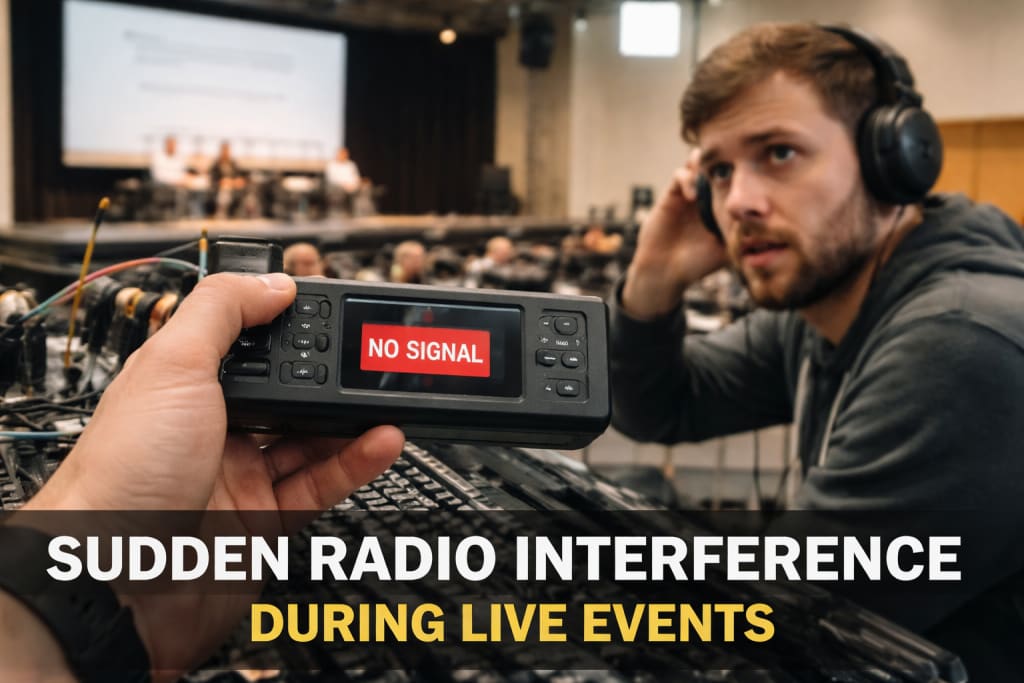
There is a specific kind of silence that only event professionals know.
It’s not the silence of a quiet room.
It’s the silence that happens when a microphone drops out in the middle of a wedding vow, a keynote speech, or a live broadcast.
No second take.
No reset.
No “let’s try that again.”
Sudden radio interference during non-repeatable live events is one of the most destabilizing technical failures a videomaker or field reporter can face. And yet, in most cases, it is neither random nor mysterious.
It is the predictable outcome of a dynamic radio environment colliding with fragile preparation.
This article brings together the full picture:
- What actually happens inside the radio spectrum during events
- Why interference appears “out of nowhere”
- The most overlooked technical mistakes
- And a realistic protocol to reduce risk dramatically
The Invisible Battlefield: What the Radio Spectrum Looks Like During an Event
When we talk about “changing frequency,” we often imagine a clean, organized system — as if each device occupies a neatly assigned lane.
In reality, the radio spectrum during a live event resembles a congested highway during rush hour.
Inside a typical conference hall, wedding venue, or trade fair, the following are competing for space:
- WiFi routers (2.4GHz and 5GHz)
- Bluetooth devices
- Other wireless microphones
- Video transmitters
- Streaming encoders
- Security systems
- Smartphones (hundreds of them)
Every one of these devices emits radio frequency (RF) energy. Some are stable. Others constantly hop channels. Some increase transmission power automatically.
The environment is not static — it evolves minute by minute.
Why It Works During Soundcheck (and Fails Later)
This is a common scenario:
- You test the lavalier during rehearsal.
- Signal is clean.
- No noise, no dropouts.
Then guests enter the room. Suddenly:
- Random static bursts
- Short signal drops
- Digital clicks
- Brief silence
What changed?
The RF density increased. Human bodies absorb radio energy. Smartphones begin transmitting. Temporary routers activate for live streaming. Another vendor turns on a wireless system nearby.
The equilibrium shifts.
Not All Interference Is “Frequency Conflict”
One of the biggest misconceptions is that interference always equals overlapping frequencies.
While frequency collision is common, it is far from the only cause.
Sudden instability can result from:
- Intermodulation between multiple transmitters
- Multipath reflections from metal structures
- Body blocking of the transmitter
- Low battery voltage instability
- Electrical noise from lighting systems
- Antenna positioning errors
Treating every issue as “wrong channel selection” often leads to frantic, ineffective troubleshooting.
UHF vs 2.4GHz: Context Matters More Than Labels
Many modern entry-level systems operate in the 2.4GHz band. This band is convenient and globally license-free, but heavily shared with WiFi and Bluetooth.
In crowded environments, 2.4GHz can become saturated.
UHF systems operate in narrower bands, often with more stability in complex environments — but they require proper frequency coordination, especially when multiple systems are present.
There is no universally superior choice.
The correct system depends on:
- Event density
- Number of wireless devices on site
- Distance requirements
- RF congestion level
Understanding this prevents unrealistic expectations.
Intermodulation: The Hidden Saboteur
When multiple transmitters operate near each other, especially at higher power levels, they can generate additional unintended frequencies. These are called intermodulation products.
They are not visible to the naked eye and often not obvious during basic scanning.
But they can destabilize a system that appears correctly configured.
This is why professional setups often use frequency coordination software. It calculates safe frequency spacing to prevent internal interference.
Without coordination, two perfectly “legal” frequencies can still interfere with each other indirectly.
The Environment Is Not Neutral
Radio waves behave differently depending on surroundings.
Multipath Reflection
Metal trusses, stage structures, glass panels, and large screens reflect RF signals. The receiver may receive multiple versions of the same signal, arriving milliseconds apart.
This causes instability.
True diversity receivers use two antennas and switch dynamically to the stronger signal, reducing this effect.
Human Body Absorption
The human body absorbs RF energy. When a bodypack transmitter is placed behind the speaker and the receiver is positioned in front, the signal must pass through the body.
If the speaker turns away, signal strength can drop instantly.
This explains why dropouts often happen when someone moves — not because of “bad equipment,” but because of physics.
Subtle Errors That Trigger Sudden Interference
Many interference crises originate from overlooked details.
1. Antenna Orientation
Antennas are not decorative accessories. Their orientation affects polarization. If they are bent, hidden, or placed horizontally when vertical alignment is required, signal stability drops.
2. Metal Contact
Placing a transmitter directly against metal — belt clips, stage hardware, or structural elements — can detune the antenna and weaken transmission.
3. Battery Instability
A battery doesn’t have to be empty to cause problems. Voltage instability near depletion can create inconsistent transmission before shutdown occurs.
4. Excessive Transmission Power
Counterintuitively, increasing power is not always beneficial. In dense RF environments, stronger transmission can increase intermodulation risk and worsen the situation.
5. Relying Only on Initial Testing
An event is dynamic. A system stable at 3 PM may become unstable at 6 PM when streaming infrastructure activates or guests fill the venue.
Stability is not permanent. It must be monitored.
A Practical Protocol to Reduce Interference Risk
Eliminating risk entirely is unrealistic. Reducing it dramatically is achievable.
Before Arriving
- Update firmware.
- Use fresh, tested batteries.
- Coordinate frequencies if using multiple systems.
- Prepare a backup recording method (internal recording, secondary mic).
Redundancy is professionalism, not paranoia.
On-Site Setup
1. Perform a frequency scan before connecting to the main system.
2. Avoid crowded RF zones rather than just choosing the first “available” channel.
3. Position antennas away from metal and lighting controllers.
4. Maintain line-of-sight where possible.
5. Test with realistic movement, not static positioning.
Walk the stage. Turn around. Simulate actual behavior.
During the Event
- Monitor with headphones continuously.
- Watch RF meters, not just audio levels.
If minor interference begins:
- Check battery level first.
- Reduce distance between transmitter and receiver if possible.
- Change frequency only if absolutely necessary and safe.
Always Have a Plan B
Some modern transmitters include internal recording. That feature alone can save an irreplaceable speech.
Even a discreet secondary recorder can prevent catastrophic loss.
In non-repeatable events, backup is not optional.
Why Interference Feels Random (But Isn’t)
From the operator’s perspective, interference appears sudden and unfair.
From a technical perspective, it is the breaking point of a shifting balance:
- A new RF source activates.
- Physical orientation changes.
- Power conditions fluctuate.
- Environmental density increases.
Understanding this changes the mindset from reactive panic to strategic control.
The Real Skill: Managing the Unseen
Handling radio interference during live events is not about memorizing one fix. It is about understanding the ecosystem:
- Spectrum density
- Device interaction
- Physical propagation
- Environmental variables
- Operational discipline
High-end equipment helps.
But informed preparation helps more.
When you respect the invisible complexity of the RF environment, sudden interference stops being a mysterious enemy — and becomes a manageable risk.
In live production, you cannot control everything.
But you can control how prepared you are when the spectrum shifts.
About the Creator
Keep reading
More stories from Elvezio Guarino and writers in Education and other communities.
Meaningful Mentorship for Students and Young Leaders: A Pathway to Confident Growth
Meaningful mentorship gives students and young leaders the support they need to grow with confidence. Young people face pressure from school, social life, and future plans. They often feel unsure about their abilities. With meaningful mentorship, they gain guidance that helps them move forward with clarity.
By Mario Payneabout 12 hours ago in Education
The Power of Perspective: Rich Thinking vsTraditional Thinking
The Power of Perspective: Rich Thinking vs. Traditional Thinking Success in life is often less about external circumstances and more about the mindset we adopt. Two dominant approaches to thinking—rich thinking and traditional thinking—illustrate how perspective shapes opportunities, decisions, and ultimately, outcomes. While traditional thinking emphasizes stability, caution, and conformity, rich thinking thrives on vision, risk-taking, and innovation. Understanding the differences between these two mental frameworks provides valuable insight into why some individuals achieve extraordinary success while others remain confined to predictable paths.
By Alhouci boumizzi4 days ago in Education
The Pride Flag and the Diversion
For nearly a decade, the LGBTQIA Pride Flag rippled in the wind at Christopher Park, a kaleidoscope of color staked into the soil of America’s first national monument to LGBTQIA+ liberation. That flag came down this week. Federal officials, citing new guidance from the Trump Administration, silently lowered the rainbow flag from its pole across the street from the Stonewall Inn. The birthplace of the modern gay rights movement now flies only the United States flag.
By Tim Carmichael6 days ago in Pride



Comments