
The Boy Who Calculated Shadows
His Mind Was a Ladder, But Poverty Had Sawed Off All the Rungs.
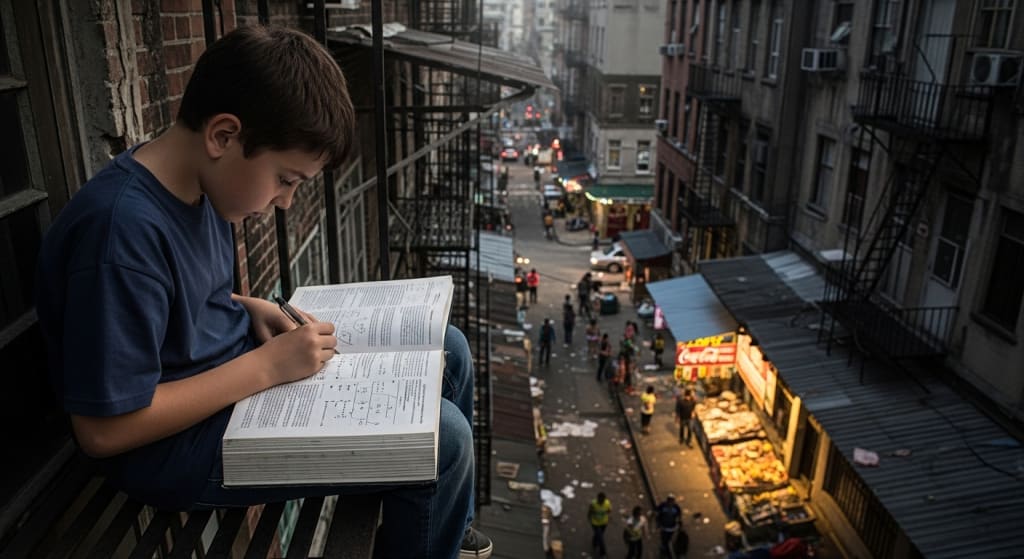
In the concrete maze of the Meridian Heights projects, eight-year-old Elias was a ghost. He was small for his age, with eyes that seemed to absorb the world rather than just see it. His mother worked two shifts, and his world was a symphony of lack—the hollow echo in the cupboard, the chill from the window that wouldn’t seal, the constant, low-grade hum of anxiety. But inside Elias’s head, there was a universe of perfect, beautiful order.
He had taught himself to read from discarded newspapers. Numbers, however, were his first language. He saw mathematics in the rust patterns on the stairwell, calculated the trajectory of a basketball arc instinctively, and understood the physics of the rickety fire escape better than the engineers who’d built it. For Elias, numbers were a refuge. They were constant, fair, and never lied. Two plus two always equaled four, unlike the world where hard work didn't always equal food.
His school was underfunded and overcrowded. His teacher, Mrs. Gable, was a weary woman drowning in paperwork. She noticed Elias’s quiet intensity, the way he’d finish the simple addition sheets in seconds and then stare out the window, solving more complex problems in his mind. One day, she slid a dog-eared book on basic algebra onto his desk. "See if this makes any sense to you, Elias."
He returned it the next morning. "I finished it," he said softly. "The part about quadratic equations was interesting, but the book stopped before it got to the good part with the graphs."
Mrs. Gable stared, dumbfounded. She began giving him more advanced books from her own son's college courses. Elias consumed them like a starving man at a feast. He was a prodigy, a diamond forming under immense pressure. But a diamond is just a rock until it's cut and polished, and poverty is a terrible jeweler.
The crisis came in the form of a city-wide "Future Leaders" math competition. The winner received a trophy, a small cash prize, and, most importantly, the attention of a prestigious scholarship academy. Mrs. Gable entered his name.
Elias was electric with a hope so sharp it was painful. The competition was held in a gleaming university auditorium, a world of polished wood and hushed tones he’d only seen on the library’s donated television. The other children arrived with parents, calculators, and confident smiles. Elias came alone, with a pencil he’d sharpened with a kitchen knife.
He sailed through the written test. It was easier than the problems he invented to pass the time. The final round was a live, on-stage problem-solving session. The moderator announced the challenge: "Using the Pythagorean theorem, calculate the height of the flagpole on the university lawn, given only the length of its shadow and the angle of the sun."
The other contestants scrambled with their protractors and notepads. Elias didn't move. He walked to the edge of the stage, squinted at the long shadow stretching across the lawn, and looked up at the sun. He closed his eyes. In his mind, he became the sun. He saw the triangle formed by the pole, the shadow, and his line of sight. He didn't need the theorem; he could feel the geometry. It was the same way he calculated the height of his apartment building to see if he could jump to the next roof to retrieve his mother’s lost laundry. It was a survival skill.
"Thirty-two feet," Elias said, his small voice cutting through the silent concentration.
The moderator blinked. "Contestant, you need to show your work."
"I did," Elias said, tapping his temple. "It's thirty-two feet."
A murmur ran through the crowd. They thought he was guessing. They sent a janitor with a measuring tape. The pole was thirty-two feet, two inches. The audience erupted in applause. But Elias saw the judges exchanging looks. They weren't looks of admiration, but of suspicion. A boy from the projects, with no tools, no working parents in the audience? He must have cheated.
He won. He got the cheap trophy and the handshake. But the whispers followed him. The scholarship committee "decided to go in a different direction." The opportunity, the ladder out, was sawed off right in front of him.
That night, sitting on the fire escape, Elias didn't open a math book. He looked down at the bustling, struggling street below. He had calculated the height of a flagpole with his mind, but he couldn't calculate the formula for escape. The numbers, for the first time, had failed him. They couldn't quantify prejudice. They couldn't solve for the variable of a broken system. He was still a ghost, just one that now knew the exact dimensions of his cage.
About the Creator
HAADI
Dark Side Of Our Society
How to Donate Venison to Manna House in Huntsville
Donating venison is one of the most meaningful ways local hunters can give back to the community. In Huntsville, Manna House plays a vital role in turning legally harvested deer into healthy meals for families in need. If you have extra venison this season and want it to make a real difference, understanding the process helps ensure your donation is safe, legal, and impactful.
By Joe Sottolano2 days ago in Education
One Simple Photography Trick That Instantly Makes Every Photo Look Professional
Taking a great photo doesn’t always require expensive cameras, advanced editing software, or years of experience. In fact, many professional-looking images come down to one simple technique that anyone can learn. Whether you’re capturing moments with your phone or using a DSLR, there is one photography trick that can instantly elevate the quality of your pictures.
By Kelln Smalla day ago in Education
Feelings Never Die
It is Valentine's Day again, and it bought back memories that were over fifty years old. It bought me back to 1971, and I woke up and I knew my baby was due today. I was big and pregnant, and I felt like I was about to burst wide open. Imagine my surprise when the doctor told my I had a due date of February 14. I couldn't believe it, and since my baby was due today, I felt I could indulge myself a bit. I had gained a lot of weight, and chocolate was on the no-no list, but I had came to the end of this pregnancy, and I hoped it would be okay, after all I would deliver this baby today. So I walked across the street to the grocery story, and bought myself, a peppermint patty, covered in chocolate, my favorite. Me and my Valentine's baby would enjoy it together.
By Susan Paytonabout 5 hours ago in Fiction



Comments
There are no comments for this story
Be the first to respond and start the conversation.