
The First UK Baby Born from a Deceased Donor’s Uterus
A groundbreaking medical milestone gives hope to women born without a uterus.

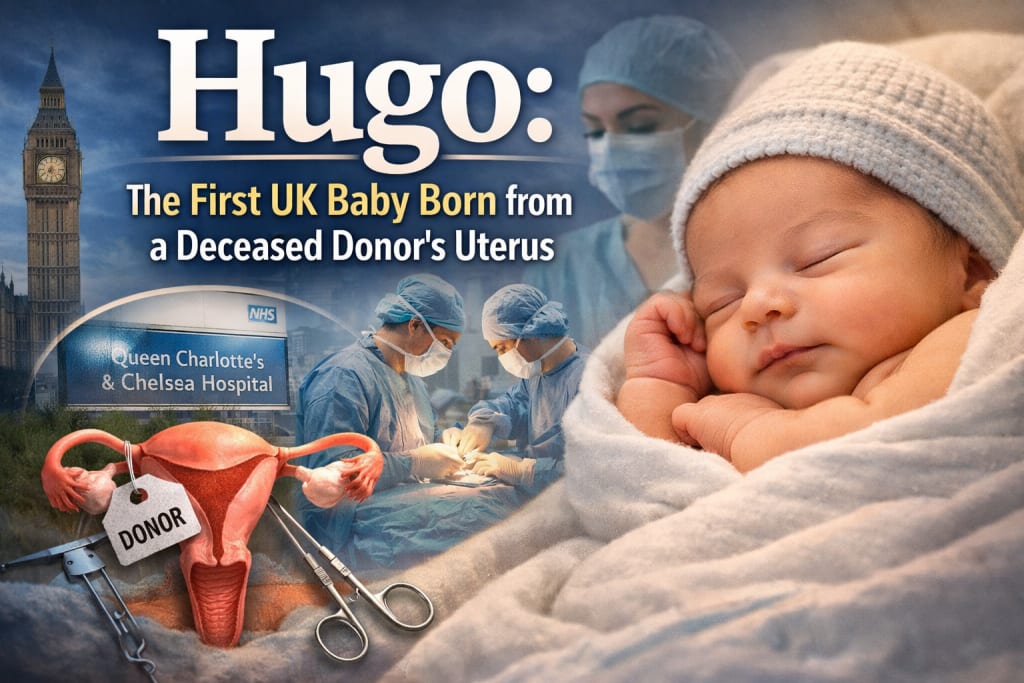
In a historic medical breakthrough, a baby boy named Hugo was born in the United Kingdom just days before Christmas 2025, weighing 7 pounds and making global headlines. His birth was not only a moment of joy for his family but also a landmark achievement in modern medicine. Hugo is the first baby in the UK to be born using a uterus transplanted from a deceased donor, marking a new era in reproductive science and offering hope to millions of women around the world.
Hugo’s story is deeply connected to the journey of his mother, Grace Bell, who was born with a rare congenital condition known as MRKH syndrome (Mayer-Rokitansky-Küster-Hauser syndrome). Women with MRKH are born without a fully developed uterus, making natural pregnancy impossible. From a young age, Grace was told that she would never be able to carry her own child. Like many women with this condition, she lived with the emotional reality that motherhood through pregnancy was not an option for her.
However, advances in medical science created a possibility that once seemed unimaginable.
Through a highly complex and carefully planned medical procedure, Grace received a uterus transplant from a deceased donor. This transplant was followed by in vitro fertilization (IVF), allowing doctors to implant an embryo and begin a monitored pregnancy. After months of medical supervision and care, Grace successfully carried her baby to term.
Hugo was born healthy at Queen Charlotte’s and Chelsea Hospital in London, one of the UK’s leading maternity and medical research hospitals. His birth represents not just a successful delivery, but the success of years of research, ethical planning, surgical innovation, and reproductive science.
A Medical Milestone
While uterus transplants have been attempted before in different parts of the world, most previous successful births involved living donors, often family members. What makes Hugo’s case extraordinary is that the uterus came from a deceased donor, proving that this method can be safe, ethical, and effective.
This breakthrough opens new possibilities for women who:
• Were born without a uterus
• Lost their uterus due to cancer or illness
• Have non-functioning uteruses
• Suffer from severe uterine conditions
For many women, adoption and surrogacy have been the only paths to motherhood. This medical advancement now introduces a third path — the possibility of carrying their own child through medical intervention.
Hope for the Future
Doctors and researchers have described Hugo’s birth as a turning point in reproductive medicine. It represents more than just a successful transplant — it represents a new category of fertility treatment that could transform lives in the future.
Medical experts emphasize that uterus transplantation will remain a highly specialized procedure, requiring:
• Advanced surgical expertise
• Ethical donor systems
• Long-term medical monitoring
• Psychological and physical screening
• Specialized fertility treatment
However, the success of this case proves that it is possible, safe, and viable.
The Human Side of the Story
Beyond science, Hugo’s story is one of human resilience, patience, and hope. For Grace, the journey was not just medical — it was emotional. It involved years of uncertainty, fear, courage, and faith in medical science. Her story now represents millions of women who live with infertility not by choice, but by biology.
Hugo’s birth shows that motherhood is not defined only by biology, but it also proves that science can restore biological possibilities once believed to be lost forever.
A Symbol of Modern Medicine
In many ways, Hugo has become a symbol — not just of medical success, but of what humanity can achieve when compassion, science, and innovation work together. His story will likely be remembered as one of the most important reproductive milestones in UK medical history.
This breakthrough will influence:
• Future fertility research
• Ethical organ donation systems
• Reproductive medicine policies
• Women’s health innovation
• Global medical protocols
Conclusion
Hugo’s birth is not just a personal miracle for one family — it is a global message of hope. It proves that medical science is continuously pushing boundaries, redefining what is possible, and creating new futures for people who were once told their dreams could never come true.
In a world where infertility affects millions, Hugo’s story stands as a powerful reminder that hope, science, and innovation together can change human destiny.
Sometimes, miracles are not magic Sometimes, miracles are medicine.
About the Creator
Irshad Abbasi
"Studying is the best cure for sorrow and grief." shirazi
Keep reading
More stories from Irshad Abbasi and writers in Education and other communities.
The Reality of Narendra Modi | Truth Behind the Image
Narendra Modi is one of the most influential and controversial political leaders of the 21st century. Loved by millions and criticized by many, his personality, leadership style, and political journey have created a powerful image that dominates Indian politics and media. The “Reality of Narendra Modi” is not a simple story of success or failure—it is a complex mix of achievements, strategy, public perception, power politics, and propaganda.
By Irshad Abbasi 2 days ago in Education
Finding Comfort: How to Manage Difficult Symptoms and Regulate Your System During Recovery Care
Recovery after colon cancer treatment can feel unpredictable. Often, food seems fine, but sometimes, it may cause side effects like nausea, urgency, or fatigue. That swing can make you doubt every choice you make. The good news is that small, consistent actions often create the biggest relief, especially when you focus on hydration, steady routines, and colon cancer nutrition treatment that supports healing instead of stressing your digestive system.
By Erika Phillips 8 days ago in Education




Comments
There are no comments for this story
Be the first to respond and start the conversation.