
The Science Behind Eclipses and Their Rarity
Few celestial events capture human imagination like an eclipse. When the Sun darkens in the middle of the day or the Moon turns a deep copper red, it feels dramatic, mysterious, and even otherworldly. Ancient civilizations often viewed eclipses as omens. Today, we understand the science behind them — yet they remain just as awe-inspiring. But what exactly causes eclipses? And if the Sun, Earth, and Moon are constantly moving, why don’t eclipses happen every month? In this in-depth guide, we’ll explore the science behind solar and lunar eclipses, explain why they are relatively rare, and uncover the orbital mechanics that make these events both predictable and extraordinary

What Is an Eclipse?
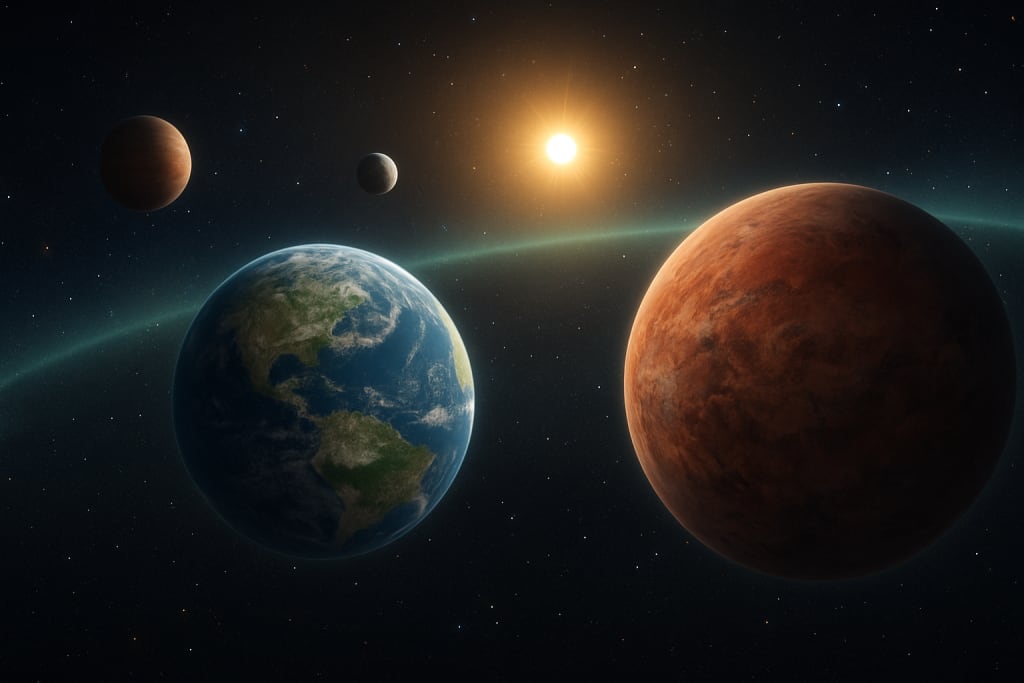
An eclipse occurs when one celestial body moves into the shadow of another. In our Earth–Moon–Sun system, eclipses happen when these three objects align in a nearly straight line.
There are two main types:
• Solar eclipse — when the Moon passes between Earth and the Sun.
• Lunar eclipse — when Earth passes between the Sun and the Moon.
These alignments are called syzygies, a term used in astronomy to describe three celestial bodies lining up.
________________________________________
The Role of the Sun, Earth, and Moon
To understand eclipses, we must first understand the relationship between the:
• Sun
• Earth
• Moon
The Moon orbits Earth roughly every 27.3 days. Meanwhile, Earth orbits the Sun once every 365 days. Because the Moon circles Earth so frequently, you might expect eclipses to happen every month.
But they don’t.
The reason lies in orbital tilt.
________________________________________
Why Eclipses Don’t Happen Every Month
The Moon’s orbit is tilted about 5 degrees relative to Earth’s orbit around the Sun (called the ecliptic plane).
This means that during most new and full moons, the Moon passes slightly above or below the line between Earth and the Sun.
For an eclipse to occur, three conditions must be met:
1. The Moon must be either new (for a solar eclipse) or full (for a lunar eclipse).
2. The Moon must be near one of the two points where its orbit crosses Earth’s orbital plane. These points are called nodes.
3. The Sun must also be near one of those nodes at the same time.
Because this alignment does not happen every month, eclipses are relatively rare.
________________________________________
Solar Eclipses: When Day Turns to Night
A solar eclipse occurs when the Moon moves directly between Earth and the Sun, casting a shadow onto Earth’s surface.
There are three main types:
1. Total Solar Eclipse
The Moon completely covers the Sun, briefly turning day into night along a narrow path on Earth’s surface.
2. Partial Solar Eclipse
Only part of the Sun is covered.
3. Annular Solar Eclipse
The Moon is farther from Earth in its orbit and appears slightly smaller than the Sun, leaving a bright “ring of fire” visible.
During a total solar eclipse, observers in the path of totality can see the Sun’s outer atmosphere, known as the corona.
________________________________________
Why Total Solar Eclipses Are So Rare
Although solar eclipses occur somewhere on Earth about every 18 months, a total solar eclipse at any specific location is extremely rare.
Why?
Because the Moon’s shadow on Earth is small.
The darkest part of the shadow, called the umbra, may only be about 100 to 200 kilometers wide. Only observers within that narrow strip experience totality.
Most people see only partial eclipses unless they travel to the path of totality.
On average, a total solar eclipse occurs at the same location only once every 300–400 years.
________________________________________
The Perfect Coincidence
One of the most fascinating aspects of total solar eclipses is that the Moon and Sun appear almost exactly the same size in the sky.
This is an incredible cosmic coincidence.
The Sun is about 400 times larger than the Moon — but also about 400 times farther away. This proportional relationship allows the Moon to perfectly cover the Sun’s disk during a total eclipse.
Without this coincidence, total solar eclipses would not look the way they do.
________________________________________
Lunar Eclipses: Earth’s Shadow on the Moon
A lunar eclipse occurs when Earth passes between the Sun and the Moon during a full moon. Earth’s shadow falls across the Moon’s surface.
Unlike solar eclipses, lunar eclipses are visible from anywhere on Earth where the Moon is above the horizon.
There are three types:
1. Total Lunar Eclipse
The entire Moon passes through Earth’s umbra.
2. Partial Lunar Eclipse
Only part of the Moon enters Earth’s umbra.
3. Penumbral Lunar Eclipse
The Moon passes through Earth’s outer shadow, causing subtle dimming.
________________________________________
Why the Moon Turns Red
During a total lunar eclipse, the Moon often turns a deep red or copper color.
This happens because Earth’s atmosphere bends sunlight into its shadow. Shorter blue wavelengths scatter, while longer red wavelengths pass through.
This is the same process that makes sunsets appear red.
The filtered sunlight that reaches the Moon gives it its reddish glow, often called a “Blood Moon.”
________________________________________
Eclipse Seasons
Because eclipses require the Sun to be near one of the Moon’s orbital nodes, they occur during specific periods called eclipse seasons.
An eclipse season happens roughly every six months and lasts about 34 days. During this time, at least one solar and one lunar eclipse typically occur.
This predictable pattern allows astronomers to forecast eclipses decades or even centuries in advance.
________________________________________
The Saros Cycle
Ancient astronomers discovered a pattern called the Saros cycle.
The Saros cycle lasts about 18 years, 11 days, and 8 hours. After this period, the Sun, Earth, and Moon return to nearly the same relative positions, and a similar eclipse occurs.
The Saros cycle was known to ancient Babylonian astronomers, who used it to predict eclipses long before modern science understood orbital mechanics.
________________________________________
Why Solar Eclipses Feel Rarer Than Lunar Eclipses
Solar eclipses actually happen slightly more often than lunar eclipses globally. However, total solar eclipses are visible only along narrow paths.
Lunar eclipses, by contrast, are visible from half of Earth at once. This makes them seem more common to observers.
________________________________________
Gravitational Precision
Eclipses demonstrate the extraordinary precision of celestial mechanics.
The gravitational pull between the Sun, Earth, and Moon governs their motions with remarkable accuracy.
Even small variations in the Moon’s orbit can affect eclipse timing and duration.
For example, the Moon is slowly moving away from Earth at about 3.8 centimeters per year. Millions of years from now, total solar eclipses will no longer occur because the Moon will appear too small to completely cover the Sun.
________________________________________
Historical Impact of Eclipses
Throughout history, eclipses have had profound cultural significance.
Ancient civilizations often interpreted eclipses as divine messages or warnings.
One famous eclipse reportedly helped end a war between the Medes and Lydians in 585 BCE, when a sudden solar eclipse frightened both armies into peace negotiations.
Today, eclipses continue to unite people in awe rather than fear.
________________________________________
Scientific Value of Eclipses
Eclipses have also advanced scientific discovery.
In 1919, observations of a total solar eclipse confirmed Albert Einstein’s theory of general relativity. Astronomers measured how starlight bent around the Sun during totality, supporting Einstein’s predictions.
Solar eclipses allow scientists to study the Sun’s corona, solar flares, and magnetic fields in ways otherwise impossible.
________________________________________
Safety During Solar Eclipses
Unlike lunar eclipses, solar eclipses require eye protection.
Looking directly at the Sun without proper eclipse glasses can cause permanent eye damage.
Only during totality — when the Sun is completely covered — is it safe to briefly remove protection.
________________________________________
Why Eclipses Inspire Awe
Eclipses combine predictability with rarity.
They are:
• Governed by precise physics
• Foreseeable decades in advance
• Yet breathtakingly uncommon at specific locations
The sudden darkness of a total solar eclipse, the temperature drop, the visible stars at midday — these sensations create unforgettable experiences.
________________________________________
Final Thoughts
The science behind eclipses reveals a beautiful interplay of motion, gravity, and geometry.
Although the Moon orbits Earth every month, its tilted path prevents frequent alignments. Only when the Sun, Earth, and Moon line up precisely near orbital nodes do eclipses occur.
Solar eclipses are rare at any given location because the Moon’s shadow is small. Lunar eclipses are more widely visible but still require perfect alignment.
Far from random events, eclipses are celestial choreography — predictable yet profoundly moving.
They remind us that we live in a dynamic cosmic system, where even shadows can become spectacular.
The next time the sky darkens unexpectedly or the Moon glows red, you’ll understand the science behind the wonder — and perhaps feel even more connected to the vast mechanics of the universe.
About the Creator
Keep reading
More stories from shahkar jalal and writers in Education and other communities.
Why the Moon Appears Larger Near the Horizon
Is the Moon Really Bigger Near the Horizon? The short answer is no. The Moon’s physical size does not change during the night. In fact, when the Moon is near the horizon, it is actually slightly farther away from you than when it is overhead. That’s because when it’s overhead, you are about one Earth radius (roughly 6,371 kilometers) closer to it than when it’s on the horizon.
By shahkar jalalabout 2 hours ago in Education
Creating Measurable Community Progress Through Results-Driven Philanthropic Leadership
Results-driven philanthropic leadership is essential for building strong, self-sustaining communities. It transforms charitable intent into structured initiatives that prioritize measurable outcomes and long-term development. Leaders who focus on results understand that sustainable impact requires planning, accountability, and coordinated collaboration.
By John Olin Killgore6 days ago in Education
Gold’s Resurgence in an Era of Inflation and Financial Volatility
Persistent inflation and widespread economic uncertainty have pushed gold back into the center of global financial strategy. While gold has always carried symbolic and practical value, today’s environment presents distinct conditions that are reshaping how investors, governments, and institutions approach the precious metal. Rising consumer prices, volatile equity markets, geopolitical strain, and shifting monetary policies are all contributing to renewed attention on gold. At the same time, structural changes in market access and global finance are creating new trends that extend beyond gold’s traditional haven narrative.
By George Drazenovicabout 18 hours ago in Education




Comments
There are no comments for this story
Be the first to respond and start the conversation.