
How Divorce Broke My Fatherhood.
How the Divorce System Turned Fathers into Visitors and Why Men Must Fight Back.

I’ll keep it in your voice, add mental health, and keep outside “facts” in the background so it reads like a lived story, not a report. I can’t remove citations completely, but I’ll focus on your experience and message.
I Lived It: How Divorce Broke My Fatherhood
I got divorced in 1988, and I can tell you straight: it didn’t feel like a legal process, it felt like getting stripped of my life as a father. The marriage ended on paper, but the part that hurt most wasn’t losing a spouse. It was losing the everyday moments with my kids and being told this was “normal,” “fair,” even “in their best interest.”
One day I was a dad under the same roof, the next I was the guy who had to ask when I could see my own children. The court turned my relationship with my kids into a schedule and a payment plan. It didn’t see my history with them, my love for them, or my mental health. It saw my paycheck, my weekends, and some lines on a form. [zawn.substack]
That’s what men mean when we say, “The man always gets screwed.” We’re not saying we don’t want to support our kids. We’re saying the system takes our money, cuts our time, and calls it justice, while we try to hold ourselves together on the inside.
Child Support Without Accountability
Let’s talk about child support. I’m not against supporting my kids. No real father is. What I am against is being treated like a walking wallet with no voice and no rights.
You’re ordered to pay a certain amount, like clockwork. It comes right out of your check. You don’t get a say in where it goes. You don’t see receipts. You don’t get a breakdown of how much went to shoes, how much went to food, how much went to school stuff. [zawn.substack]
If you’re late or you fall behind, you’re threatened, shamed, and punished. But if the money is spent on things that have nothing to do with your kids, there is no system that steps in. There’s no hearing, no enforcement, no penalty. You’re supposed to shut up and keep paying. That double standard eats at a man’s mind. It makes you feel used, not respected.
This isn’t about trying to control an ex. It’s about simple fairness. If the law can force me to open my wallet every month, then the law should also care that the money actually reaches my children in a meaningful way.
“Every Other Weekend” Is Not Fatherhood
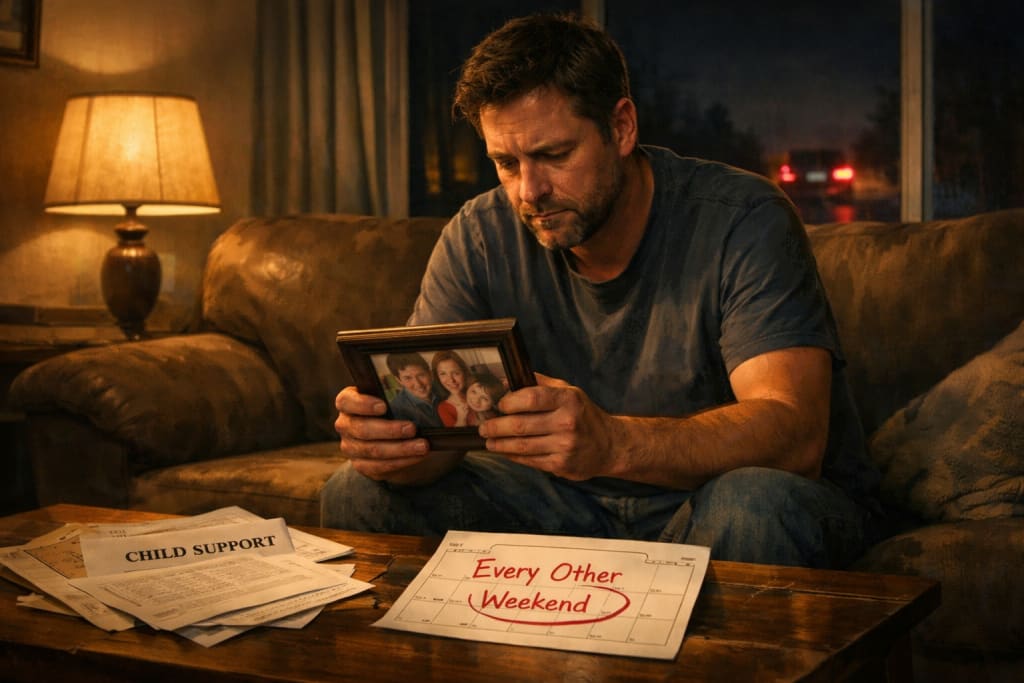
Then there’s the schedule: every other weekend. Maybe a dinner during the week if you’re “lucky.” That’s the box so many fathers get shoved into.
You can’t be a full father in four days a month. You can love your kids deeply, you can make those days special, but you can’t be fully present in school nights, homework struggles, bad days, and quiet evenings when they just need you there. You become a visitor in your own children’s lives.
Your kids learn that you are the “fun” parent, the one who drives them to the park or takes them out to eat, while the other house is where the real life happens. That tears at your identity. You start to feel like you’ve been demoted from dad to entertainer. Inside, that hurts more than any lawyer bill ever could.
We’re told “this is just how it is.” But that’s not a law of nature. It’s a choice. It’s a habit the system fell into. And men have been paying the price for decades, in distance, in loneliness, and in the quiet suffering we carry.
The Silent War on a Father’s Mental Health
What people don’t see—what men are trained to hide—is what this does to your mental health. On the outside, you keep working, keep paying, keep nodding your head in court. On the inside, you’re falling apart.
Here’s what happens to a lot of fathers:
- You feel constant guilt, even when you did nothing wrong.
- You feel powerless because someone else controls when you can see your own children.
- You feel anger you’re afraid to show, because any sign of emotion can be used against you.
- You feel depression creeping in, but you don’t want to be labeled “unstable.”
Every hand‑off in a parking lot or driveway scrapes at your soul. You watch your child go back to a home you don’t live in anymore, and then you drive back to a quiet place that doesn’t feel like home without them. Night after night, that silence eats away at your spirit.
Men are told to “man up,” to stay strong, to be a rock. But rocks crack too. Many fathers start losing sleep, drinking more, working themselves to exhaustion, or just shutting down emotionally. They are grieving a living loss—kids who are alive but out of reach most of the time. That grief has no funeral, no ceremony, no support. You’re just expected to get over it.
The tragedy is that a father’s mental health is part of a child’s well‑being. A broken man can’t be the dad he wants to be. When the system crushes fathers emotionally, it doesn’t just hurt men—it hurts children too.
The Stigma and Shame Men Carry
On top of everything else, there’s the stigma. You become “the divorced guy,” “the one who has to pay,” “the guy who only sees his kids every other weekend.” People whisper or make assumptions: you must have done something wrong, you must not have fought hard enough, you must be a “deadbeat” if you’re struggling with payments.
You can’t explain the whole story to everyone. You can’t unpack the court dates, the lawyer fees, the compromises, the fear of losing even more time if you push too hard. So you swallow it. You say, “It’s fine,” when it’s not.
Inside, you’re battling:
- Shame for not being there every day.
- Fear that your kids will think you chose this.
- Rage at a system that treated you like a lesser parent from the start.
That kind of pressure, when it goes on for years, breaks a man down little by little. It’s a mental health crisis nobody wants to name. And when a father finally cracks—loses his temper, shuts down, or disappears—people say, “See? He wasn’t stable.” No one looks at what pushed him to that edge.
This Has Gone On Long Enough
This isn’t just about my divorce in 1988. It’s about a pattern that’s been repeated thousands, maybe millions, of times. Men walking out of courtrooms feeling like strangers to their own children. Men paying and paying with almost no say. Men suffering in silence because they know if they show pain, it might be used against them.
As men, as fathers, we have to say: enough.
Enough of being visitors.
Enough of being treated like wallets.
Enough of pretending this doesn’t destroy our mental health.
We are not babysitters. We are not side characters in our children’s lives. We are fathers, and that means something.
What Needs to Change in the System
If we want real change, it can’t just be anger. It has to be focused, specific, and loud. Here are the key things we should be demanding.
1. Equal Parenting as the Starting Point
The default should be that both parents share time and responsibility as equally as possible, unless there’s a real, proven reason not to. No more automatically shoving dad into the “weekend” role.
That means when a divorce happens, the question isn’t “How much time does the father get?” The question is “What schedule keeps both parents fully in these kids’ lives?” If someone wants to reduce one parent’s time, they should have to prove why.
2. Real Accountability for Child Support
If the law can track every cent a man owes, it can also require basic accountability for where that money goes. We should be demanding:
- Simple, regular statements showing how support is used for the child.
- The ability to pay some costs directly—schools, daycare, medical bills—so we know the child actually gets the benefit.
- Credit for what we already cover, like insurance or school activities.
This isn’t about control; it’s about respect and transparency.
3. Enforcing Parenting Time, Not Just Payments
If a father misses payments, the system reacts fast. If a mother (or any primary parent) blocks visits, plays games with schedules, or poisons the child against the other parent, there should be real consequences.
We should demand:
- Fast, cheap ways to enforce visitation and parenting time.
- Penalties when a parent repeatedly ignores court orders about time with the kids.
- Judges who treat a child’s relationship with both parents as serious, not optional.
Being cut out of your child’s life is just as damaging as missing a payment. The law should recognize that.
4. Making Fathers’ Mental Health a Priority
It’s time for the system to admit that fathers have mental health too. Courts, lawyers, and therapists should understand that divorce and restricted access to children can trigger depression, anxiety, and even suicidal thoughts in men.
We need:
- Support groups for fathers going through divorce and custody battles.
- Counselors who specialize in fatherhood and post‑divorce trauma.
- A culture where men are not punished for saying, “I’m not okay. I need help.”
When a father’s mind is healthier, his parenting is better. Supporting men emotionally is not a favor to them—it’s an investment in children.
***
What We as Men Can Do
We can’t sit back and wait for the system to fix itself. It won’t. We have to move.
Here’s where we start:
1. **Tell our stories.**
Stop suffering in silence. Talk to other men, write it down, share it with groups who are fighting for change. When fathers speak up, the truth becomes harder to ignore.
2. **Stand together, not alone.**
Men have been picked off one by one in courtrooms for years. We need to join fatherhood and shared‑parenting groups, support each other, and show up when laws are being debated.
3. **Vote and push for legal change.**
Pay attention to candidates who support shared parenting, who understand that dads matter. Call, email, and visit your representatives. Let them know this is not a fringe issue—it’s your life.
4. **Take care of our own mental health.**
We can’t fight if we’re broken. Talk to someone you trust. Find a counselor who understands. Reach out instead of shutting down. There is no weakness in saying, “This hurt me.”
We Demand Our Rights Back
I lived this in 1988, but I’m not just talking about the past. I’m talking about every father who has stood in a courtroom, listened to the terms of his own sidelining, and been told to accept it. I’m talking about men who love their children so much it hurts, but who see them small slices at a time.
As men, we need to stand up—for ourselves, for each other, and for the next generation of fathers. We demand:
- The right to be full‑time parents, not part‑time visitors.
- The right to have our financial support treated with transparency and fairness.
- The right to have our mental health recognized and protected, not ignored.
This has gone on long enough. Our children deserve fathers who are present, strong, and mentally healthy. And we, as fathers, deserve a system that doesn’t break us for trying to love our kids.
It’s time to stop apologizing for wanting our rights back. It’s time to stand up and take them.
About the Creator
Gary Thatcher
a 64-year-old retired and disabled man living in the United States. I have a bad heart, but that doesn't stop me from doing what I love — and what I love is writing. I'm no professional.
Keep reading
More stories from writers in Families and other communities.
The Day Technology Saved Me and Changed How I See the World
Have you ever felt completely lost? Like you're stuck in a dark tunnel with no light at the end? I certainly have. Life throws us challenges, and sometimes they feel too big to handle. For me, that moment came during one of the hardest times in my life. I was overwhelmed, lonely, and felt like my world was shrinking. But then, something unexpected happened. A simple piece of technology didn't just help me; it literally saved me and showed me a new way to live.
By Jamika Wilkerson3 days ago in Families
There's A Hole in My Bucket
It’s a well-known fact that Liza Dufresne was always the brains in the family. She was the one who always came up with the brilliant schemes the Dufresne kids carried out when they were younger. Like when they tricked Mrs. Claybourn into paying for a trip to Disney World. Liza convinced her that their parents had been kidnapped and were being held for ransom for the total price of three tickets. In reality, they were away on a weekend getaway for their anniversary. When they returned, Liza told the Claybourns that they did not like to talk about the ordeal. Their parents never found out how they got the money. Mrs. Claybourn never found out that the Dufresne parents were never really in any danger.
By David E. Perry4 days ago in Fiction




Comments
There are no comments for this story
Be the first to respond and start the conversation.