
Captain Willem Sterling George Braunbauer, IV
Creative Nonfiction loosely based on author's great grandfather-in-law

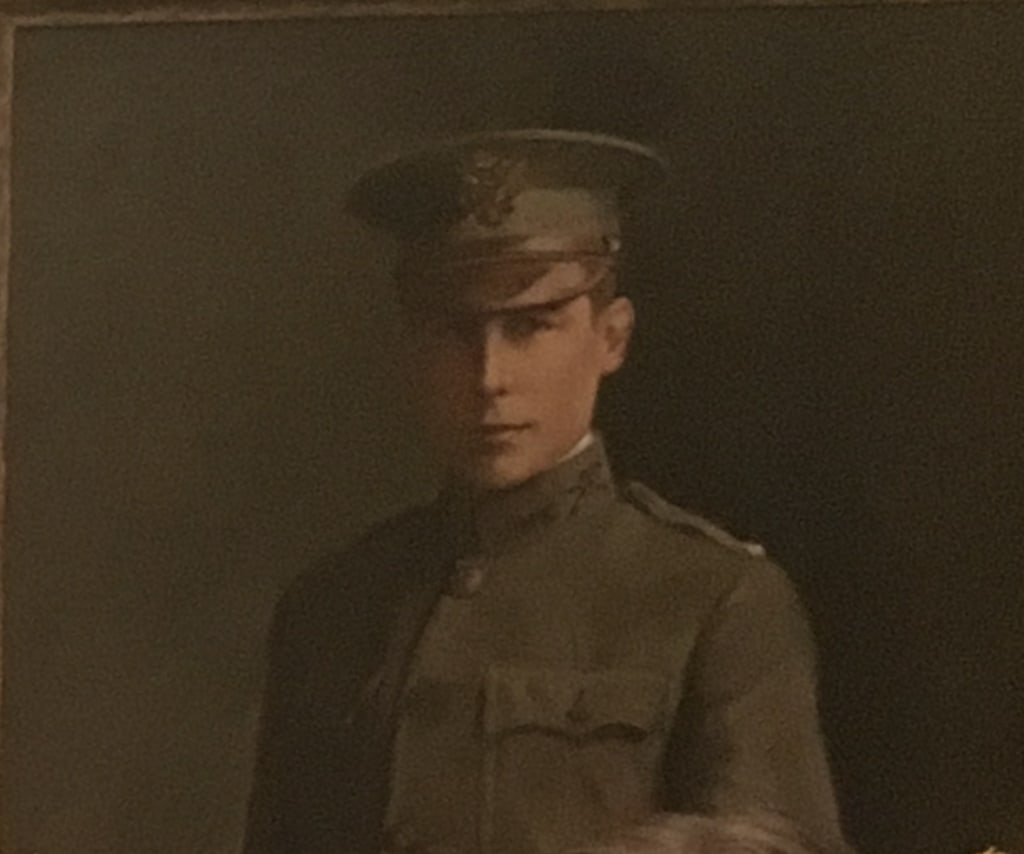
Willem Sterling George Braunbauer, IV wasn’t a Grandpa Bill or Billy. Grandfather Willem, the W pronounced like a V, was actually Captain Willem Sterling George Braunbauer, IV. The epaulettes of his drab green military uniform and piercing slate eyes sear from across the room, even after so many years. The oil painting, stark but beautiful, is accurate in its dismal precision: back, ramrod straight, strong jawline, blazing eyes with no hint of smile. Sterling could nearly smell the sweet acrid scent of the cigar aura that swirled around his father as he sat by the fire each evening, reading his papers.
Willem came from a long line of important men. Men who’d come to the new world in the early 18th century, with grit and determination. His ancestors were founders of a new nation and leaders of great movements. His grandfather rubbed elbows with the likes of Alexander Hamilton and George Washington. Although he wasn’t particularly large or an imposing man, Grandfather Willem carried himself as if he stood seven feet tall. The tenor of his voice could strip cowhide clean through. His hands, though delicate in appearance, assaulted the piano during his interpretation of Rachmaninoff’s Prelude in C# Minor, the darkest and angriest piece of music known to man. The piece would begin calmly, even innocently, but crescendoed to a menacing climax as his fingers beat the keys mercilessly, turning purple like a bruise. He played it daily, then insisted his young wife, Clara, do the same. She, an accomplished pianist, never played it with his vigor or ire. He’d stand at her shoulder, counting and berating, striking her fingers with a ruler when she made mistakes. Thankfully a timely gardening incident impaired her enough to keep her from ever having to play the piano again, and particularly, that piece.
Willem adhered to a strict regimen of calisthenics and five mile runs each morning, accompanied by his two sons and any unsuspecting nephews. Sterling and George only knew this life. They were expected to excel in classes and athletics. They were to be leaders in their esteemed universities, aspiring to greatness. They mostly did as expected, as there was no other way to live with their father. George once made the mistake of trying out for the school play during fourth grade. When his father discovered the betrayal, young George was packed off to military school soon after. Even the pleas of his withered mother made no difference. For George, military school was preferable to the cruelty of his father at home.
Life with father was cold and lonely without his brother around, but Sterling managed to stay in Willem’s good graces. Secretly he kept close ties with George. He’d visit him at school but grew concerned when George admitted a love for literature and books. They both knew a career outside the family business would not be tolerated. For the time being, George kept his secret passions tucked away and learned to live a double life, fooling even his roommates and the academy when he graduated with honors.
As time passed, Willem’s rage compressed, squeezing more violence into small spaces than his family thought possible. The boys knew to stay scarce after their father’d been drinking at the club. Sadly their mother couldn’t escape into the barn, like them. They shuddered, covering their ears to dull the sound of her cries. Sterling once overheard his father boast to a friend that he kept a knife under his pillow in case he ever found the courage to do away with his dim-witted wife. The boys adored their mother as she was their only reprieve from their father’s brutality, but felt powerless to protect her.
Throughout their lives, the brothers remained close. As the eldest child, Sterling was expected to follow his father’s illustrious path and take over the family business, Braunbauer Industries, innovators and producers of wartime machinery. When instructed to join the family business, George declined. After graduating from the academy, he never returned home but found work in the city with an antique bookbinder. He ultimately broke family ties when he married a girl his father deemed unworthy of the Braunbauer name. He eschewed his family legacy and became a book-binder and writer, much to his father’s horror. “So pedestrian,” he’d utter with disgust.
Willem was outraged by his son’s disloyalty but even more so when George convinced his mother to move in with him. He seethed at the audacity, cutting off Clara, financially. She moved in with George anyway, and filed for divorce.
Alone with his anger, Willem grew restless. He had no one to bully with Clara out of the house and his boys grown. After nearly burning down the family farmhouse, he decided to move in with his elder son’s family. Sterling and his wife Cassandra only acquiesced because they could relegate him to his own wing of their family estate. They hired sitters and kept their own children, Lilah and Lucas away from their volatile grandfather.
Years later when diagnosed with lung cancer, Willem felt betrayed by his once ‘strong as an ox’ body. Slowly the sharp edges of his being began to dull. Baby Lilah was too little to remember her angry grandfather. But she once overheard her father and uncle recalling the time Grandfather beat them with a dog leash, thwacking them with the metal end, for neglecting to walk his 120-pound German Shephard. The boys were terrified of that dog, but even more terrified of their father.
Then one day, the grand patriarch, Willem Sterling George Braunbauer, IV, suffered a stroke. His own body couldn’t manage the fury anymore. It fell away, like a glacier calving, sinking into an abyss, never to surface again.
It took months before his traumatized family believed the new body taking up space in their home. Prior to the stroke, they’d had to find new sitters every few months, as he’d scare them off with his tirades and threats. Even George returned, stunned by the changes in his father’s demeanor and temper. He was unrecognizable, hunched in an elaborate brocade smoking jacket, eyes rheumy and weepy, no longer fiery.
His wife, Clara, died before his stroke, never seeing a softer side to the man who abused her and refused a divorce. This new Willem asked after her as he’d lost the memory of her passing. He also lost the memory of his sheer disdain for her. The shriveled man in the bed called out for his beloved wife, the light of his life. His dying devotion to a woman he terrorized for years, was almost too much to bear for his sons. They’d witnessed the scars and bruises left on her frail body during their tumultuous marriage. Eventually his sons stopped reminding him of her death, as it would distress him so much. Later they created elaborate tales of their parents’ love story, to help buoy the decrepit, old man.
Willem transformed in more ways than just temperament. His eyes softened, no longer blazing and stinging. His voice lilted, as if singing softly. The smoke and tang of his Cubans faded with time. Even his erect stature curled, giving him the slouchiness of a doddering grandpa. He wanted to be called Grandpa Billy and invited his grandchildren to climb into his lap.
Lilah was the first grandchild brave enough to climb up. He tickled and hugged her, playing with her shining dark curls. She’d scramble up with a handful of oatmeal cookies, spilling crumbs all over the floor, all over him. He didn’t care, only craved a few nibbles from her sticky fingers. Her father watched in awe, suspicious. He’d been on the receiving end of too many lashes to trust what was before his eyes. Even George permitted his young ones to clamor onto their grandpa’s knees. Grandpa Billy grasped at their youth, wanting his own back. He made up fairy tales to keep the children entranced. Sterling and George had never heard these tales. The only stories they’d heard as children were of war and man’s dominion over all living things.
Grandpa Billy died at home, surrounded by family. The cancer stole his last breath. The stroke stole his anger.
Sterling stares at the haunting portrait once again, waiting to hear it bark or issue a command. It doesn’t. There were days and years when he hated his father. But with time and the continued connection with his brother, George, he feels something else besides anger. He feels something else besides fear and powerlessness. Nothing can undo the past. He can’t change the trajectory of his mother’s life. But he’s grateful to knows a different side of this impossible man. He clings to his father’s final years of grace.
Despite living over five decades as Captain Willem Sterling George Braunbauer, IV… in the end, he died Grandpa Billy.
Author's Note: The real George Richard Delaplaine Schieffelin's portrait hangs in our dining room. He was a stern man and was reported to have kept a knife under his pillow in case he got the nerve to kill his wife in the night. In truth, they did divorce. And it's rumored that his second wife, who also served as his nurse, "accidentally" knicked his neck during a shaving accident, killing him. Sometimes truth is stranger than fiction.
About the Creator
Cathy Schieffelin
Writing is breath for me. Travel and curiosity contribute to my daily writing life. My first novel, The Call, is available at www.wildflowerspress.com or Amazon. Coming soon: Snakeroot and Cohosh.
Keep reading
More stories from Cathy Schieffelin and writers in Fiction and other communities.
The Sack
Author’s Note: This story was originally written for a creative prompt and has since been revisited and revised. Though fictional, it draws inspiration from real historical atrocities and the destruction of thriving Black communities in America. The language within the journal entries reflects the prejudices of the era in which the fictional narrator lived. While certain terms have been softened, they are included to illuminate the cruelty and contradictions of that time, not to excuse or endorse them.
By Briya Shockley8 days ago in Fiction



Comments
There are no comments for this story
Be the first to respond and start the conversation.